
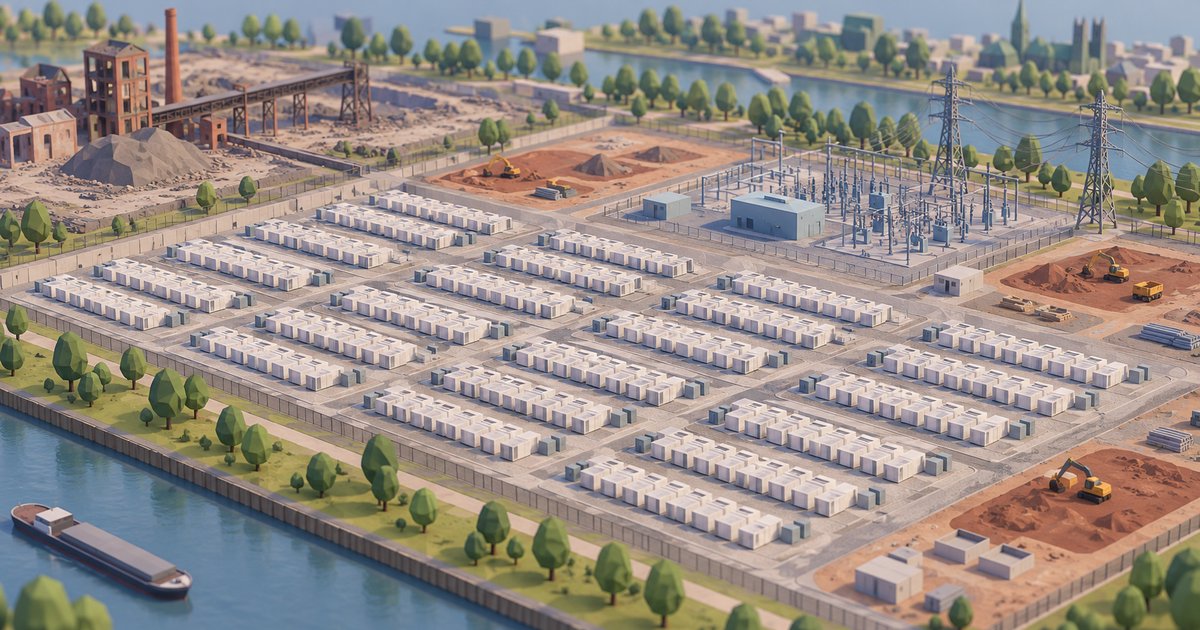
Construction is under way in Belgian Limburg on what will be, by a distance, the largest battery installation in Belgium — and one of the largest single sites in Europe. Green Turtle is being built on the grounds of a former zinc works in Dilsen-Stokkem, and it will be filled with 640 Tesla Megapack 3 units.
The developer is GIGA Storage, a Dutch company. Tesla is not merely the supplier: it is the EPC partner, responsible for engineering, procurement and construction as well as the batteries themselves, plus long-term maintenance once the site runs. Tesla has commissioned the Belgian firm Stadsbader Contractors for the civil works.
The numbers
| Green Turtle | |
|---|---|
| Power | 700 MW |
| Energy | 2,800 MWh |
| Units | 640 Tesla Megapack 3 |
| Location | Rotem industrial estate, Dilsen-Stokkem |
| Grid connection | Elia 380-kilovolt Van Eyck–Gramme line |
| Commissioning | End of March 2028 |
Elia, the Belgian high-voltage grid operator, is building a new substation on the Rotem estate for the connection. That detail is the reason the project exists where it does: a 700 MW battery needs a 380-kilovolt line next door, and there are not many such sites with permits and industrial land already zoned.
Why this one is different from Tesla's other European energy news
TeslAnt has reported two larger European Megapack numbers this year, and neither is comparable. In June, Tesla signed with NatPower for 25 GWh across Italy and the United Kingdom, and in September it agreed roughly 3 GWh with Zhero for Italian grid storage. Both are framework agreements covering pipelines of projects over years.
Green Turtle is a single site with permits, a contractor on the ground and a commissioning date. Those are different units of measurement, and it is worth keeping them apart: a 25 GWh framework is a statement of intent, while 2,800 MWh of Megapacks going into one field in Limburg is concrete being poured.
It is also an early large-scale deployment of the Megapack 3, the generation whose production began at Houston's Megafactory in August.
What it does
Green Turtle is a grid-balancing asset, not a supply-side one. It absorbs surplus wind and solar generation when output exceeds demand and returns it when demand exceeds supply, alongside congestion management for Elia. GIGA Storage puts the scale at enough to serve up to 385,000 households during discharge — a figure worth reading as an illustration of power, not as a claim that the site generates anything.
Belgium's grid needs it. The country is closing nuclear capacity while adding North Sea wind, which widens exactly the gap between when power is produced and when it is wanted that storage exists to close.
"This site has a long industrial history and was of great significance to Dilsen-Stokkem for many years," said Mayor Sofie Vandeweerd. "It is wonderful that a place so strongly connected to our industrial past is now being filled with economic activity again, but this time focused on the energy supply of the future."
What it means for Tesla owners in Europe
Nothing directly, and that is rather the point. Tesla Energy is the half of the European business that has been growing quietly while vehicle registrations fell, and it is increasingly the half winning contracts that run for a decade. A Megapack site where Tesla does the engineering and the long-term maintenance is a much stickier customer relationship than selling a car.
For Belgian drivers there is a slower second-order effect. Storage at this scale is what lets a grid absorb more renewable generation without curtailing it, and a grid that can do that is the one that eventually supports cheap overnight charging rather than rationing it. March 2028 is when that starts, not now.