
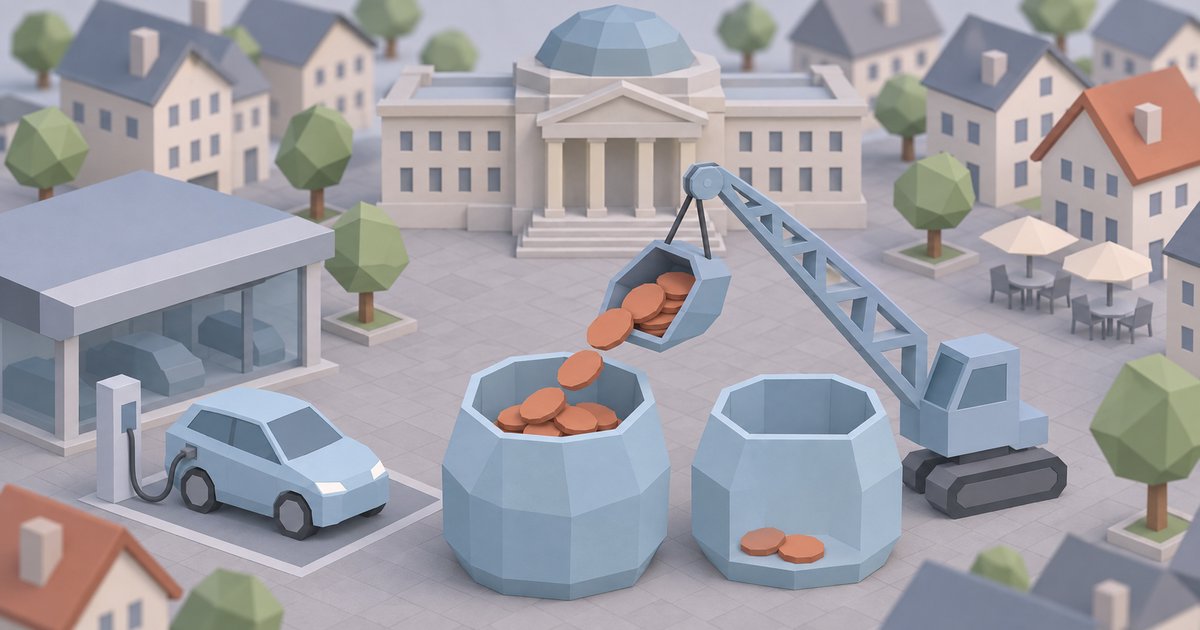
Germany's government wants to spend more than twice as much on its electric-car purchase grant next year as it planned in the summer, and it is not adding a cent to the programme to do it.
The Finance Ministry's adjustment list for the 2027 federal budget, a 1,134-page document sent to the Bundestag's budget committee on the evening of 9 November, raises the grant's 2027 budget line by €917 million to €1.72 billion. The government's draft budget had set aside €803 million. Reuters, Business Insider and Welt have seen the document.
| EV purchase grant, 2027 budget line | Amount |
|---|---|
| Government draft budget | €803 million |
| Finance Ministry adjustment list | €1.72 billion |
| Increase | €917 million |
| Programme total, 2026 to 2029 | €3 billion, unchanged |
"The EV grant is developing much more dynamically than assumed when it was designed and in the original planning of demand," the ministry writes. The line is adjusted to actual demand "while keeping the programme volume". The money comes from the Climate and Transformation Fund (KTF), and nothing is added to the €3 billion that was meant to run the income-tested grant from 2026 to 2029 and pay for about 800,000 cars.
Why the plan broke
The federal office that runs the grant, BAFA, publishes its approvals monthly, and they roughly doubled every month over the late summer, the run-rate TeslAnt has tracked since applications passed 100,000 in August:
| BAFA cut | Cars approved | Grant money approved |
|---|---|---|
| 1 August 2026 | 26,875 | €117 million |
| 1 September 2026 | 52,473 | €230 million |
| 1 October 2026 | 97,790 | €432 million |
Business Insider writes that 2026 alone could absorb about €1 billion if applications keep arriving at this rate. Germany registered 94,086 battery-electric cars in October, a record 37.0% of the market, and private registrations, the segment the grant is paid to, rose 20.6%.
The arithmetic for 2028 and 2029
Moving money forward does not create more of it. If 2026 ends near €1 billion and 2027 takes the €1.72 billion now planned, about €2.7 billion of the €3 billion will have gone by the end of next year, leaving roughly €0.3 billion for 2028 and 2029. Business Insider reports that the coalition apparently expects a few hundred million euros to remain at the end of 2027, and that at the recent pace of €200 million a month the money would run out in autumn 2027. There is no statement yet on whether the pot would be refilled.
Environment Minister Carsten Schneider (SPD), who said in October that the rush had exceeded all expectations, told Auto Motor und Sport that buyers who decide on a battery-electric car now and meet the conditions "need not worry with a view to next year either". The new budget line backs that promise for 2027. It says nothing about 2028.
What it means for Tesla buyers
The Model Y has been the most-subsidised single car in the scheme at every monthly cut, with 8,297 approvals on 1 October. At group level Tesla ranked third on 12,155, behind Volkswagen and Stellantis.
The practical risk is timing. The grant is not reserved when a car is ordered; it is granted only after the car's first registration. A buyer whose car is registered in 2027 can count on the larger budget line. One whose delivery slips towards the end of 2027 depends on how quickly everyone else claims what is left.
What comes next
The budget committee starts its final clean-up session, the Bereinigungssitzung, on Thursday 12 November and will decide the last changes to the 2027 budget on the basis of this list. BAFA's statistics for the 1 November cut, which would show whether October's record registrations brought another jump in approvals, have not been published yet.