
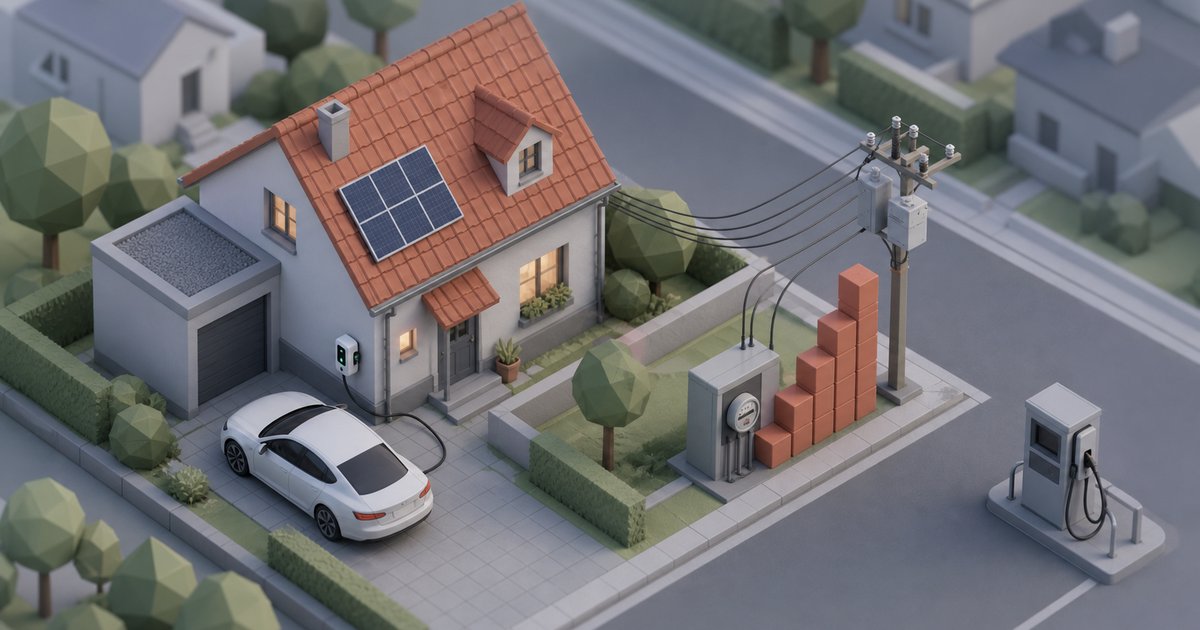
The German federal finance ministry has written to the European Commission to make sure member states keep room to tax electricity above the European minimum rate. In practice that letter is about preserving Germany's ability to keep the electricity tax where it is, or raise it. The country's motor trade association has come out against it, and the argument it makes is one every EV owner can check on their own bill.
What Berlin asked the EU for
Electricity taxation in the EU is set by a floor, not a ceiling: member states must levy at least the minimum rate and may go higher. Germany has long gone higher. As the Commission works on the shape of energy taxation, Berlin has moved to ensure that national discretion survives — leeway that lets Germany continue taxing electricity above the European minimum.
The Zentralverband Deutsches Kraftfahrzeuggewerbe, the federation representing German dealers and workshops, is asking for the opposite. Its position is that retaining the option of higher electricity taxation, at the moment when transport electrification is the stated policy goal, sends the wrong signal — and that the tax should come down instead.
The arithmetic the ZDK is pointing at
An electric car's case against a combustion car is mostly a fuel-cost case. Purchase prices have converged more slowly than anyone forecast, so the payback rests on the gap between cents per kWh and euros per litre. The ZDK's warning is straightforward: a higher electricity tax narrows that gap, and a narrower gap means weaker demand. Current cost comparisons already show the battery-electric advantage shrinking as electricity prices rise.
This bites hardest on home charging, which is where most German owners take most of their energy and where the tax lands directly on the domestic tariff. It is the half of the cost equation that policy can move overnight, without touching a single charge point.
Why this is a Tesla story
Germany is Tesla's largest European market and Giga Berlin's home. A prospective Model 3 or Model Y buyer there runs exactly the comparison the ZDK describes, and the answer is increasingly sensitive to the electricity price rather than to the car.
It also compounds pressure already in the pipeline. German public charging is expanding but the ad-hoc price now averages around 57 cents per kWh, so owners without a driveway are already paying near the top of the European range. And a separate proposal would cap what a home battery is allowed to feed back, removing one of the few ways an owner can lower an effective per-kWh cost. Each measure is defensible alone. Together they push the same direction.
What is decided and what is not
Nothing here is a tax increase. The finance ministry has asked to keep an option; the ZDK has asked it not to. No rate has changed, no date has been set, and the Commission has not ruled on how much discretion member states will retain. What has changed is the direction of travel becoming visible: Berlin is not planning to use electricity tax as an electrification lever, and the trade that sells the cars has noticed.