
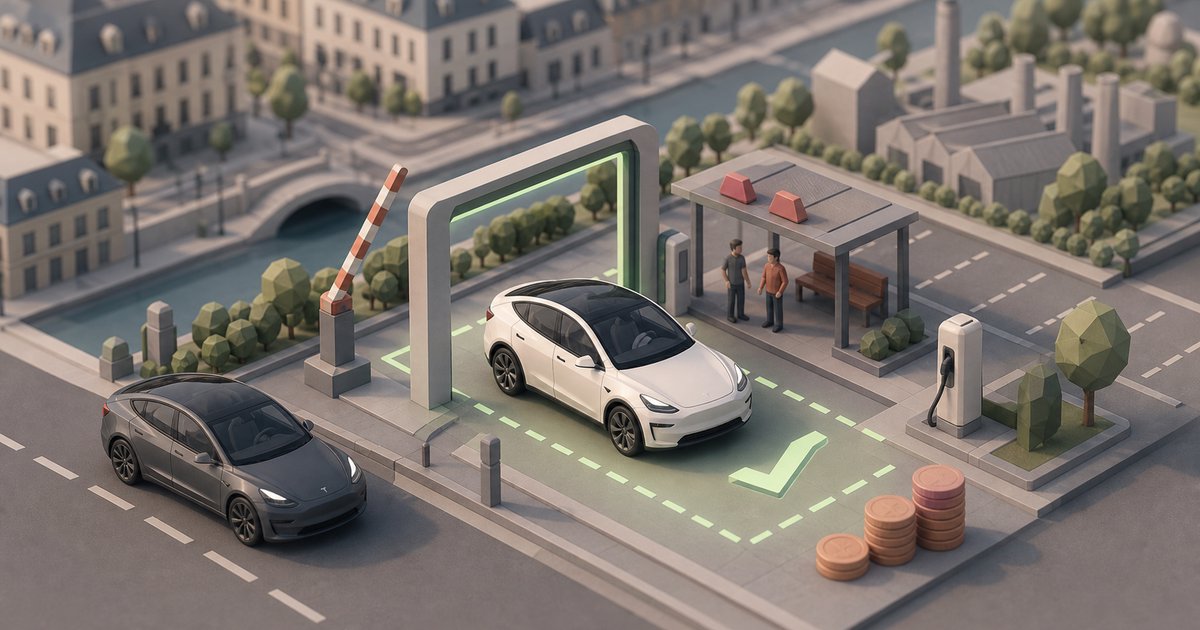
From 1 September, a French taxi driver ordering an electric car can claim roughly €3,500, rising to about €5,500 where both the vehicle and its battery are built in Europe. The window shuts on 31 December. For Tesla, the interesting part is not the amount but the gate the scheme borrows: France's environmental score, which the Berlin-built Model Y clears and the Shanghai-built Model 3 does not.
What it pays, and what pays for it
The Ministry for Ecological Transition confirmed the terms on 12 August 2026, pulling the start forward a month from the October date announced in May by transport minister Philippe Tabarot. Only orders placed between 1 September and 31 December qualify — four months, purchase or lease, open to individual drivers and to taxi companies.
The amounts are approximate by design. This is a Certificats d'Économies d'Énergie scheme rather than a budget line, and the ministry's figures assume €8 per MWh cumac, €14 for the précarité tranche; if the certificate market moves, the payout moves with it. France used the same mechanism for the used-EV grant created on the very same day, which is how that one arrived at €337 rather than the four-figure sums trailed beforehand. Treat €5,500 as a ceiling, not a price.
Claiming it means filing the autorisation de stationnement, the taximeter installation invoice from an approved fitter, and a registration certificate carrying the "taxi" mention.
Which Tesla clears the gate
Four criteria decide eligibility: fully electric, under 2,400 kg unladen, no more than €65,000 excluding options, and above the minimum environmental score.
Price and weight rule out nothing that matters in Tesla's French range — the Model Y opens at €40,990 and the Premium Long Range RWD at €46,990, both well inside the caps.
The score is where it bites. ADEME publishes the eligible list monthly, and the calculation prices in where a car and its cells were built and how far they travelled to reach France. The Model Y is assembled at Giga Berlin and is on that list. The Model 3 sold in Europe comes from Giga Shanghai and is not — which is why Tesla has been discounting the Model 3 in France out of its own margin while the Model Y carries a state bonus. The taxi scheme inherits that split rather than changing it.
Whether a Model Y reaches the upper tier is unanswered: that step also requires the battery to be manufactured in Europe, and Tesla does not publish cell origin per VIN.
The exclusion that leaves most Tesla owners out
VTC drivers cannot claim. All three required documents are licensed-taxi paperwork, so private-hire drivers fall outside the scheme entirely.
That is the wrong half of the market for Tesla. The Model 3 is the default private-hire car in French cities, while the licensed taxi trade skews towards hybrid saloons. The aid lands on the drivers least likely to be shopping for a Tesla and skips the ones already driving one — and for those who do apply, the eligible Tesla is the pricier Model Y, not the Model 3 the trade actually uses.
Bottom line
France has roughly 60,000 taxis, only 4% of them electric in rural areas as of May 2026, and Automobile Propre expects 1,500 to 5,000 claims across the window. This is a small scheme.
The precedent is the durable part: two CEE-funded purchase aids inside a month, both gated on the environmental score, both structured to reward European assembly. For Tesla that is a standing advantage for Berlin and a standing penalty on Shanghai, now extended into one more corner of the French market. Private buyers still have the stack worth up to €10,700 on a Model Y.