
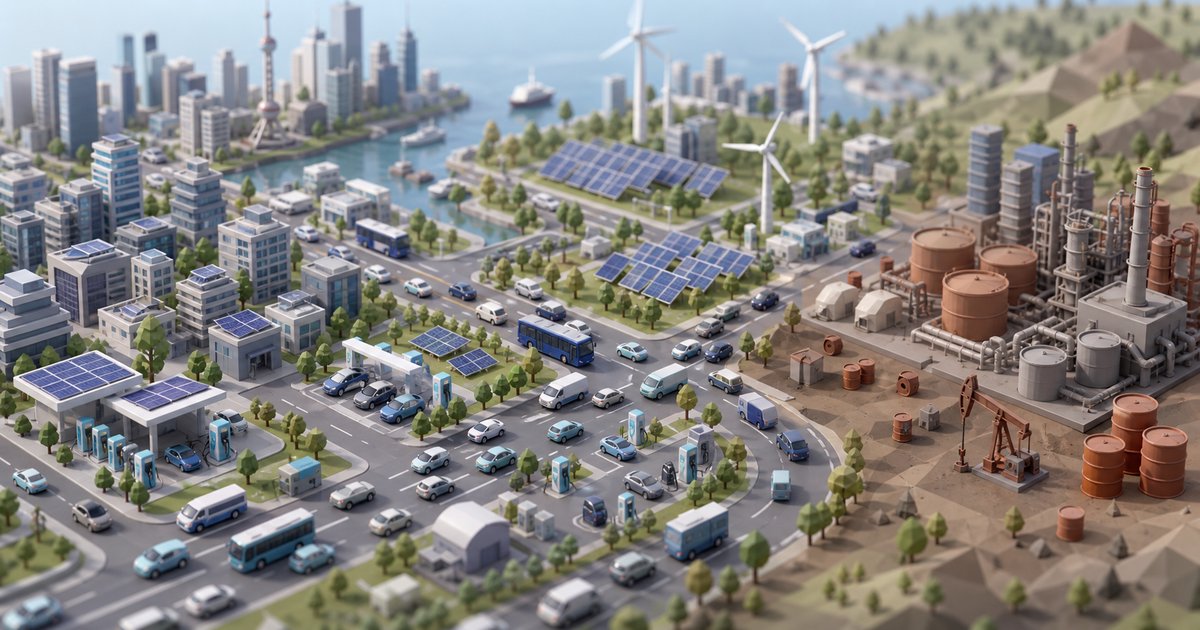
The argument about whether electric cars actually displace oil has a number attached to it now. In the International Energy Agency's Global EV Outlook 2026, the world's EV fleet avoided the consumption of around 1.7 million barrels of oil per day in 2025 — about what Indonesia burned in total over the same year.
That is a fleet effect, not a sales effect. It counts every electric vehicle already on the road, which is why it keeps compounding even in months when sales growth slows.
Where the barrels come from
| Measure | Figure |
|---|---|
| Global oil displaced by EVs, 2025 | ~1.7 mb/d |
| Global oil displaced by EVs, 2020 | ~0.4 mb/d |
| China, 2025 | ~1 mb/d |
| China, 2030 (projected) | ~2.7 mb/d |
| Global, 2030 (projected) | ~5 mb/d |
| Electric light-duty vehicles' share of 2025 displacement | ~80% |
The IEA is explicit that the displacement concentrates in markets that regulate fuel economy and CO2 — naming China and the European Union as the places where the effect actually shows up. Rules that force efficiency, in other words, are what convert EV sales into oil that never gets burned.
Electric trucks are the part most people underestimate. In China they already account for more than 10% of the country's displacement, and the IEA expects electric trucks alone to avoid 1 mb/d globally by 2035 under current policies.
China is pulling further ahead this year
More recent data suggests the 2025 baseline is already stale. Analysis from Jefferies put the oil displaced by EVs in China during the first half of 2026 at 33.7 million tonnes of oil equivalent — about 1.4 million barrels a day — up 42% year on year.
If that pace holds, China alone will pass the level the entire global fleet reached in 2025 within roughly a year.
What it means for Europe
Europe's contribution rests on a sales share that is still climbing: 28% of new car sales in 2025, which the IEA expects to reach 33% in 2026. That is the mechanism by which European displacement grows — a bigger share of each year's new cars arriving without a fuel tank, feeding a fleet that then avoids oil for the next decade and a half.
The practical read for European drivers and policymakers is about the direction of the underlying market rather than any single month's registration figures. Fleet-level oil displacement is slow, cumulative and hard to reverse; it does not swing on one country's subsidy scheme expiring or on one brand having a weak quarter.
It is also the number that makes the strategic argument, and it is the reason the IEA frames electrification partly as an energy-security question rather than a purely environmental one. Every barrel a European car does not burn is a barrel the continent does not have to import.
The caveat worth keeping
Displacement is not the same as emissions reduction — the electricity has to come from somewhere, and the IEA's figures describe oil avoided, not net carbon saved. The two converge only as far as the grid decarbonises, which varies enormously between a Norwegian and a Polish charging session.
What the 1.7 mb/d figure does settle is the question of scale. At 0.4 mb/d in 2020 this was a rounding error in global oil demand. At 5 mb/d in 2030 it is not.