
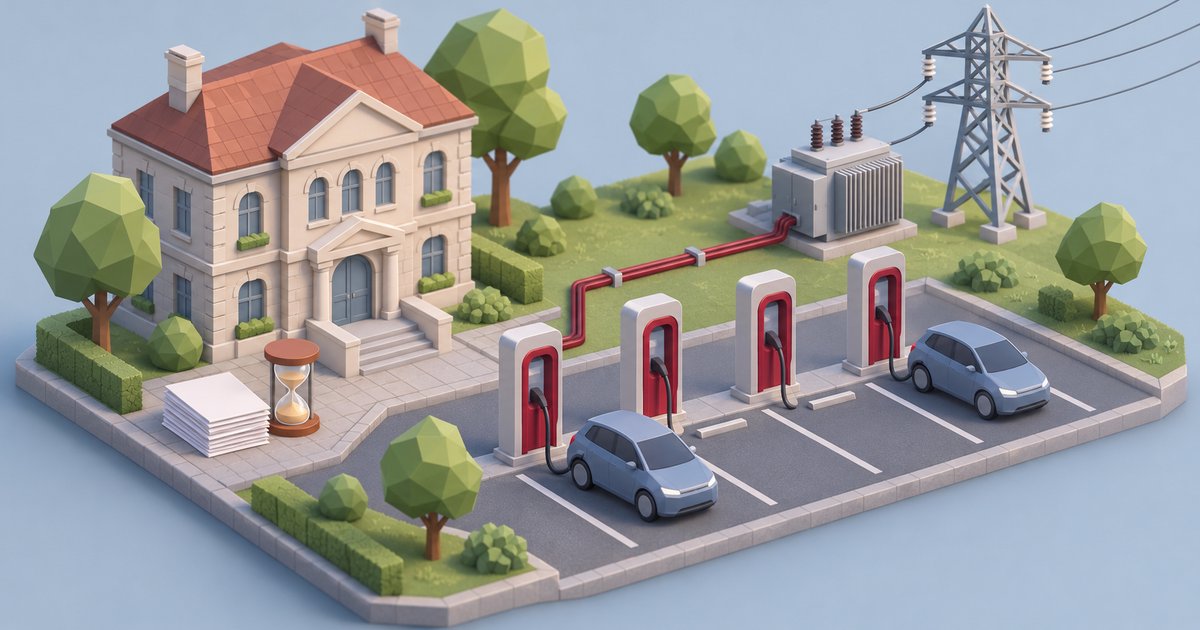
The EU has agreed to put a time limit on permits for new charging stations. Early on Wednesday 18 November 2026, negotiators for the European Parliament and the Council's Irish presidency reached a provisional deal on a revised permitting directive, part of the EU's grids package, the Parliament said. Permits for stand-alone recharging stations will have to be granted within six months, and grid-connection procedures will have a three-month deadline.
What the deal says about charging
| Rule | Provisional agreement |
|---|---|
| Permit deadline for stand-alone recharging stations and energy storage | Six months at most |
| Grid-connection procedures | Three months, or six where duly justified |
| Grid capacity above which charging stations, small solar and storage need a permit | 200 kW, raised from 100 kW during the talks |
| Recharging stations of 1 MW or less on artificial structures | No administrative permit needed |
The deal also adds a single national digital portal for every permitting step and treats renewable and grid projects as being of overriding public interest, which member states can set aside only for cultural heritage or security and defence. Small and isolated grids, such as those in the EU's outermost regions, get a derogation from the connection deadlines. According to electrive, member states will also be able to treat an authority's silence on intermediate steps as tacit approval, and the text does not define what counts as an artificial structure.
What it means for fast-charging sites
One megawatt is about four 250 kW stalls, so the permit exemption covers small sites on existing structures. Larger hubs, Tesla Supercharger sites among them, still need permits, but the authorities would have six months to decide, and the grid-connection procedure a three-month deadline. The rules apply to every charging operator alike.
The Parliament says slow procedures are among the main causes of delay for energy projects across the EU: building a transmission line takes about ten years, more than half of it in permitting. "Procedures take too long, and decisions are issued too slowly," said Borys Budka, who chairs the Parliament's industry and energy committee.
What happens next
The Parliament's industry committee votes on the text first, then the full Parliament and the Council must endorse it before it is published in the EU's Official Journal. The Council described the deal as streamlining permitting for a faster clean energy transition. After publication, member states have 18 months to write the rules into national law, electrive reports, so the new deadlines will not reach charging projects much before 2028.