
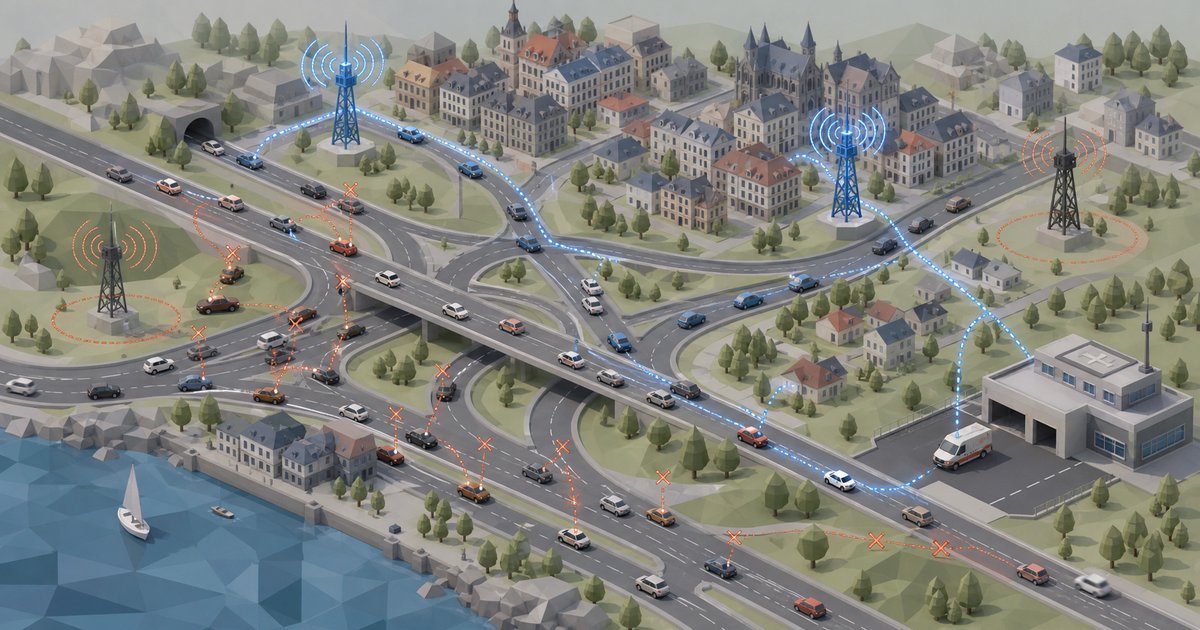
Every car sold new in the EU since April 2018 carries eCall: a system that dials 112 by itself after a serious crash and sends the car's position to the emergency services. It works over the mobile network, and the mobile network it was built for is being switched off.
A study commissioned by the European Commission and carried out by LS Telcom puts the exposure at roughly 64 million vehicles across the EU that could lose eCall if operators retire 2G and 3G without coordination. In June 2026 the Commission asked operators to keep those networks alive until at least 2030. The request is not binding.
Why phones cope and cars do not
A modern handset holds several radio technologies at once and simply falls back when one disappears. The eCall modems fitted to a generation of cars do not: they were specified for 2G and 3G only, with no 4G path in the hardware. When the carrier signal goes, the emergency call goes with it, silently, with nothing on the dashboard to say so.
The affected population is roughly model years 2010 to the early 2020s, but the year on the registration document is the wrong thing to check. What matters is the communication module the manufacturer fitted, which varies by brand, model and equipment level within the same production year.
What else stops working
eCall is the safety-critical loss. The convenience functions that share the same modem go at the same time:
- Remote locking and unlocking from the app
- Remote climate control and pre-conditioning
- Vehicle location, and stolen-vehicle tracking
- Vehicle status data sent to the phone
- Live online traffic information
- Remote service booking
Bluetooth phone pairing is unaffected — it never touched the mobile network. Anything that reaches the car when the driver is not standing next to it does.
Sometimes a software update is enough. Often nothing is.
Where the fitted hardware already supports 4G, a software update delivered over the air or at a workshop can migrate the car. Where it does not, swapping the module is technically demanding and, on a car of that age, usually not economic.
Škoda is a fair illustration of the split: the brand offers updates for its MOD3 and MOD4 module generations, and has no technical solution for the older MOD2. Aftermarket retrofit kits are not expected on the market before 2030, which is the same horizon as the Commission's request that the networks stay up.
What Europe has already fixed, and what it has not
Next-generation eCall over 4G and 5G became compulsory for newly approved vehicle types on 1 January 2026, and applies to all new vehicles from 1 January 2027. New cars are solved. The gap is the fleet already on the road.
| Milestone | Date |
|---|---|
| eCall mandatory on new EU vehicle types | 31 March 2018 |
| NG eCall required for new type approvals | 1 January 2026 |
| NG eCall required on all new vehicles | 1 January 2027 |
| Commission's requested 2G/3G floor | 2030 |
National timetables do not wait for that floor. The Czech Republic switched off 3G in 2021 and has 2G scheduled to end by 2028 at the latest, and other member states are on their own schedules — which is precisely the uncoordinated pattern the study warns about.
The practical advice for owners of a car from this window is unglamorous: ask the manufacturer which module is fitted and whether an update exists, rather than assuming the SOS button still reaches anyone.