
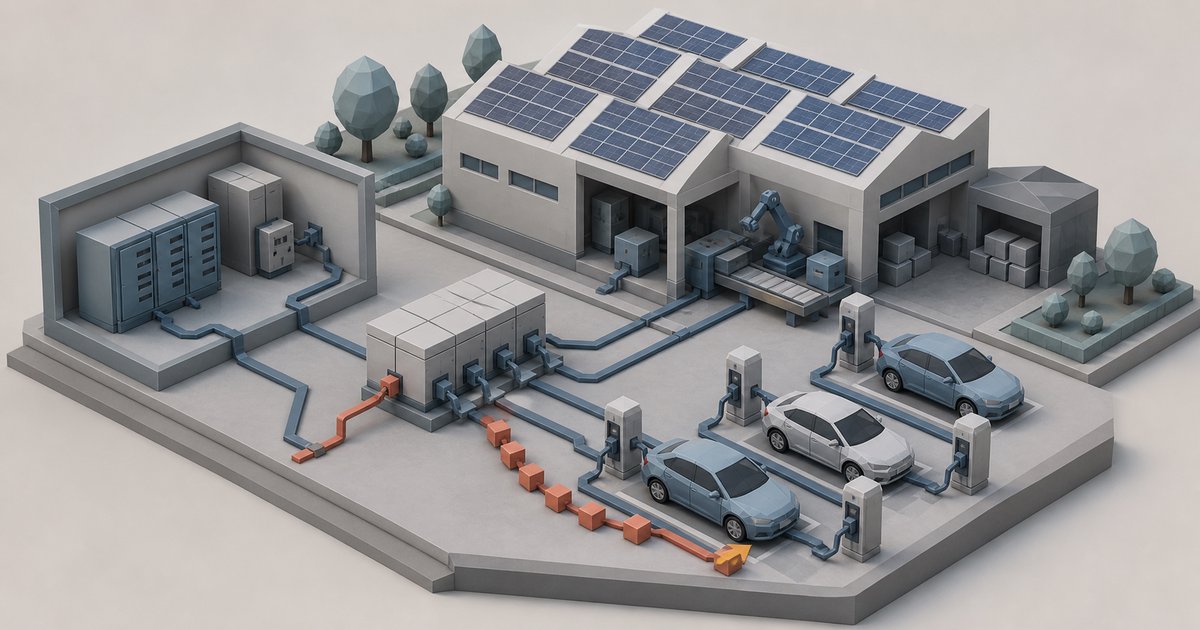
Most conversations about vehicle-to-grid start at the public grid and work inwards. A German research consortium has spent three years arguing the interesting boundary is much closer to home: the direct-current network inside a factory.
DCI4Charge — industrial direct current for charging — has now concluded, and its partners say they have a practice-tested concept for joining an industrial DC grid, charging infrastructure and electric vehicles into a single integrated energy system.
The conversion losses nobody counts
A growing number of industrial sites already run internal DC networks, because so much of what they contain is natively DC: drives, robots, photovoltaics, battery storage. A conventional charging point ignores all of that. It takes AC from the building, converts it to DC for the car, and the site has typically already converted DC to AC to feed it.
"If we connect the charging infrastructure directly to the company's internal DC network, we avoid these detours," says Dietmar Hölderle of Fraunhofer IPA. The same connection then works in reverse — the project's stated goal is to "use the storage capacity of vehicle batteries as a virtual battery and smooth consumption peaks."
That reversal is the commercially interesting half. A company car park is a fleet of large batteries that sits still all day, exactly when an industrial site's demand charges are set.
What was actually built
The consortium delivered four connected pieces:
- An electrical model of the DC grid together with the charging infrastructure
- A software energy-management system to schedule charging and discharging
- Secondary voltage regulation to hold the DC grid stable as vehicles come and go
- DC/DC converters from Fraunhofer IISB that step company-grid voltage to what a vehicle battery needs, while providing safe electrical isolation between the two
The isolation requirement is the unglamorous engineering at the heart of it. Connecting a car battery to a factory's power network without galvanic separation is not something a safety case survives.
Who did it
| Role | Organisation |
|---|---|
| Coordinator | Technische Hochschule Ostwestfalen-Lippe |
| Research | Fraunhofer IPA, Fraunhofer IISB |
| Industry partners | Ambibox, Eaton, Weidmüller and others |
| Funding | German Federal Ministry for Economic Affairs and Climate Action, reference 01MV23005A-E |
The project ran from 2023 to 2026.
What this changes for European fleets
Depot and workplace charging is where European fleet electrification is currently getting expensive, and the cost is rarely the electricity. It is the grid connection: a site that wants to charge thirty vans overnight often needs a bigger supply than its industrial process does, and the upgrade is quoted in years as well as euros.
Bidirectional charging inside the site attacks that problem from the other end. If parked vehicles can carry the peak, the connection does not have to. That makes DCI4Charge less a V2G story than a capital-expenditure one.
The regulatory frame is moving in parallel. Germany is rewriting the grid rules that govern charging hubs and bidirectional charging, and it is worth being honest that the rules, not the converters, are what currently decide whether a company can do this. A demonstrated concept is not a product, and the consortium has not announced one.