
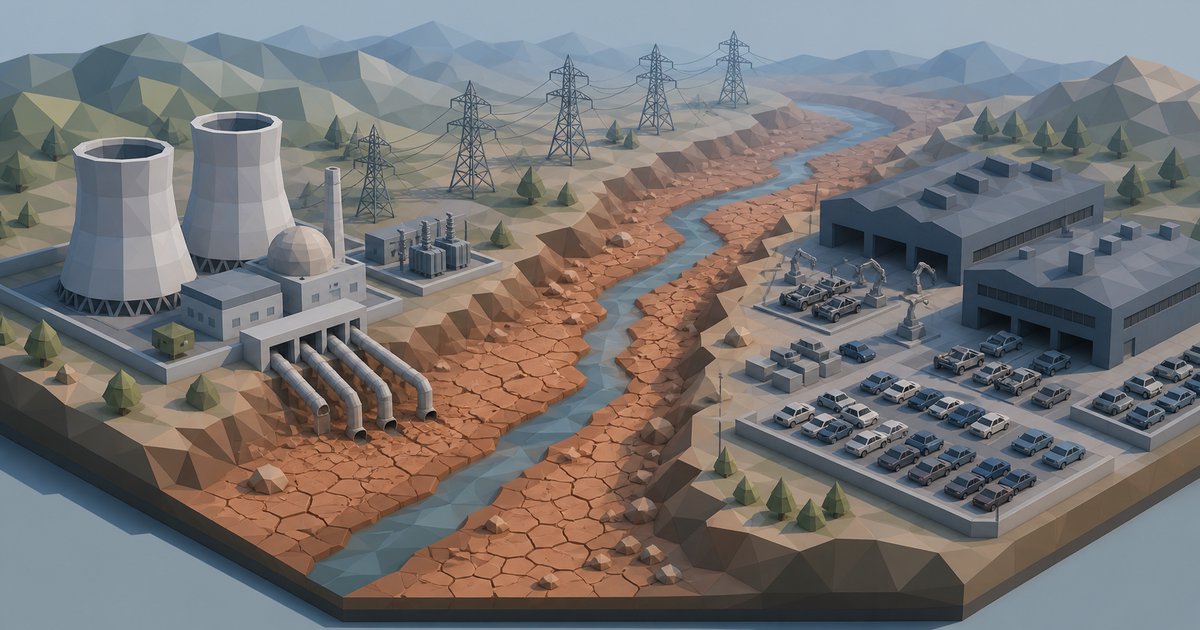
On 3 August 2026 the Danube at Budapest measured around 10 centimetres. The previous record low, set in 2018, was 33 centimetres. In Romania the river's flow dropped to about 1,500 cubic metres per second — less than a third of the July average — while a heatwave pushed temperatures towards 38 °C and electricity demand to a seasonal peak.
Rivers do not usually make automotive news. This one did, because two car plants stopped.
What broke
The Danube is cooling water. Take it away and thermal generation stops being optional.
| Country | Plant | Impact |
|---|---|---|
| Hungary | Paks nuclear | Output fell from ~2,000 MW to 240 MW |
| Romania | Cernavodă nuclear | One reactor shut down, second under intensified monitoring |
| Serbia | Hydroelectric | Running at roughly 20% capacity |
Paks normally supplies around half of Hungary's electricity generation and covers about a third of national consumption. Dropping it to 240 MW is not a trim; it is most of a country's baseload disappearing in the middle of a heatwave. Hungary's prime minister, Péter Magyar, told reporters that avoiding a complete Paks shutdown was "very good news" — a low bar, honestly stated.
Romania declared a nationwide state of alert in the energy sector on 2 August. Hungary issued a decree allowing mandatory electricity conservation for large industrial and commercial consumers, restricted peak-hour use between 5pm and 10pm, and banned electric freight trains during those hours. Serbia's prime minister, Đuro Macut, called the situation "serious and demanding" and convened an emergency meeting.
The car plants
Dacia stopped its plant at Mioveni and Ford stopped Craiova, both until 19 August. The companies framed it as scheduled maintenance brought forward, which is true and also convenient: the halt sheds roughly 200 MW of demand at exactly the moment the grid needs it gone.
Romania's government had asked large industrial users to cut consumption voluntarily. Two of the country's biggest electricity consumers doing so in the same week is the kind of voluntary that arrives after a phone call.
Note that some early reports also listed Suzuki among the affected manufacturers. TeslAnt has not been able to corroborate that, and we are not repeating it as fact.
Why this matters for European EV drivers
The obvious reading is the wrong one. Nobody's charging session got cancelled this week, and grid operators shed industrial load precisely so that households and public infrastructure do not notice.
The useful reading is about correlation. Electrification assumes a grid that is there when you plug in, and the failure mode on display here is not "not enough wind" — it is thermal and hydro generation losing its water supply during the hottest, highest-demand days of the year. Climate stress and peak electricity demand arrive together, which is the least convenient possible pairing.
That is also the argument for the boring infrastructure. Storage smooths a peak that generation cannot meet; flexible demand moves load out of the 5-to-10pm window Hungary just had to legislate; bidirectional charging turns a parked fleet into a buffer. Germany is redrawing its grid rules for charging hubs and vehicle-to-grid for reasons that look considerably less abstract this week than they did last.
For now the Danube is still falling, no significant rain is forecast, and two Romanian car plants are dark until the 19th.