
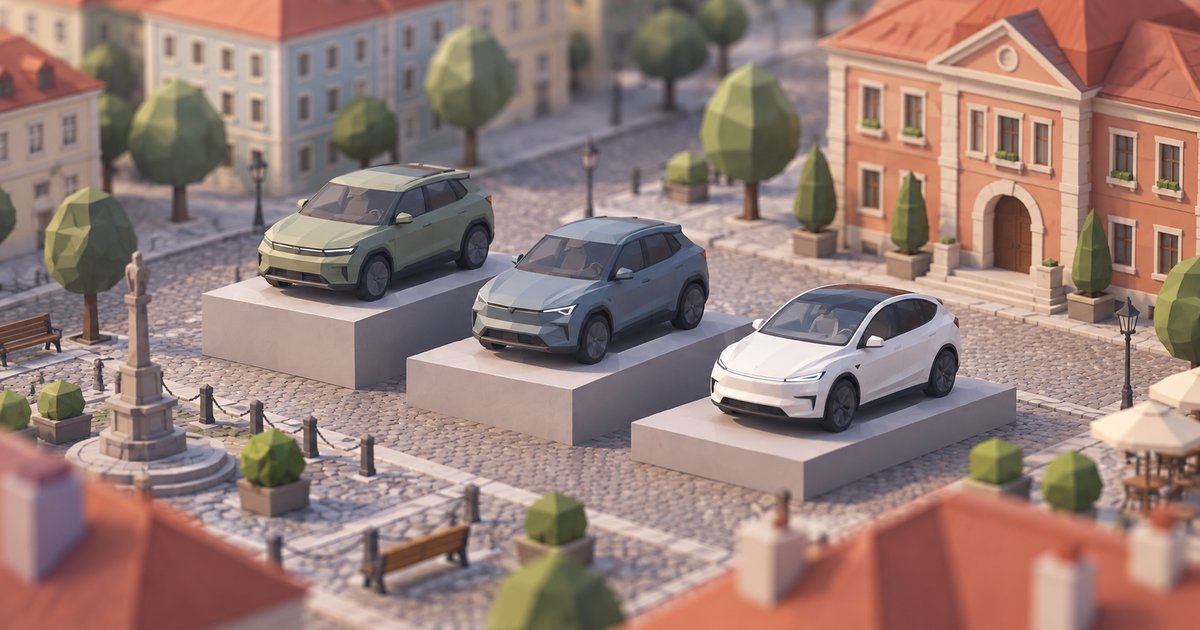
Czechia's electric-car market grew by almost a third in the first eight months of 2026, and the country's own brand took a third of it.
An analysis published by cistadoprava.cz, built on registration data from the Czech Ministry of Transport and the importers' association SDA, counts 11,665 new battery-electric cars registered between January and August 2026 — 32% more than in the same period last year. August alone contributed 1,497 of them, up 78% year on year.
Seven percent, and what that is measured against
Battery-electric cars now take 7% of new passenger-car registrations in Czechia, against 5.5% a year ago. There are now more than 77,000 electric cars on Czech roads.
That 7% is the number worth holding onto, because it is roughly a quarter of what the same metric reads further west: EV share across Europe passed 25% this summer. Czechia is growing quickly from a low base, not converging on the European average. Neighbouring Austria, for comparison, reached 29% in August.
Two Škodas, then the Model Y
The model ranking is the part that has changed most.
| Model | Registrations, Jan-Aug 2026 |
|---|---|
| Škoda Enyaq | 1,951 |
| Škoda Elroq | 1,794 |
| Tesla Model Y | 1,218 |
Škoda accounts for 34.1% of all battery-electric registrations in its home market, and it did it with two cars rather than one — the Elroq, launched into the compact segment the Model Y sits above, has come within 160 registrations of the larger Enyaq in the same period. Two more Škoda nameplates entered the table in August: the Epiq on 112 registrations and the Peaq on 114, both from a standing start.
Where Tesla actually sits
The Model Y is the best-selling non-Škoda electric car in Czechia, which in a market this size is a real position. The Model 3 is the problem: its registrations fell 7% year on year in a market that grew 32%.
Tesla's European year has not had one direction, it has had several. August broke the losing streak in northern Europe — the Model Y led France outright and Tesla more than doubled in Germany — while Italy fell 36% and Austria pushed Tesla down to fifth. Czechia belongs to the second group: a market growing 32% in which Tesla's older model is shrinking, and the space is being taken by the domestic brand rather than by a Chinese entrant.
The used-import channel is growing faster than the new one
The figure that says most about where Czech electric cars actually come from is not a new-car number at all. Importers brought in 8,930 used battery-electric cars between January and August, up 68% from 5,317 a year earlier. Used EVs are now 8.3% of all used vehicles imported into the country — a faster growth rate than the new-car market managed.
For a Czech buyer, that is where the supply of affordable electric cars is coming from, and it is largely second-hand stock imported from western Europe rather than anything sold new in Prague.
Commercial segments remain thin by comparison: 1,328 electric light commercial vehicles (9.3% of that market), 87 electric trucks (1.4%) and 45 electric buses (6.7%).