
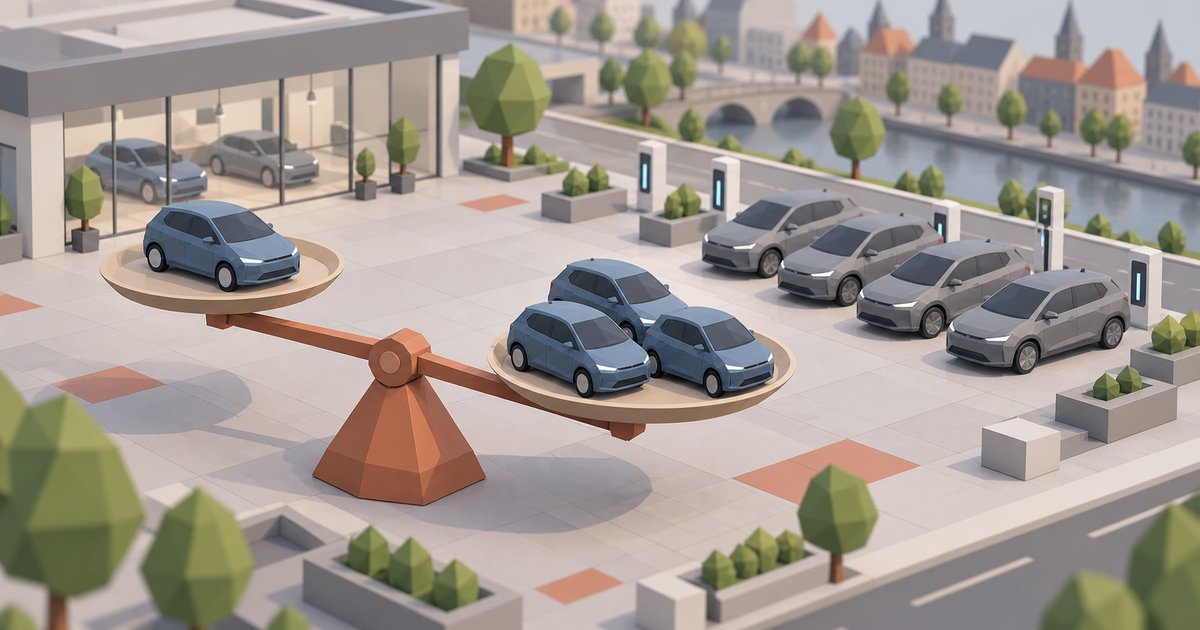
Only 8% of people across Europe's five largest car markets say their next car will be a battery-electric one, according to a YouGov survey commissioned by CLEPA, the European automotive supplier association.
The number is being used to argue for softening the EU's 2035 combustion-engine rules. It is worth looking at carefully, because the survey is more interesting than the argument built on it.
What was asked, and when
YouGov polled 5,221 adults, roughly 1,000 each in France, Germany, Italy, Poland and Spain. Fieldwork ran from 7 to 16 July 2026 — two months before the results were published, a gap worth noting on any survey released into a live policy debate.
Averaged across the five markets, 8% named a BEV as their next purchase. Hybrids beat battery-electric in nearly every market. Germany was the single exception, and even there it was close: 14% for BEV against 13% for hybrid.
CLEPA's position is that policymakers should keep a range of low- and zero-emission technologies available rather than mandate one, and should fix charging infrastructure, affordability and energy costs first.
Set it against what people actually bought
Stated intent and registrations are different measurements, and the gap between them is the story.
| Measure | BEV | Hybrid |
|---|---|---|
| CLEPA/YouGov intent, five markets, July 2026 | 8% | Higher in four of five |
| ACEA registrations, EU, H1 2026 | 20.7% | 37.3% |
| ACEA registrations, EU, H1 2025 | 15.6% | — |
Actual BEV share in the first half of 2026 was two and a half times the survey's intent figure, and it rose from 15.6% a year earlier. Whatever 8% measures, it is not what happens at the dealership.
The survey does get the ranking right. Hybrids really are outselling battery-electric cars in the EU, by 37.3% to 20.7%. That part is not in dispute, and CLEPA is entitled to point at it.
What it does not support is the implication that BEV demand is collapsing. A stated-intent figure that reads a third of the real registration rate is telling you something about how people answer surveys — most respondents are not in the market this year, and "electric" still reads as a bigger decision than a purchase eventually turns out to be.
Where Tesla sits
Tesla is not named in the survey, which asked about powertrains rather than brands. But the five markets polled include the ones where Tesla's European position has been weakest this year, and the policy at stake is one Tesla is directly exposed to: a company that sells only battery-electric cars has nothing to gain from a technology-neutral 2035.
In Germany, the market with the highest stated BEV intent, Tesla is the single most-subsidised brand in the country's EV grant programme with 8,141 approvals. In Austria, BEVs took 29% of registrations in August with Tesla fifth. Those are the numbers a European buyer should weigh against a July intent poll.
The practical read for European buyers
Treat the 8% as a sentiment reading from a lobby with a position, taken before the summer, and treat 20.7% as what the market did. Both are real. Only one of them is a purchase.