
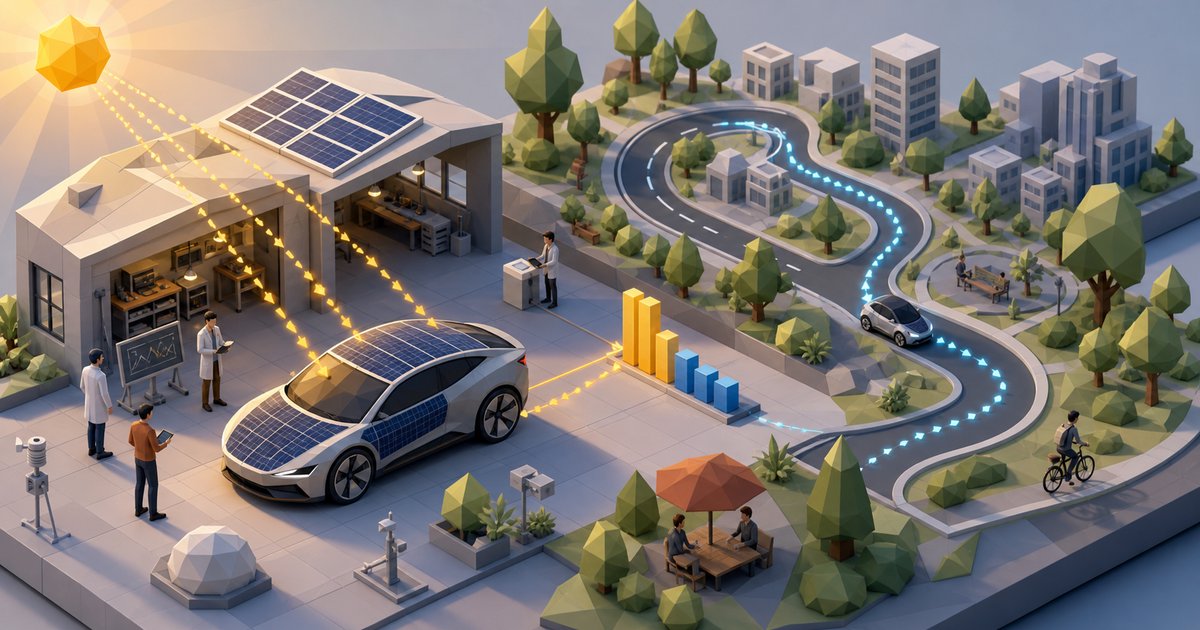
Clemson University has unveiled Deep Orange 17, a solar-integrated electric prototype its student team calls Luminetta, built to a challenge set by BMW's research and development group in autumn 2024. The claim attached to it is unusual: over a typical short urban commute, the car is designed to collect more energy than it uses.
What they built
Luminetta is a two-door coupe weighing 1,212 lb — roughly 550 kg, which is less than a third of a typical compact electric SUV. More than 1,700 photovoltaic cells are integrated directly into the exterior surfaces rather than sitting on a roof panel, so the body itself is the collector. The team worked with the Fraunhofer Institute for Solar Energy Systems ISE in Germany on that integration, treating the available skin of the car as harvesting area.
The car collects while parked and while driving, and pairs that with regenerative braking and efficient drivetrain control to keep consumption down. In the students' modelling of a 12-mile — about 20 km — daily commute, the surplus amounted to an average of 31 miles, or roughly 50 km, of additional range.
Read the claim carefully
The energy-positive result is a modelling outcome for a specific, short duty cycle, not a measured figure across a year of real use. Two things carry it, and both are fragile outside the assumptions.
The first is mass. At 550 kg the car needs very little energy per kilometre, so a modest solar harvest covers a disproportionate share of it. That weight is achievable in a single-purpose prototype and very difficult in a production car that must meet crash standards, carry four people and their luggage, and survive a decade of use.
The second is the commute length. A 20 km round trip is short enough that a full day of sunlight can outrun it. Double the distance or park in an underground garage and the arithmetic inverts. Latitude matters too: the harvest a car sees in the Carolinas is not the harvest it sees in Norway in December.
None of this makes the project trivial. It makes it a demonstration of what body-integrated photovoltaics can do when every other variable is optimised in their favour.
Europe has been here before
European readers have watched this idea fail commercially at least twice. Lightyear, the Dutch company that built a solar-skinned long-range saloon, collapsed in early 2023. Sono Motors dropped its solar-panelled Sion the same year after failing to fund production. In both cases the technology broadly worked; the business around it did not.
What is different here is the framing. Deep Orange 17 is not a product with a price and a waiting list — it is a research vehicle for BMW, built by graduate engineers, with a European research institute supplying the photovoltaic expertise. The output is knowledge about integration, not a car to sell.
Why it still matters
Body-integrated solar has a plausible niche even if solar-powered cars do not. A few kilometres of daily harvest is close to irrelevant for a driver with a home wallbox and a 500 km battery. It is not irrelevant for a car parked outdoors all week without a charger, for fleet vehicles that idle in the sun between jobs, or for reducing the parasitic drain that flattens a battery over weeks of standing.
The interesting question Luminetta poses is not whether a car can run on sunlight. It is how cheaply photovoltaics can be laminated into ordinary body panels — and that is a question a BMW research programme is well placed to answer.