
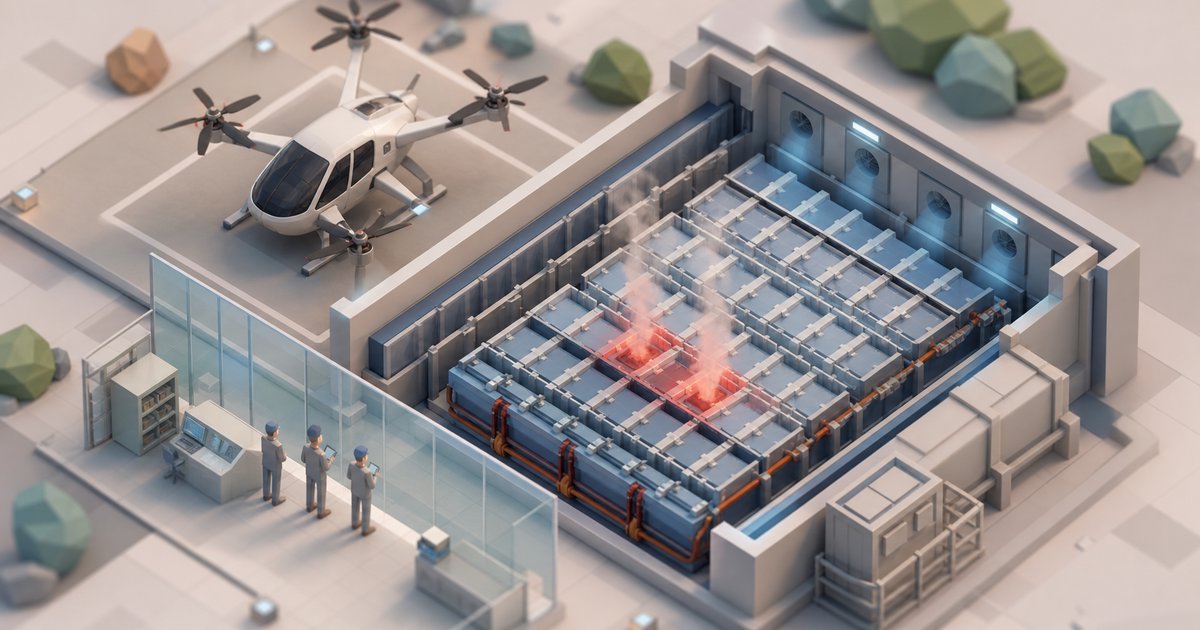
CATL says its battery system for passenger eVTOL aircraft has passed a thermal runaway propagation test in which two adjacent cells were deliberately driven into failure at the same time, without the event spreading through the rest of the pack. The company describes it as the first aviation battery system built on prismatic cells with an energy density as high as 350 Wh/kg to clear such a test.
What was actually tested
Thermal runaway propagation testing is routine for both road and aviation batteries, but the usual protocol triggers a single cell and checks whether its neighbours follow. CATL says it triggered two adjacent cells simultaneously, and repeated the exercise at different positions in the pack — in the middle and at the corners, where heat behaves differently because there is less surrounding mass to absorb it. Neither configuration propagated.
Representatives of the Civil Aviation Administration of China witnessed the production, inspection and testing process. That procedural detail matters as much as the result. Aviation certification rests on a regulator being able to verify how a part was built and tested, not simply on a sample having survived. CATL says the system is ready for mass production and that the first application will be AutoFlight's passenger eVTOLs.
Why the energy density is the hard part
Energy density and thermal safety normally pull against each other. Packing more energy into the same mass leaves less thermally inert material between cells, so a failure has a shorter path to its neighbours and more stored energy to release when it gets there. That trade-off is a large part of why the cells in affordable European EVs are so often lithium iron phosphate — a chemistry that gives up energy density in exchange for stability and cost.
At 350 Wh/kg, these cells sit well above the packs in cars on European roads today. Containing a two-cell failure at that density is the genuinely difficult part of the claim, and it is the part CATL has chosen to publicise.
What it does not mean for your next car
It is worth being precise about the limits here. Aviation cells are optimised for a different job. An aircraft needs the maximum possible energy per kilogram and can accept shorter cycle life and a much higher price per kWh, because weight determines whether the vehicle flies at all. A car needs eight years or more of service, thousands of cycles, fast charging, and a cost per kWh low enough to survive a price list. A 350 Wh/kg aviation cell is not a Model Y cell waiting for a launch date.
What does transfer is the pack engineering and the validation method: the barrier materials, venting design and thermal isolation that stopped two simultaneous failures from cascading are the same disciplines that keep a road pack safe after a crash or a fast-charge fault.
The European angle
CATL is the world's largest battery manufacturer and already a direct supplier to European carmakers, with its own manufacturing footprint on the continent including a plant in Erfurt, Germany and a larger site in Hungary. Announcements like this one are as much positioning as engineering — a signal to regulators and customers about what the company can certify, at a moment when European battery projects are still struggling to reach volume production.
For European drivers the practical read is modest but real: the safety engineering that makes a very dense pack survivable is being pushed forward, and that work eventually reaches the cars.