
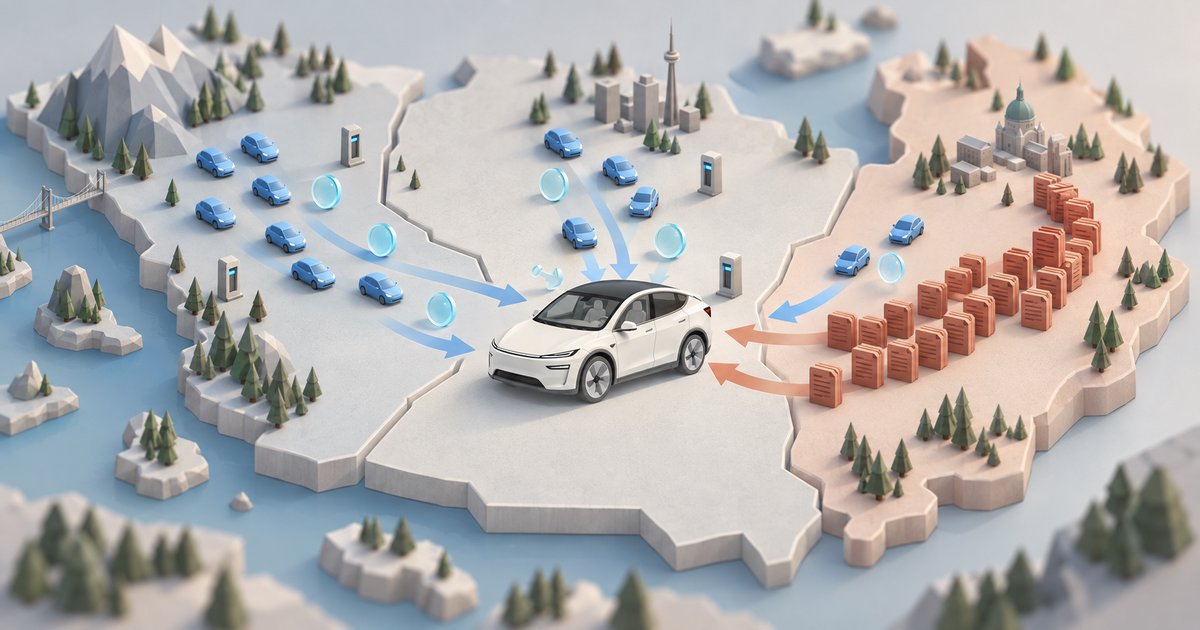
Transport Canada's open data for the federal EV rebate puts the Tesla Model Y at the top of the August 2026 claims list — with one large hole in the map. Outside Quebec the Model Y recorded 691 claims, ahead of the Chevrolet Bolt on 577. Inside Quebec it managed 63, which put it 16th, tied with the Kia EV4.
The split
| Measure | Model Y | Note |
|---|---|---|
| Claims outside Quebec, August | 691 | 1st |
| Claims in Quebec, August | 63 | 16th, level with the Kia EV4 |
| Claims nationally, August | 754 | 5th by model, of 10,956 total |
| Ontario | 362 of 2,267 | 1st, about 16% |
| British Columbia | 311 of 1,913 | 1st, 16.3% |
Two provinces where Tesla leads outright, and a third where it does not reach the top ten. Quebec is not a small market to lose: it is one of the strongest EV regions in North America, and it stacks its own Roulez vert grant of 2,000 dollars on top of the federal 5,000, so a Model Y RWD bought there carries the richest incentive package in the country.
The explanation is leasing, not price
Drive Tesla Canada points at the mechanism, and it is a clean one. Nearly 49% of Quebec's rebate claims in August were for leases. Just 4.3% of Tesla's were.
Quebec buys its cars on lease far more than the rest of Canada does, and Tesla sells its cars overwhelmingly on purchase finance. The province is not rejecting the Model Y on merit — the product is simply being offered through the wrong channel for the market. That is a distribution problem, and distribution problems are fixable in a way that a price gap is not.
Only one Model Y qualifies at all
The Electric Vehicle Affordability Program replaced iZEV on 16 February 2026 and caps eligibility for imported cars at a 50,000-dollar final transaction value, options and fees included. The Model Y RWD lists at 49,990 dollars and slips under it; Long Range AWD and Performance do not. Every one of the 1,945 Tesla claims filed since the programme opened is for a 2026 Model Y RWD.
That single-trim eligibility makes the monthly curve more striking rather than less.
| Month | Federal EVAP claims, Tesla |
|---|---|
| March | 46 |
| April | 158 |
| May | 223 |
| June | 571 |
| July | 193 |
| August | 754 |
August is up 291% on July, against 18% growth across all eligible EVs. Chevrolet still led all brands for the month on 3,130 claims. Transport Canada reported 2 billion dollars left in the fund as of 1 September 2026.
Why this matters to a European reader
Because the leasing gap is not a Canadian quirk. Quebec at 49% leases is not unusual by European standards — it is ordinary. Germany, the Netherlands and Belgium all run heavily on leasing and company-car channels, and in those markets the registration that counts is placed by a fleet manager comparing monthly cost and residual value, not by a retail buyer comparing sticker prices.
A brand that converts 4.3% of its claims through leases is optimised for a customer Europe has proportionally fewer of. Tesla has been narrowing that gap in Europe, but Quebec is a useful small-scale demonstration of what happens where it has not: strong product, correct price, richest available subsidy, and 16th place.
The July figure of 193 is worth keeping in view too. One month does not make a trend in either direction, and a programme this young produces jumpy numbers.