
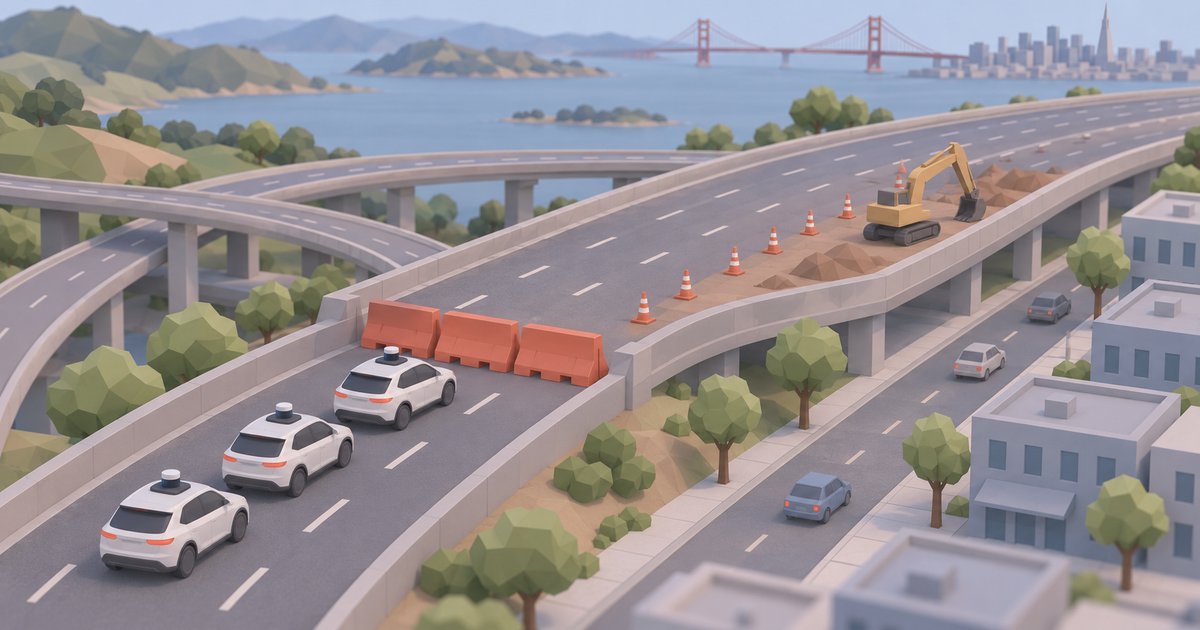
California's Department of Motor Vehicles has ordered Waymo to stop driving its autonomous cars on the state's freeways, ABC7 News reported on 17 November 2026. The DMV "determined that Waymo's driverless freeway operations pose an imminent hazard to public safety due to recurring incursions by its vehicles" into closed sections of highway, the San Francisco Chronicle quotes its statement as saying. The restriction took effect on 11 November and "will remain in place until Waymo demonstrates to the Department that it has taken effective corrective actions". It covers freeways only: Waymo's ride-hailing service continues on surface streets.
What the DMV cited
The agency pointed to two incidents on Bay Area freeways:
- Three Waymo vehicles drove into an active construction zone on US Highway 101 near Burlingame, putting workers, equipment and other road users at risk. The DMV said similar incidents had happened several times.
- Earlier in November, video showed a driverless Waymo trying to pass California Highway Patrol cars that were running a traffic break on Interstate 280, the manoeuvre in which officers slow down and hold the traffic behind them.
Waymo said its service "continues to operate safely on surface streets, serving over half a million trips each week", and that it is working with the DMV and other state officials "to resume freeway operations". It has also gone further than the order: the company told the Chronicle it has temporarily paused freeway driving in other states too, "to evaluate our performance", and said the two latest Bay Area incidents caused no injuries or collisions. One practical effect, the Chronicle notes, is that riders can no longer take a Waymo to San Francisco International Airport.
It is the second time this year that Waymo's freeway rides have stopped. In May, Waymo paused them in several cities, among them San Francisco and Los Angeles, to improve how its cars handle construction zones, ABC7 noted, and the DMV's statement refers to a "prior restriction and corrective actions" at that time. The San Francisco Business Times describes the new pull-back as indefinite.
Why it matters to Tesla
Freeway driving has been the clearest capability gap between Waymo's service and Tesla's. TeslAnt made that point in September, when a Cybercab ride in Austin took a 70-minute detour to stay off the freeway, and again when a Cybercab carried a passenger on an interstate at the end of October. For now Waymo has given up that advantage everywhere: in California by order, and in other states by its own pause.
The order also shows how California now polices driverless fleets. Regulations adopted in April let police send the manufacturer a "Notice of AV Noncompliance" when a driverless car breaks a traffic law, require companies to answer first responders within 30 seconds, and allow the DMV to restrict or suspend a permit, the agency said at the time. Keeping Waymo on surface streets is a narrower step than the full suspension that took Cruise's cars off California roads in October 2023.
The same rules set Tesla's route to a driverless service in the state. A manufacturer has to test with a safety driver, then without one, before it can apply for commercial deployment, logging 50,000 miles in each phase for a passenger car and filing a structured safety case. Tesla's Bay Area service still runs with an employee in the driver's seat. What the DMV accepts from Waymo as a fix, on construction zones and on police traffic breaks, will show what it expects of any driverless fleet on California's freeways, Tesla's included.