
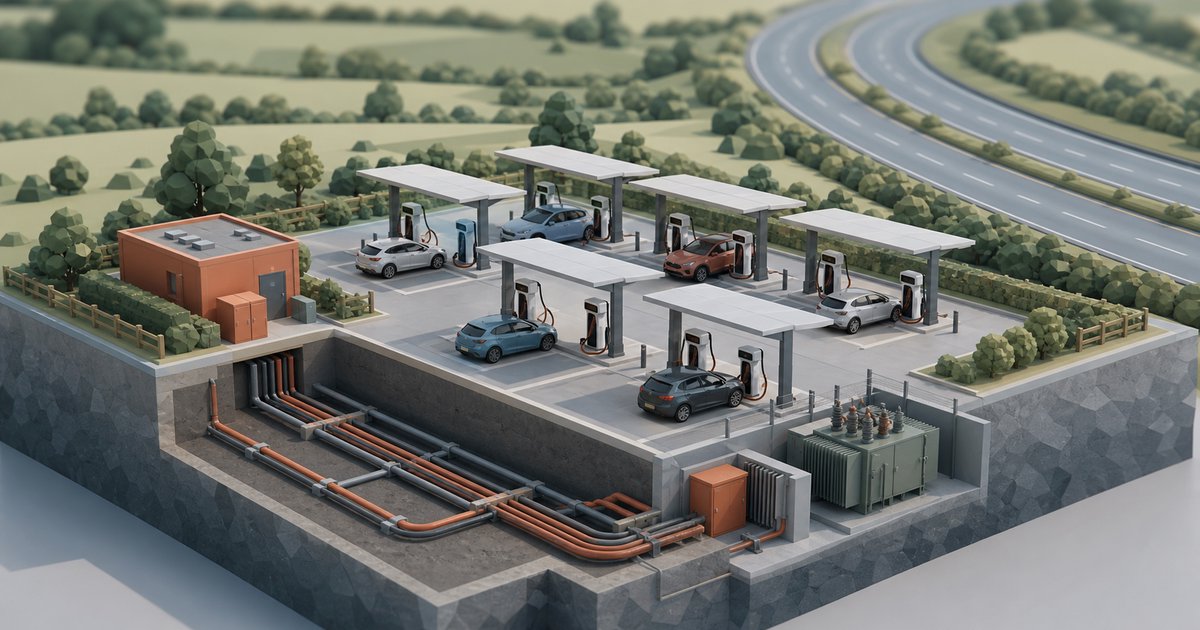
BYD says it has installed its 10,000th Flash Charger, with the milestone station opening in Shenzhen. That is half of the 20,000 it promised to build in China by the end of 2026 — and, more to the point for European drivers, the same hardware has started going into the ground in the UK.
The hardware
Flash Charging is BYD's megawatt-class system, launched in its second generation in March 2026. The stations are T-shaped, carry two cables each, and are rated at up to 1,500 kW through a single connector. Paired with a compatible Blade Battery car, BYD claims 10% to 97% state of charge in about nine minutes.
The build rate is the part worth watching. BYD had 4,239 units in place at the end of February 2026 and 10,000 by 28 August. Getting to 20,000 by December means roughly 80 new stations a day for the remaining four months — an aggressive target even by BYD's standards, and one it has publicly attached itself to. The rollout leans on partners rather than BYD-owned real estate: Sinopec, PetroChina, CNOOC, Teld and JD.com are all named.
It is not a walled garden
The detail that makes this relevant rather than merely large is that the network is open to other brands. BYD says roughly one in three charging sessions on it involves a non-BYD vehicle, with delivered speed limited by what the car can accept rather than by brand.
That is the same strategic move Tesla made when it opened the Supercharger network, arrived at from the opposite direction — Tesla opened an existing advantage, BYD is building an open one from scratch.
What it means in Europe
The UK is first. BYD executive vice-president Stella Li has said 200 to 300 Flash Chargers will be installed there by the end of 2026, around 300 stations offering up to 600 charging points, with thousands more planned across Europe. Siting focuses on BYD and Denza dealerships, motorway services and existing charging hubs. The first UK units are already in. In Germany a station was briefly displayed at an internal event and then removed, so the mainland timeline is still unannounced.
For a European Tesla driver, the near-term value is not the peak figure. No Tesla can take 1,500 kW — Model 3, Model Y, Model S and Model X cap at 250 kW, the Cybertruck at 325 kW on V4 stalls — so plugging a Model Y into a Flash Charger yields a normal fast charge, not a nine-minute one.
| Peak power | |
|---|---|
| BYD Flash Charger | 1,500 kW |
| Tesla V4 post (hardware) | 500 kW |
| Cybertruck at V4 | 325 kW |
| Model 3, Y, S, X | 250 kW |
The value is competitive. A second carmaker building an open, high-power network on British motorways changes the pricing and availability picture around the Supercharger network, and it sets a hardware ceiling that Tesla's 250 kW cars now sit a long way beneath. Superchargers remain ahead on the thing that actually decides road trips — coverage, reliability and the number of stalls already built — and 300 UK stations does not threaten that in 2026.
The caveat
Two numbers here are Chinese-market claims: the nine-minute charge and the 1,500 kW peak both assume BYD's own cars and its own grid connections. UK sites will be constrained by British grid capacity, and no independent European measurement of a Flash Charger exists yet. The count of installed stations is BYD's own figure, unaudited.