
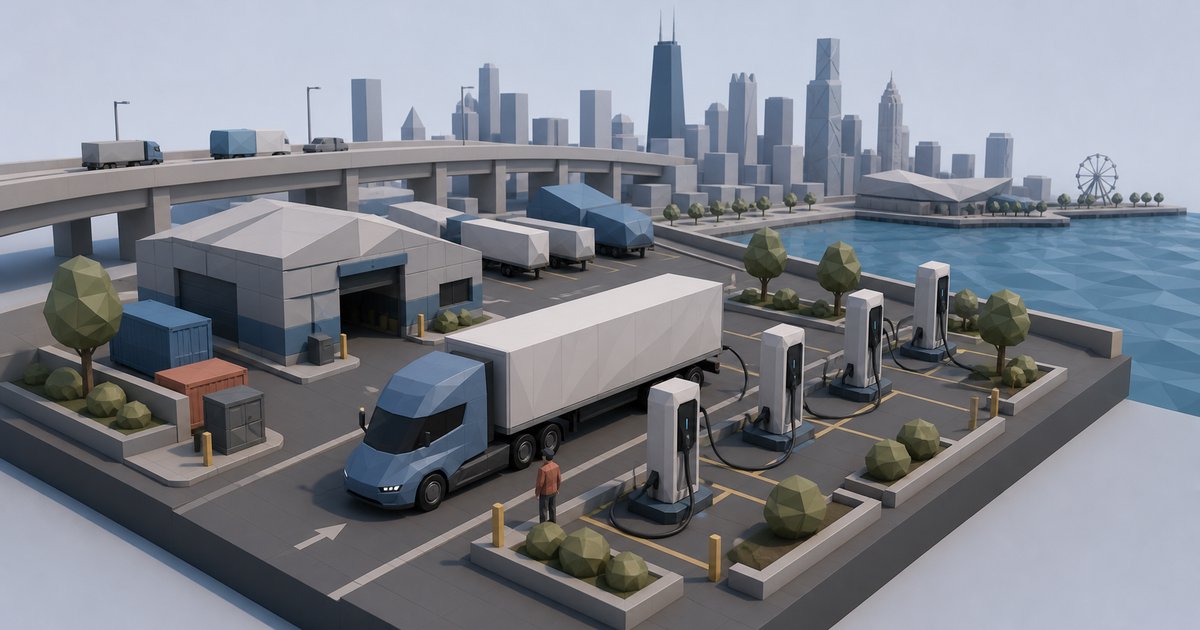
Bison Transport, one of Canada's largest trucking companies, has begun running a Tesla Semi with its own drivers in the Chicago area. The Winnipeg-based carrier confirmed the trial last week.
It has not said how many trucks are involved. It has not published route or duty-cycle data, and it has not committed to an order. What it has said is that early driver feedback is positive, and that the point of the exercise is to work out where a Class 8 electric truck fits in its operations.
Chicago is becoming the proving ground
Bison is not the first carrier there. In July, Wisconsin-based Paper Transport began evaluating the Semi Long Range in dedicated Chicago operations. Two fleets piloting the same truck in the same metro area inside two months is a pattern rather than a coincidence: Chicago is where Tesla has concentrated the charging and support a pilot fleet needs to keep moving.
That is the part worth watching. A Semi pilot is not really a test of the truck — its specification has been public for years. It is a test of whether the infrastructure around it survives a real duty cycle, with loaded trailers, winter, and a schedule that does not bend.
What Europe should take from it, two weeks before Hannover
Tesla will publish the European Semi's specification and market-launch detail at IAA Transportation in Hannover, which runs from 15 to 20 September. The European truck is not the American one: a different gross weight limit, and MCS charging rather than Tesla's own connector.
European operators assessing it will ask exactly what Bison is asking, and they will be asking a harder version of the question. Einride's 500-truck order, the largest ever placed for the Semi, contained no European units at all. The charging network a Chicago pilot leans on does not exist here in a form the European Semi could use, and MCS deployment across the corridors a long-haul fleet actually runs is years from complete.
So the useful reading of a Canadian carrier's Chicago trial is as a rehearsal. Tesla is accumulating operator evidence in a market where it controls the charging, shortly before asking European fleets to commit in one where it does not.
What would count as a result
Not the driver quotes. Those are the easiest part of any pilot to produce, and every carrier's are positive.
The numbers Bison has not released are the ones that decide anything: energy consumed per kilometre against a diesel baseline on the same lane, how much of the working day the truck spends plugged in rather than earning, what happens to range with a full trailer in a Great Lakes winter, and whether the pilot converts into a purchase order. Paper Transport's trial has not produced those publicly either, two months in.
Until a carrier publishes them, a pilot announcement establishes that Tesla can place trucks with fleets. It does not yet establish that fleets can run them profitably — and that second question is the one European operators will have to answer for themselves, on worse charging infrastructure, from a standing start.