
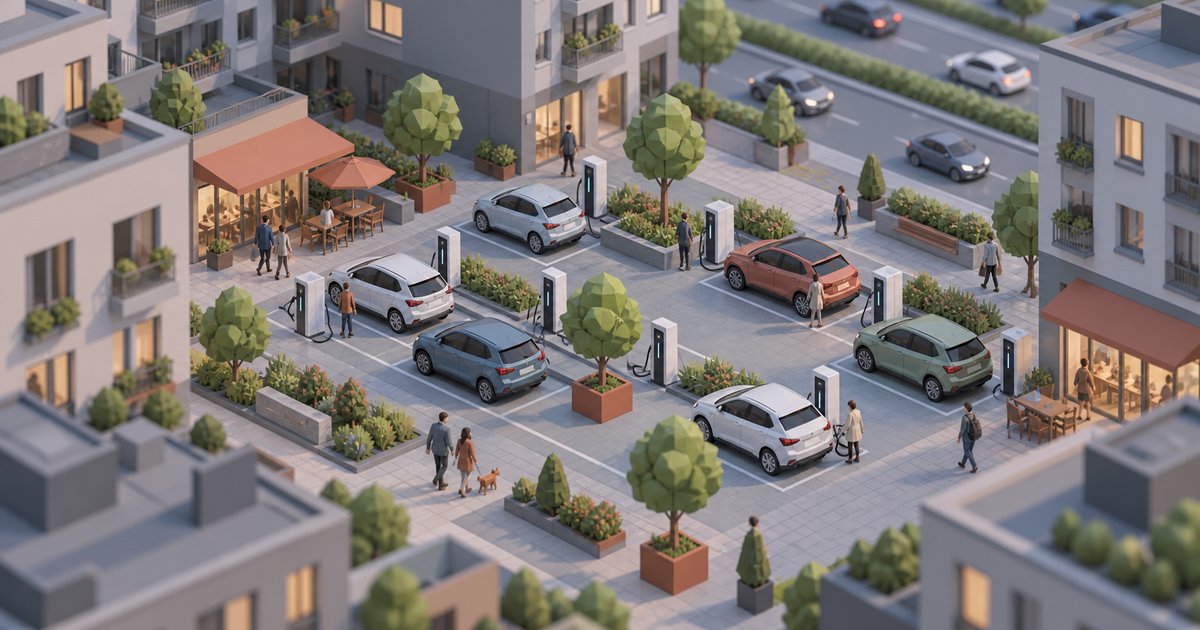
German drivers are charging their electric cars in town and skipping the motorway. That is the clearest movement in the fifth BDEW user survey on electric mobility and charging, conducted by UScale among 1,009 battery-electric drivers in Germany during July and August 2026.
Inner-city hubs nearly doubled in a year
39% of respondents now charge at an inner-city charging hub, against 21% in the 2025 edition — an 18-point jump, and the largest single movement in the survey.
| Where they charge | 2026 | Previous survey |
|---|---|---|
| At home | 75% | 82% |
| Inner-city charging hubs | 39% | 21% |
| Customer and retail car parks | 47% | 43% |
| Workplace | 40% | 42% |
| On route / motorway | 34% | 50% |
Two lines carry the story: home charging fell seven points and motorway charging fell sixteen. Charging is becoming something done during an errand in town rather than a stop designed into a journey — what you would expect as hubs grow dense enough to be incidental, and as more EV drivers live without a private wallbox.
Satisfaction is high, and so is retention
Among the 775 respondents who use public charging, 91% said the offering at least meets expectations and 55% said it exceeds them. 94% would buy an electric car again, and the same share would recommend one.
What they actually pay
As reported by electrive, three-quarters of respondents pay no more than 59 cents/kWh on AC and 69 cents/kWh on fast charging. 82% charge on a contract via app or card rather than ad-hoc, and around 59% use price-comparison apps.
Those are ceilings for three-quarters of drivers, not averages, and they read oddly against the ad-hoc tariff — the walk-up price with no contract — which sat at 57 cents/kWh on AC and about 62 on DC in August. The survey's upper quartile lands close to that on AC and above it on DC. A contract is not automatically cheaper; it is cheaper only if the tariff was chosen well, which is presumably why so many drivers are checking — the same behaviour visible when Poland's summer charging discounts ended.
Why this matters to a Tesla owner
Tesla drivers in Germany sit inside this market, not beside it. The Bundesnetzagentur's 1 August register puts Tesla third among 12,914 charge point operators with 3,951 points — behind EnBW mobility+ on 12,464 and E.ON Drive on 4,942 — out of 212,064 public charging points nationally. Around 98% of German public charging is somebody else's hardware on somebody else's tariff, so the overwhelming majority of the sessions in this survey happened away from a Supercharger.
Two things follow. If motorway charging is genuinely shrinking as a share of sessions, the value of a network built around long-distance corridors — which is what the Supercharger network was designed to be — shifts toward urban siting, where EnBW and the hub operators have built hardest. And if 59% of drivers compare prices per session, per-kWh pricing becomes a competitive variable rather than a footnote.
The survey does not mention Tesla anywhere. That is arguably the finding: for the average German EV driver, the charging network is now a market, and no single brand's network is the reference point.