
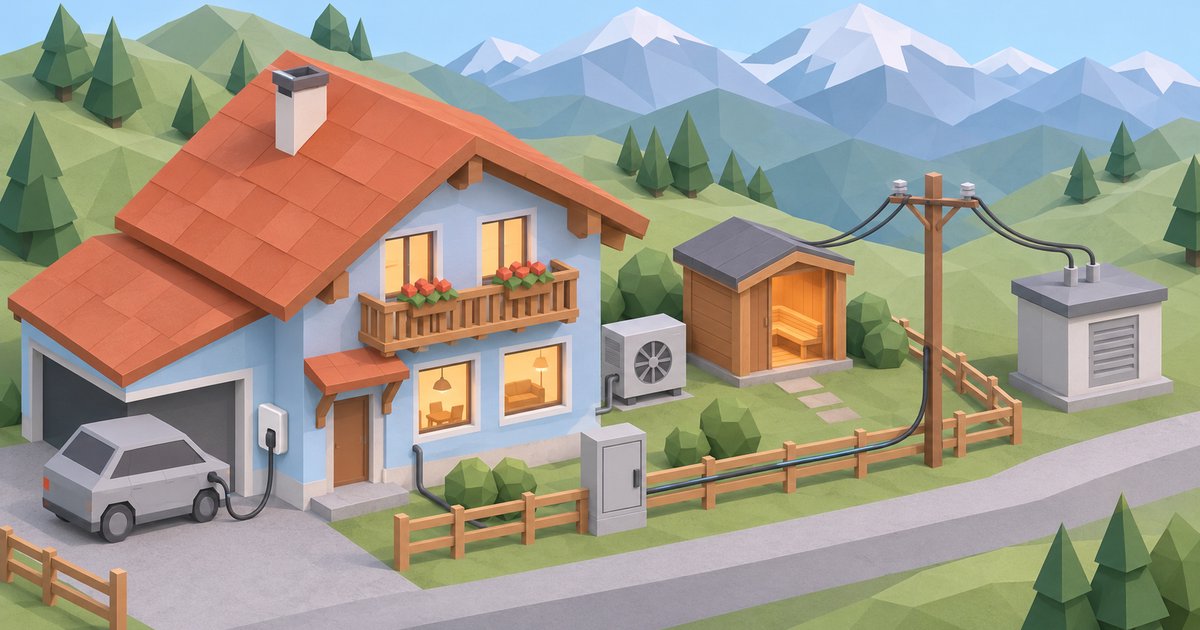
Austrian households with a big electricity draw, such as those that charge an electric car at home, heat a sauna or run a heat pump, should expect to pay "roughly €10 to €15 a month" more for the grid if they change nothing about how they use power. E-Control chief executive Michael Strebl gave that figure to the Kronen Zeitung on 6 November 2026. By E-Control's calculations about 75% of households will pay less without doing anything, while around 22%, roughly a million households, risk paying more.
The cause is what the regulator calls the largest reform of Austria's grid tariffs since the electricity market was liberalised. E-Control presented the new rules, the SNE-G-V ordinance, on 12 October. The draft grid fees for 2027 followed at the end of October and are now in consultation.
What changes
Today about 90% of a household's grid fee depends on the kilowatt-hours it uses, and about 10% is a flat charge. In steps, the split moves to 50:50 between energy and power, and the power part is set by the highest 15-minute draw of each month.
| Element | Rule | When |
|---|---|---|
| Power price | Highest 15-minute draw of the month; energy-to-power split moves from about 90:10 to 50:50 | Each grid operator starts it between 1 January 2027 and 1 July 2028; 50:50 by 1 January 2029 |
| Summer low price (SNAP) | Grid energy price cut, currently by 20%, from 10:00 to 16:00 | 1 April to 30 September, continues in 2027 |
| Winter low price (WINAP) | Lower grid energy price from 23:00 to 05:00 | 1 October to 31 March, first from October 2027 |
| Flexible draw | Rebate for letting the grid operator curb part of the power, at most twice two hours a day | Replaces the interruptible tariff over three years |
Both low-price windows need a smart meter that the grid operator can read every quarter-hour. For the connection itself, every existing customer is allocated 10 kW of draw capacity, and nobody is billed retroactively for higher peaks in 2026.
Why an 11 kW wallbox matters
A Model 3 or Model Y charges at up to 11 kW on a three-phase home connection. One quarter-hour at full power therefore sets that month's peak on its own, before the oven or the heat pump is counted. Kurier, citing E-Control, reports that households that never draw more than 10 kW at once can cut their grid fees by up to 10%. For homes with heat pumps or EV charging points it puts the range at up to 21% more if they ignore the new rules, or up to 8.5% less if they adapt.
The levers are in the car. Lowering the charging current in the car or the Tesla app from 16 A to 10 A takes a three-phase charge from about 11 kW to about 7 kW, and scheduled charging moves it into the night, where the winter low price applies from October 2027. E-Control's own case for the reform rests on exactly that behaviour: it expects to avoid about €300 million a year in grid costs if home batteries and EVs spread their charging over several hours instead of charging at full power at the same time.
What 2027 brings first
Before the power price arrives, the 2027 draft lowers the average grid fee for a household using 3,500 kWh a year by 3.6%, about €15 a year, still under the old structure (Kronen Zeitung). Six of the nine states get cheaper, led by Lower Austria at 12% less; Carinthia rises by 9.6%.
Tesla ranked third among Austria's electric brands for the first nine months of 2026 (TeslAnt's September report), so many of the cars this tariff is aimed at are Teslas. Owners who charge at home have until their grid operator switches, at the latest in July 2028, to set a lower charging current and a charging schedule.