
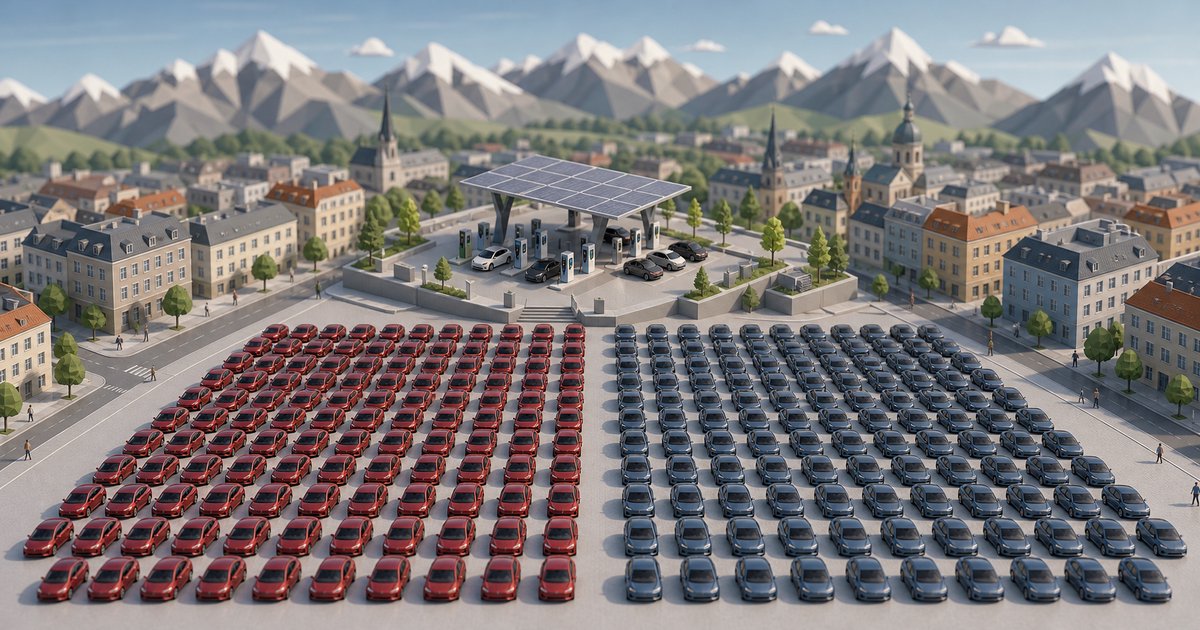
Austria passed 300,000 battery-electric cars in July 2026. The transport ministry put the stock at 304,328 at the end of the month, and used the round number to make a point: 7,073 of the cars registered in July were fully electric, 27.39% of everything registered that month.
"300,000 electric cars on Austrian roads send a strong signal: E-mobility has reached the centre of society," said mobility minister Peter Hanke.
The interesting number is the interval
Austria reached 100,000 electric cars in September 2022. Getting from 200,000 to 300,000 took roughly 19 months. The stock is not merely growing, the growth is compounding — each 100,000 has arrived faster than the one before, and several federal states are now above a 30% electric share of new registrations.
Electric has drawn level with petrol
The first half of the year is where the shift shows most clearly. Austria registered 40,060 battery-electric cars in H1 2026, up 27% year on year, for a 24.3% share. Petrol managed 40,509 — a 24.6% share, and essentially flat against the year before.
| Powertrain, Austria H1 2026 | Registrations | Share |
|---|---|---|
| Petrol | 40,509 | 24.6% |
| Battery-electric | 40,060 | 24.3% |
Four hundred and forty-nine cars separate them. June alone ran at 8,993 battery-electric registrations and a 26.3% share, up 44% year on year, so the crossover is a matter of when rather than whether.
Where Tesla stands in it
Tesla is the most-registered electric brand in Austria for the first half of 2026 — by a tenth of a percentage point.
| Brand | Share of Austrian BEV market, H1 2026 |
|---|---|
| Tesla | 10.6% |
| Škoda | 10.5% |
| BMW | 9.9% |
| BYD | 9.8% |
Four brands inside 0.8 points is not a lead, it is a photo finish. And the growth rates underneath it run against Tesla: Kia added 112% year on year, Škoda 63% and Mercedes 57%. Škoda is 0.1 points behind while growing at 63%, which is the arithmetic that decides second half of the year.
This is the same squeeze visible elsewhere in Europe. In July's European registration figures the Škoda Elroq climbed as the Model Y fell. Austria is a smaller market telling the same story: the electric segment is expanding quickly enough that Tesla can grow in absolute terms and still lose share, because the growth is being shared out among a dozen credible rivals rather than accruing to whoever got there first.
Charging kept pace
Austria counted about 39,500 public charging points in July, having added 676 in the month and 3,817 since the start of the year. The ministry expects to cross 40,000 during the summer.
That ratio matters more than the headline. Roughly 7.7 electric cars per public charging point, in a country where a large share of the fleet charges at home, is not a network under strain — and it is the part of the picture that most often lags the car numbers.
What it signals for the rest of Europe
A single country crossing a round number is not, by itself, news an owner acts on. What is useful is the shape underneath: electric level with petrol in a market whose federal purchase subsidy for private buyers ran out in February 2025 and has not returned, and a brand ranking where the incumbent leads by a rounding error. Both are leading indicators for the larger European markets, and both point the same way.