
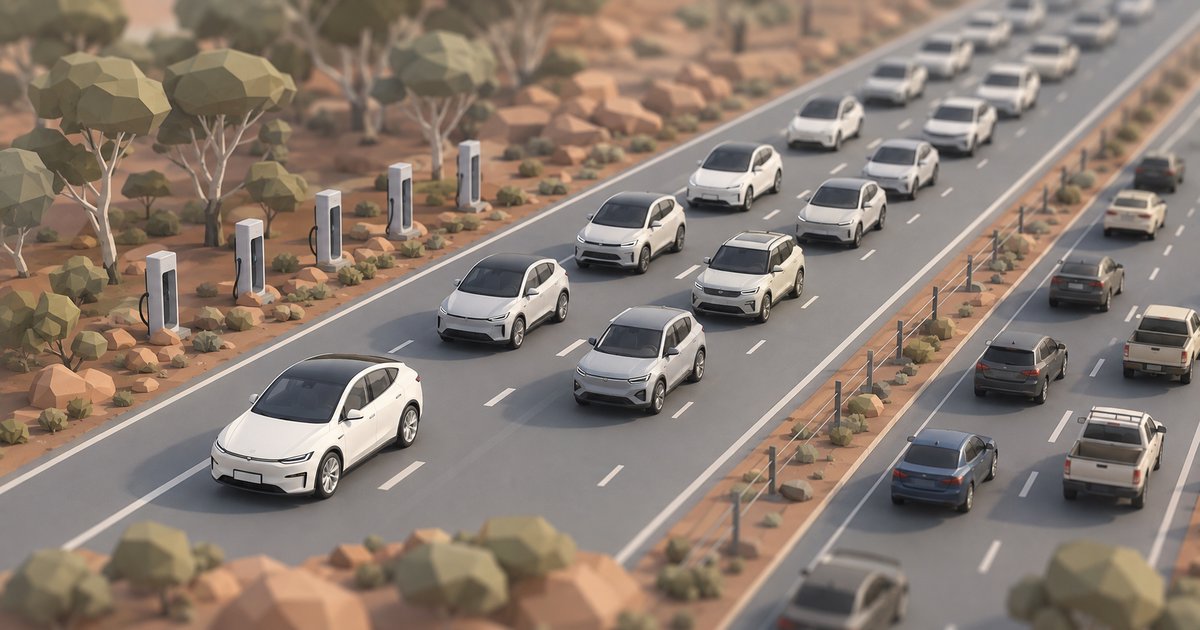
Battery-electric vehicles outsold every other powertrain in Australia in August 2026, and the Tesla Model Y was the best-selling vehicle in the country. Both are firsts, and in a market long treated as a lost cause for electrification.
The powertrain split
| Powertrain | Deliveries |
|---|---|
| Battery electric | 27,078 |
| Petrol | 25,824 |
| Diesel | 23,608 |
| Hybrid | 18,662 |
| Plug-in hybrid | 10,591 |
Total deliveries were 108,760, up 4.9% year on year. BEVs took a record 24.9% share and grew 169.4% — not a share gain won by a shrinking market, but by nearly tripling in volume.
Add hybrids and plug-in hybrids and electrified vehicles account for 51.8% of the month. August is the first time combustion-only cars have been in the minority in Australia.
The Model Y beat the utes
| Rank | Model | Deliveries |
|---|---|---|
| 1 | Tesla Model Y | 6,414 |
| 2 | Toyota RAV4 | 5,470 |
| 3 | Toyota Hilux | 4,833 |
| 4 | Toyota Prado | 2,475 |
| 5 | Ford Ranger | 2,440 |
| 6 | BYD Sealion 7 | 2,213 |
The Model Y finished roughly 900 clear of the RAV4 and well ahead of the Hilux. In a market where the monthly sales chart has been a contest between the Hilux and the Ranger for most of two decades, an electric SUV winning outright is the headline — it is the Model Y's third outright win this year.
Tesla was the third-largest brand overall on 7,685 deliveries, up 162.6%, behind Toyota's 19,712 (down 5.2%) and BYD's 8,231 (up 68.8%). The Model 3 contributed 1,271.
Chinese brands did much of the work
Four of the top ten were Chinese: BYD's Sealion 7, the Chery Tiggo 4, the Geely EX5 and the Zeekr 7X. Australia has no tariff on Chinese-built EVs and no local car industry to protect, so it has become the clearest available preview of what an open market does when cheap Chinese electric cars arrive without a trade barrier in the way.
The answer, on this month's evidence, is that they take volume quickly — and that Tesla still wins the top spot while they do it.
Why a European reader should care
Australia is not Europe and its numbers do not transfer. But it is the closest thing to a controlled experiment for two questions Europe is actively arguing about: what happens to EV share when Chinese brands compete on price without duties, and whether an electric SUV can beat the segment leaders on their own ground.
It is also a useful check on the Model Y's global position. We reported in July that the Model Y remains the world's best-selling car, and Australia is now a market where that is true nationally rather than as a global aggregate.
For European buyers the practical read-across is narrow: no pricing, no product and no policy here changes anything about buying a Tesla in Europe. What it does establish is that when the tariff variable is removed, Chinese brands grow fast and the Model Y still finishes first.