
Audi builds the E5 Sportback and the E7X in China with SAIC, under a sub-brand that drops the four rings, and Volkswagen Group has confirmed it has "no plans at this time" to export its China-exclusive EVs to Europe. The Cupra Tavascan is the single exception.
A third-party importer is doing it anyway. Auto China GmbH lists the E5 Sportback Flagship quattro for import into Germany from EUR 59,980 before VAT, quoting six to nine months for delivery, "guaranteed" registration in Germany and the EU, and a two-year warranty from the importer rather than from Audi's network.
The car is not a modest one: 579 kW (787 hp), 0-100 km/h in 3.4 seconds, a 100 kWh pack on 800 volts, and 647 km on China's CLTC cycle — a test that reads far more generously than WLTP.
The price does not travel
In China the E5 Sportback starts at just under $34,000, and Audi cut it by roughly $4,350 in February 2026 after slow sales. Add German VAT to the importer's EUR 59,980 and the delivered figure is about EUR 71,400 — which is where the "cheaper than local models" framing needs care.
| Audi EV, Germany | Price |
|---|---|
| A6 Sportback e-tron | EUR 62,800 |
| A6 Avant e-tron | EUR 64,450 |
| A6 Sportback e-tron performance | EUR 75,600 |
| S6 e-tron Avant | EUR 101,150 |
| E5 Sportback Flagship (imported, incl. VAT) | ~EUR 71,400 |
The imported car undercuts an S6 e-tron by some EUR 30,000 while making considerably more power, and comes in below an A6 e-tron performance. It is also nowhere near the Chinese price. Importing does not buy China's price list; it buys roughly double it.
Why the gap is a duty schedule
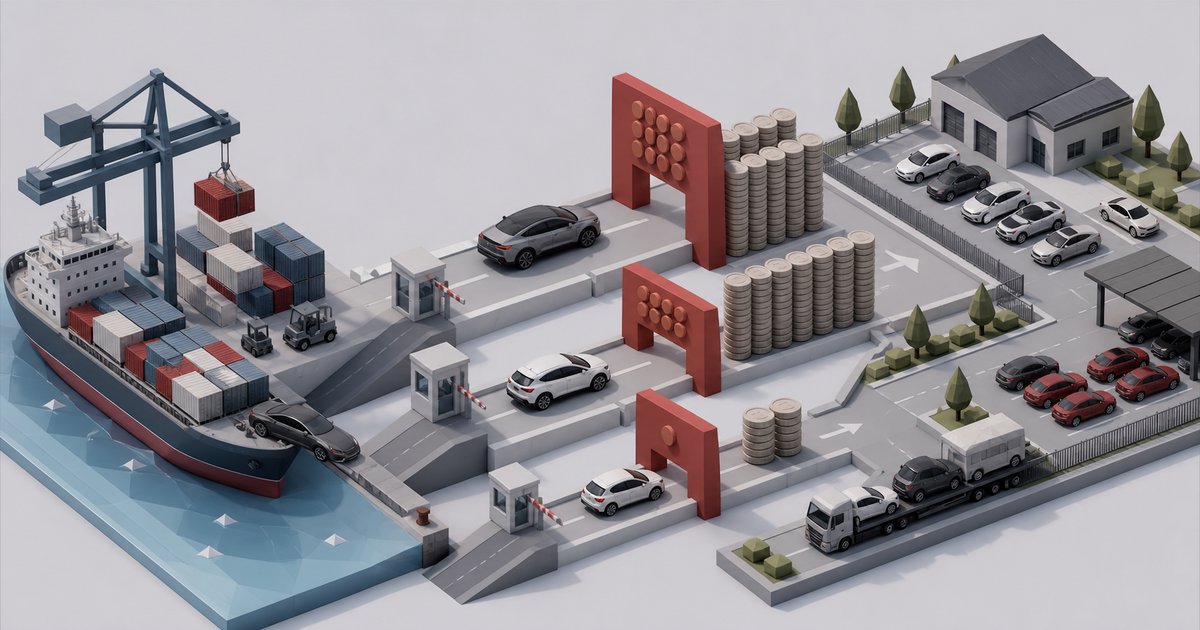
The EU's definitive countervailing duties on China-built battery-electric cars took effect on 30 October 2024, at the close of the Commission's anti-subsidy investigation. They range from 7.8% to 35.3%, sit on top of the standard 10% car import duty, and are company-specific rather than uniform. SAIC, the partner that builds the E5, drew the top rate.
Tesla drew the lowest: 7.8%, following its own individual examination.
That contrast is the part worth keeping. Both firms build cars in Shanghai. One can put a Shanghai-built car on a European price list at an ordinary price; the other cannot, and the difference is a line in a Commission regulation, not anything about the factory or the car.
A legal route exists, and Audi has not used it
Duties are not the only option. The Commission has been accepting price undertakings — a minimum sale price plus an annual quota, in exchange for exemption — and published guidance for submitting them in January 2026. Volkswagen has already used it: Cupra's Tavascan won an exemption in February 2026 on those terms.
The E5's absence from European showrooms is therefore a decision, not a prohibition. Audi could seek the same treatment. It has instead kept the car in China and left a grey importer to serve whichever buyers will absorb the duty, the VAT and the margin.
Others route around the problem. Geely will build its premium brands inside Volvo's European factories, removing the duty question altogether, and the cost of moving China-built vehicles into a Western market has already reshaped one autonomy business case — Waymo pays over 100% in tariffs to import its robotaxis.
What a European buyer takes on
No Audi warranty and no Audi service obligation, but the importer's two years. A six-to-nine-month wait. A range figure from the wrong test cycle. And a resale value nobody here can price, because there is no second-hand market for a car Europe never sold.