
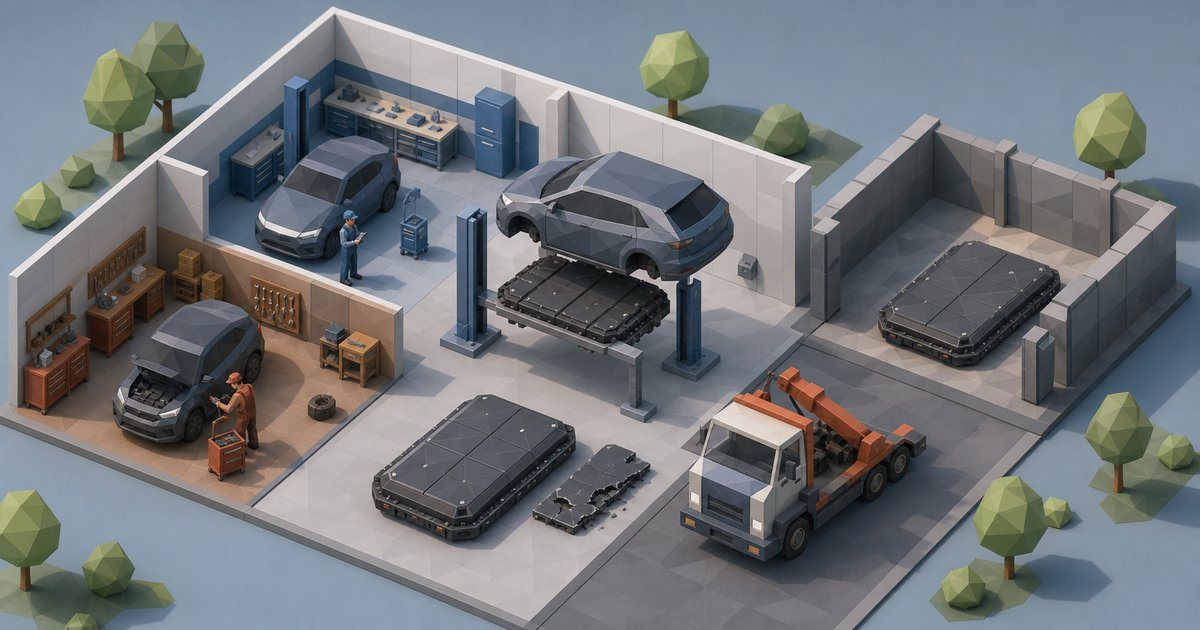
For years the most-quoted number in European EV insurance has been the Allianz Zentrum für Technik's finding that electric cars cost roughly 30% more to repair after a collision than comparable combustion models. The AZT's current reading keeps the number and takes away the conclusion most people drew from it: the electric drivetrain is not what makes the bill.
What the 30% is actually made of
Carsten Reinkemeyer, who heads safety research at the AZT, is direct about it — an electric car after an accident is not automatically more expensive to repair than a comparable combustion car. Spare parts for EVs are not generally dearer either.
What differs is everything around the repair:
- Fleet age. Europe's electric fleet is far younger than its combustion fleet. Newer cars are repaired rather than written off, are worth more, and carry more sensors in the crash path. Compare a three-year-old EV with a twelve-year-old diesel and the EV wins the cost comparison for reasons that have nothing to do with volts.
- Where it gets repaired. Hourly rates at franchised dealers run roughly 50% above independent workshops, and EVs still land at franchised dealers far more often.
- Missing repair solutions. Where a manufacturer has not published a way to fix a component, the only path is replacement.
The battery is where the range explodes
AZT puts the cost of battery and underbody damage anywhere from under €1,000 to €29,000. That is not a spread caused by how hard the car was hit. It is caused by whether the pack has a protective casing and whether the maker offers a repair solution at all — the difference between swapping a shield and condemning a pack.
The bill that arrives after the crash
Two costs sit outside the workshop entirely, and AZT found both inflated. Examining towing invoices for electric cars, it found substantial increases against average prices for combustion vehicles. And quarantine storage — parking a damaged EV in isolation in case the pack ignites — is frequently kept running far longer than the risk justifies.
That one is solvable, and two makers have shown how: VW and BMW have cut initial monitored quarantine to 24 hours, using battery temperature as the indicator rather than a fixed calendar period.
What this means for European owners, and for Teslas
AZT draws on the German claims pool, the largest in Europe and the one most European insurers benchmark against, so this is not a national curiosity. Two of the cost drivers are an owner's to act on: franchised-dealer labour is a choice once the car is out of warranty and the work is not battery-side, and an over-long quarantine is a line on an invoice that can be questioned. Fleet age and missing repair routes are not.
The €1,000-to-€29,000 range is where it gets specific for a Tesla. A structural pack with the floor as its lid is excellent for stiffness and poor for the economics of a kerb strike, and the underbody is the part of any Tesla most likely to meet something solid. What decides whether that is a claim or an economic write-off is exactly what Reinkemeyer names: casing, and whether a published repair route exists.
It also explains why an exchange-price sheet matters. Tesla's remanufactured Model 3 and Model Y pack at $8,000 against roughly $14,500 new is, in AZT's language, a value-appropriate replacement battery — one of the things Reinkemeyer asks manufacturers for.
What Allianz wants changed
The list is short and unglamorous: objective information about EV damage instead of folklore, regular training for technicians, better protective housings around packs, and repair-friendly solutions or reasonably priced replacement batteries.
None of that requires a new battery chemistry. It is the difference between an EV that is expensive to insure and one that isn't.