
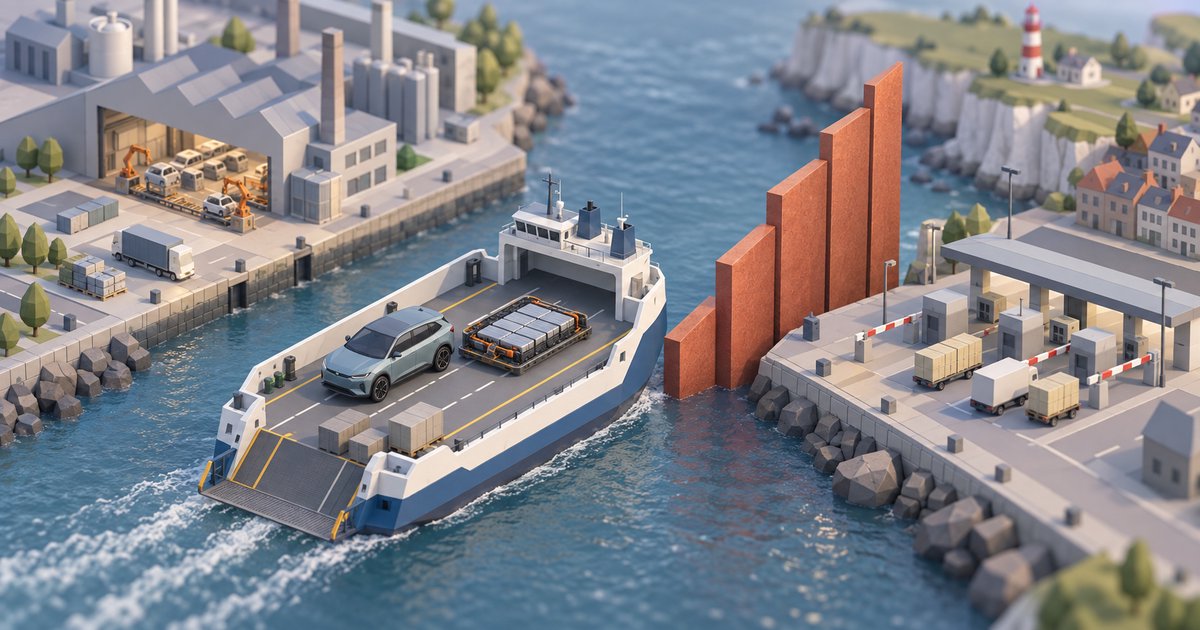
Europe's carmakers have told Brussels that a rule they already delayed once is still unmeetable. In a letter dated 17 September 2026, the European Automobile Manufacturers' Association (ACEA) asked the European Commission and member states to change the battery rules of origin in the EU–UK Trade and Cooperation Agreement before they tighten on 1 January 2027 — because, on the industry's own numbers, most electric cars crossing the Channel will fail them.
The thresholds, and the gap
From the start of 2027 the TCA stops accepting battery-pack assembly as the test of where a battery comes from and starts counting materials and cells.
| Requirement from 1 January 2027 | Share that must originate in the UK or EU |
|---|---|
| Vehicle value | 55% |
| Battery pack | 70% |
| Battery cells | 65% |
ACEA's assessment is that the cell and pack figures cannot be hit on that timetable. It expects the EU to export 520,000 electric cars and vans to the UK in 2027, and reckons 82% of them — roughly 426,000 vehicles, worth about €17.9 billion — would fall outside the rules and become liable for the 10% customs duty that applies to non-qualifying goods. The association puts the tariff bill at €1.47 billion in 2027 alone.
This is the second time the deadline has moved. The stricter requirements were originally due in 2024 and were pushed to the end of 2026 after manufacturers warned that European battery supply chains were not scaling fast enough. That extension was presented as a one-off.
What ACEA is asking for
Rather than another blanket delay, the proposal is a staircase: keep the existing pack-assembly-based rules until the end of 2029, bring in stricter cell-localisation requirements from 2030, and add cathode-material requirements from 2032, with a similar but longer timeline for heavy trucks. ACEA's framing is that the direction is not in dispute — "the question is not whether they will be able to comply, but when."
The UK side has signalled it is open to talking. Reporting on the letter describes the UK government as a willing partner in considering further flexibilities, which is unsurprising: a tariff on EU-built EVs raises prices for British buyers without moving a single factory.
Why this lands on Tesla
ACEA names no manufacturers, and it does not publish a compliance verdict on any individual model — so nobody should read a Tesla figure into the 82%. What is not in doubt is the exposure. The Model Y sold in Britain is built at Giga Berlin, inside the EU, which puts it squarely in the category of vehicle the letter is about. The UK is also one of Tesla's strongest European markets; the company passed 300,000 cumulative UK sales this summer.
A 10% duty on a Berlin-built car entering the UK is the kind of change that shows up on a price list rather than in a policy document. And it cuts differently from the tariff story Britain settled last week, when ministers ruled out matching the EU's duties on Chinese-built cars: this one would tax European production, not Chinese.
What to watch
The decision sits with the Commission and member states, and the calendar is short — any change has to clear the EU side and then be agreed with London before January. If it does not, the rules bite on schedule and the carmakers absorb or pass on the duty. Buyers in Britain will find out which, in the new year.