
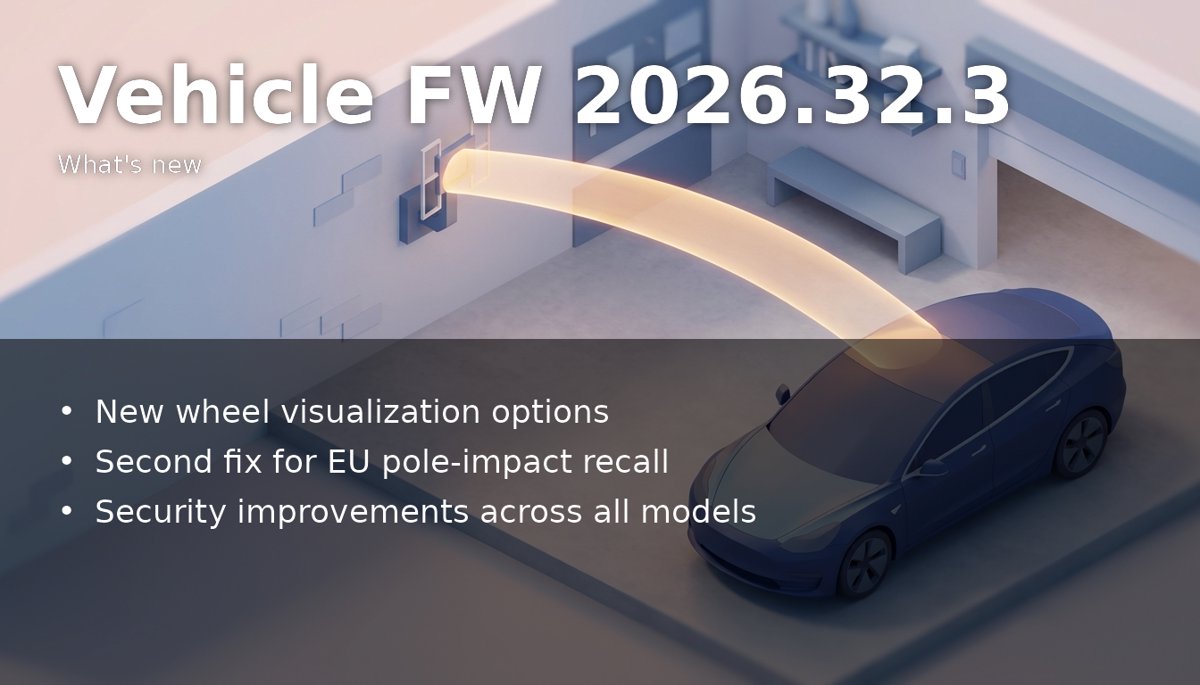
Tesla began rolling out firmware 2026.32.3 on 9 September 2026. It is the first and so far only build in the 2026.32 branch, and the highest branch number Tesla has shipped. The release notes run to four entries, and none of them mentions Full Self-Driving.
What is in it
| Entry | Models | New? |
|---|---|---|
| Wheel Selection | Model 3, Model Y | Yes |
| Apple Music library browsing | Model 3, Model Y | Carried over |
| Recall Notice — EU Recall 2026_103555 | Model 3, Model Y | Second branch to carry it |
| Security Improvements | All | Routine |
Wheel Selection — "Choose from new wheel options to customize the appearance of your Tesla" — is the only genuinely new heading. It appears neither in the 2026.27.6 build from the day before nor anywhere in the 35-entry note set of the 2026.26.6.5 Summer Update. What it changes is cosmetic: the wheel the car draws in its own visualisation, not the wheels bolted to it.
Apple Music is not new. The same instruction — go to Search, select Apple Music, then tap Library — already sits in the 2026.26.6.5 notes. That is the habit worth knowing about Tesla's release notes generally, and it is the same thing that made the v14.2 Lite notes identical to v14.1: entries are reprinted, and anyone diffing by eye concludes more changed than did.
The recall remedy, and what it means for European owners
The third entry carries the remedy for EU Recall Submission 2026_103555, restoring compliance with UNECE Regulation No. 135 on pole side impact. TeslAnt covered that remedy when it first shipped inside firmware 2026.27.200 on 1 September.
This is not a second recall. It is the same submission number arriving on a second branch — and that is the useful part, because 2026.27.200 is a Hardware 4 FSD build that never went past about 1% of the fleet. A European Model 3 or Model Y owner who was never offered 2026.27.200 now has another route to closing the recall on their car.
What has not changed is the explanation. Tesla still has not said which mechanism a software change touches on a pole-impact approval test, and no EU approval authority has published a notice of its own.
Where the branch sits
Both trackers agree the build is early and disagree on how early, which is normal — they follow different fleets.
| NotATeslaApp | TeslaFi | |
|---|---|---|
| Installs | 44 cars | 102 |
| Share of tracked fleet | 0.4% | 0.8% |
| Pending | 1 | 196 |
The fleet itself is still overwhelmingly on 2026.26. TeslaFi has 2026.26.6.1 alone at 45.5% across 5,693 cars, and NotATeslaApp puts the whole 2026.26 branch at 79.5%.
What the branch number does not tell you
A higher number is not a newer feature set. The FSD work is on 2026.27.x — v14.3.9 for Hardware 4 and v14.2 Lite for Hardware 3, both inside 2026.27.6 — while 2026.32.3 has no FSD section at all.
On content alone, 2026.32 reads like the successor to the 2026.26 mainstream branch rather than to the 2026.27 FSD branch, which would make it the build most cars eventually land on. Tesla has not said that, and a four-entry note set is too thin to confirm it.
Update: 2026-09-10
On 9 September 2026, Not a Tesla App published a hands-on look at 2026.32 with photographs, which qualifies the description of Wheel Selection above. The setting is not purely cosmetic. It sits on the Wheel and Tire configuration screen under Controls > Service, and Tesla uses the selected configuration to calculate range estimates in the Energy app, because running without the stock aerodynamic covers adds drag and slightly reduces highway efficiency. The menu itself replaces the old plain-text dropdown with a grid of full-colour renders that shows each design twice, with the aero covers fitted and bare, so a 21-inch Arachnid 2.0 appears beside a “No Cover” card. The Apple Music entry resolves in the interface to a Library tab under Search, for finding saved songs, albums and playlists instead of the global catalogue.
Update: 2026-09-11
Not a Tesla App reported on 10 September 2026 that 2026.32.3 also carries something the four-entry release note above does not mention: a built-in ad blocker for the car's web browser. A new AD button in the top-right of the browser toggles it, and with it on the browser drops ad trackers, third-party analytics scripts and heavy banner animations before the page renders. There is no settings panel — no blocklist editing and no way to whitelist a domain. The benefit is largest on older MCU2 cars with Intel Atom processors, where script-heavy pages are what makes the browser feel slow. Tesla did not document it, which is why it did not appear in the entry table above. Source: Tesla Adds Built-In Ad Blocker to Browser in Update 2026.32.
Update: 2026-09-15
A third undocumented change surfaced on 15 September 2026, when Not a Tesla App reported that 2026.32 adds an automatic timeout for the seat heaters. After roughly 30 minutes of continuous use the seat heater switches itself off, and the driver can turn it straight back on from the touchscreen climate bar or the Tesla app. Like the ad blocker above, it appears in none of the four release-note entries — it was found in Tesla's owner's manual, revised as the build rolled out. The manual gives component protection as the reason: seat heaters draw 12-volt power continuously, and long unbroken sessions can degrade the heating-wire insulation and dry out seat materials. That makes three items 2026.32.3 shipped without listing, which is the pattern worth keeping: on this branch the release notes are a floor, not an inventory.
Update: 2026-09-19
Ten days on, the rollout has answered the question this article left open. NotATeslaApp now has 2026.32.3 at 39.4% of its tracked fleet — 4,928 cars, up from the 44 counted here — and TeslaFi puts it at 39.5% across 4,942 installs with 1,494 still pending. It is the most-installed build on both trackers. The 2026.26 branch it was measured against has been displaced: 2026.26.6.1, which TeslaFi had at 45.5% on 9 September, now sits at 11.9%. That settles the reading offered above — that 2026.32 is the successor to the mainstream branch rather than to the 2026.27 FSD line — which a four-entry note set was too thin to establish at the time. Separately, 2026.27.300, released on 15 September with FSD 14.2.2.6 for Europe, is now a third branch carrying the EU Recall 2026_103555 remedy.