
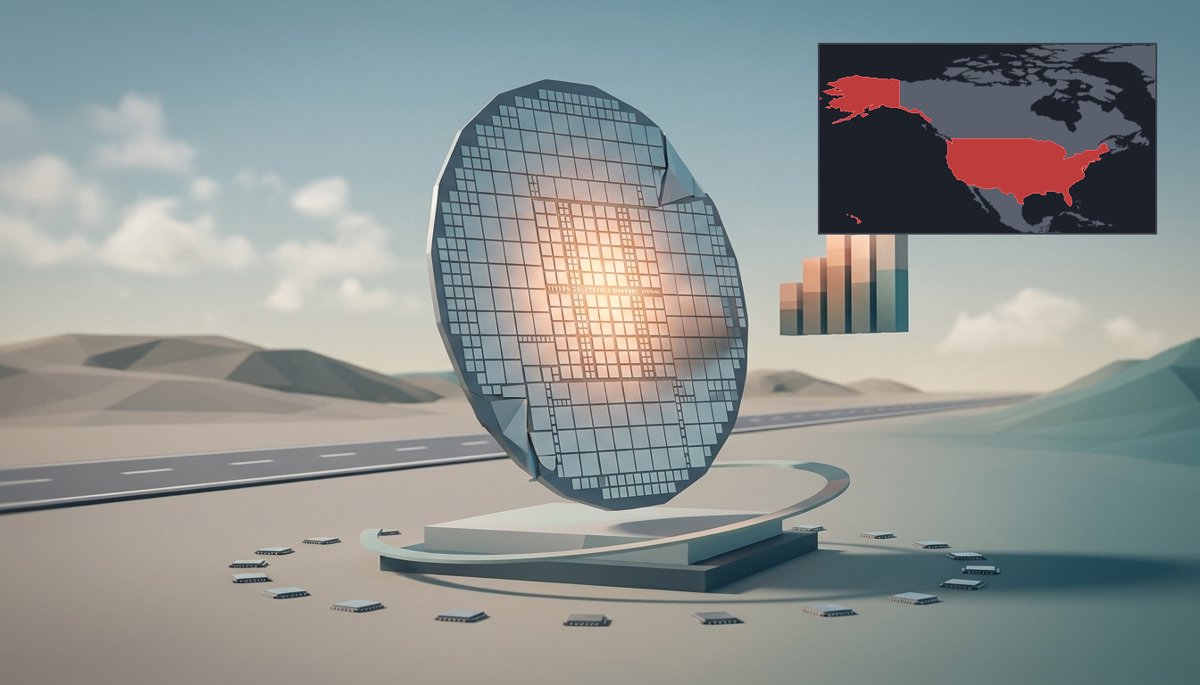
Elon Musk has offered a fresh progress report on Tesla's next-generation AI chip, and the headline claim is ambitious: the AI6 inference processor could set a record for how much usable computing power Tesla extracts from a single silicon wafer. As with any Musk projection about unreleased hardware, the figures are targets rather than measured results — but the broader chip roadmap behind them is now well documented.
What Musk actually said
In a post on X this week, Musk praised Tesla's in-house AI chip design team, describing the latest engineering design reviews as "so great" and calling the team "awesome". His more concrete claim was that AI6 might set a record for the most usable intelligence obtainable from a wafer once manufacturing yield is taken into account.
That framing matters. Rather than chasing peak performance on a flawless chip, Tesla is reportedly designing AI6 so that a larger share of each wafer turns into working silicon — tolerating defects and using die area efficiently. In high-volume automotive production, intelligence-per-wafer is arguably a more useful metric than raw benchmark numbers.
How AI6 compares to AI5
Musk has previously said AI6 should deliver a true doubling of performance over AI5 while keeping the same half-reticle die size — meaning roughly twice the capability without a larger, more expensive chip. AI5, the generation immediately ahead of it, has already been designed and reviewed. AI6 is the chip Tesla expects to underpin the most demanding versions of its self-driving and AI workloads in the years ahead.
Built by Samsung, in Texas
The AI6 is expected to be manufactured on Samsung's 2-nanometre process at the company's new fabrication plant in Taylor, Texas, as part of a supply agreement reported to be worth roughly $16.5 billion. Building a leading-edge node in the United States is a notable shift for Tesla, which has historically leaned on Asian foundries. Musk has said an AI6 tapeout — the point at which the final design is sent for production — is targeted for December 2026, with AI7 and later generations already in planning.
Why it matters for European owners
Tesla's custom chips are the brains behind Autopilot and Full Self-Driving, the latter of which is now being approved country by country across Europe. More capable, more efficient inference silicon is what lets future FSD builds run heavier neural networks in the car. The important caveat for European buyers: AI6 is a roadmap part, not a shipping product. Cars on the road today use earlier hardware, and a December 2026 tapeout means production silicon — and any vehicles built around it — are still some way off. Nothing announced here retrofits an existing Tesla.
For now, AI6 is best read as a statement of intent: Tesla believes its self-designed chips, not off-the-shelf parts, are its edge in autonomy, and it is willing to commit billions to a US fab to prove it.