
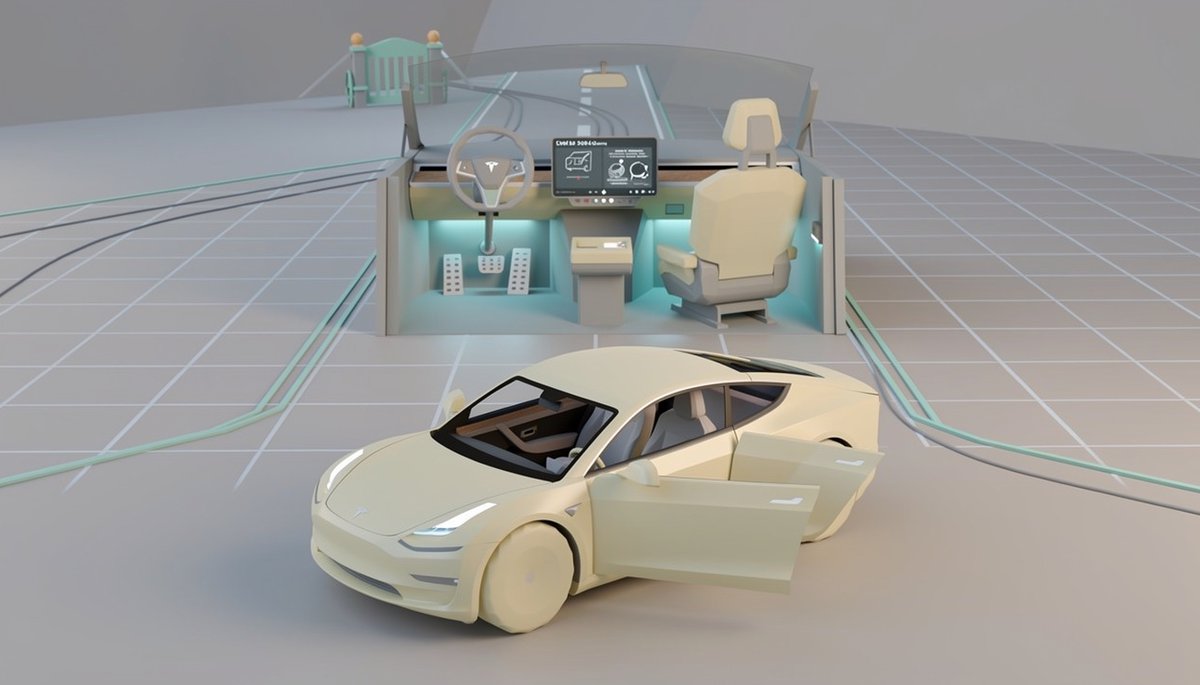
Tesla has put its first production Cybercab on public roads. On 30 June 2026 the company confirmed it had started "engineering tests" of a customer-spec unit in Austin, the first time the purpose-built robotaxi has been validated outside the Giga Texas factory where it entered production in April.
A robotaxi with no wheel and no pedals
The Cybercab is a two-seater designed from the ground up for autonomy, and the production cars now on Austin streets reflect that: they have no steering wheel and no pedals. That is a deliberate design choice rather than a retrofit. The Model Y cars that currently run Tesla's paid robotaxi rides in Austin are standard vehicles with their controls left in place; the Cybercab removes them entirely.
The wheel-less layout aligns with Tesla's decision earlier this year to self-certify the Cybercab as SAE Level 4 in Texas, a classification that allows a vehicle to drive itself within a defined operating area without a human ready to take over.
Still supervised, for now
Despite the absence of manual controls, the cars are not yet operating on their own in Tesla's commercial service. Video shared by the company shows the Cybercab driving with a Tesla supervisor sitting in the front passenger seat. Because there is no driver's position to occupy, the monitor's role is to observe and, if needed, trigger a stop rather than steer.
Tesla has framed this phase as engineering validation: confirming that production hardware behaves on real roads the way pre-production prototypes did. It is a step between manufacturing the vehicles and putting paying passengers in them without any human aboard.
Why it matters for Europe
For European readers the Cybercab remains a vehicle to watch rather than buy. Tesla is not yet taking orders, and the car is initially destined for the company's own robotaxi fleet rather than private ownership.
The bigger question for Europe is regulatory. A car with no steering wheel or pedals does not fit neatly into the EU's existing type-approval framework, which has long assumed a human driver with conventional controls. Tesla's Texas self-certification carries no weight in Europe, so any Cybercab service on the continent would need a separate approval path. The Austin tests are a sign of how fast the hardware is maturing, but the European timeline still depends on rules that have yet to catch up.
What comes next
The immediate milestone Tesla is working toward is removing the in-car monitor and letting production Cybercabs carry passengers unsupervised in Austin. Today's engineering tests are the clearest signal yet that the company intends to move the purpose-built robotaxi from prototype to revenue service, even as the supervised phase shows it is not there yet.
Update: 2026-07-12
On 10 July 2026, Tesla announced it will soon begin fully autonomous Cybercab rides for employees at Giga Texas, carrying passengers on factory grounds — a step beyond the Austin engineering tests above and the first time people will ride in the wheel-less, pedal-less robotaxi, according to Not a Tesla App. The move coincides with a sharp production ramp: sightings at Giga Texas have climbed past 120 units, per Teslarati, signalling the purpose-built robotaxi is edging closer to revenue service.