
What the EPA filing shows
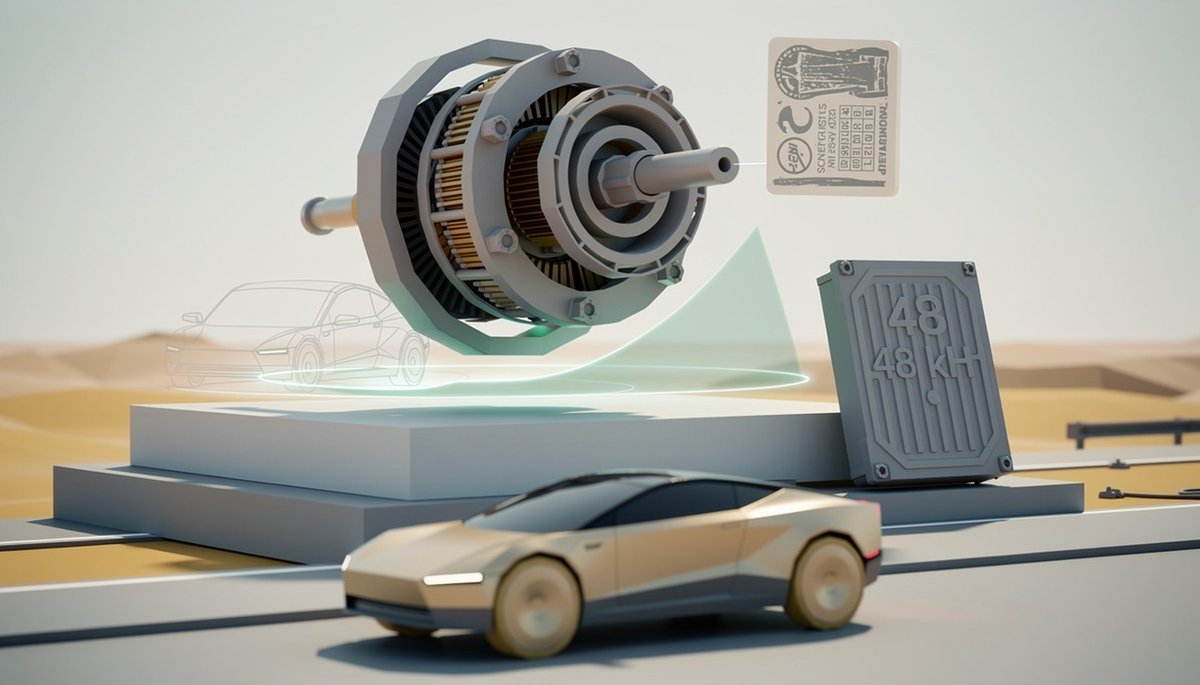
Tesla's purpose-built robotaxi, the Cybercab, has had its production specifications laid out in detail for the first time, courtesy of new EPA certification documents surfaced this week. The filing — submitted on 21 May 2026 and certified on 26 May — covers the 2026 Cybercab as a battery-electric Zero Emission Vehicle, and it fills in numbers Tesla had kept deliberately vague since the vehicle's October 2024 reveal.
The headline figures paint a picture of a small, light and highly efficient two-seater built for one job: moving people cheaply.
The numbers
| Specification | Value |
|---|---|
| Drivetrain | Single front motor, front-wheel drive |
| Motor power | 219 HP (163 kW) |
| Battery | 48 kWh |
| Curb weight | 3,113 lb (1,412 kg) |
| GVWR | 3,730 lb (1,692 kg) |
| Architecture | 326-volt |
| Efficiency | 165 Wh/mi |
The 48 kWh pack is small by modern EV standards, but paired with a 3,113 lb curb weight it yields a 165 Wh/mi efficiency rating that Tesla claims is the best of any production EV. The single front-mounted permanent-magnet motor and front-wheel-drive layout are a clear departure from Tesla's rear- and all-wheel-drive passenger cars, and they reflect the Cybercab's focus on packaging and cost rather than performance.
A range number that needs a caveat
The documents list 418 miles of equivalent all-electric range and 375 miles of highway range. Those are unadjusted test-cycle values, however, not the EPA-adjusted figure that appears on a window sticker — the real-world rating will be meaningfully lower once the standard correction factors are applied. Tesla has not yet published a final EPA range, so the headline figure should be read as a ceiling rather than a promise.
A regulatory green light, too
The spec reveal landed alongside a second milestone: the Cybercab has cleared a key US certification step that readies it for operation on public roads. Combined with the EPA Certificate of Conformity, it signals that the hardware is moving from prototype to a road-legal production vehicle, consistent with the more than 100 Cybercabs recently spotted staging at Giga Texas.
Why it matters for Europe
The Cybercab is not sold in Europe and faces a far harder regulatory path here than in the US — there is no European framework yet for a vehicle built without a steering wheel or pedals. For European readers the filing matters less as a buying decision and more as a signal of where Tesla's autonomy and cost engineering are heading. A 48 kWh, 165 Wh/mi two-seater hints at the efficiency targets Tesla is chasing across its line-up, and the regulatory progress in the US sets the template Tesla will eventually have to argue for with EU type-approval authorities.