
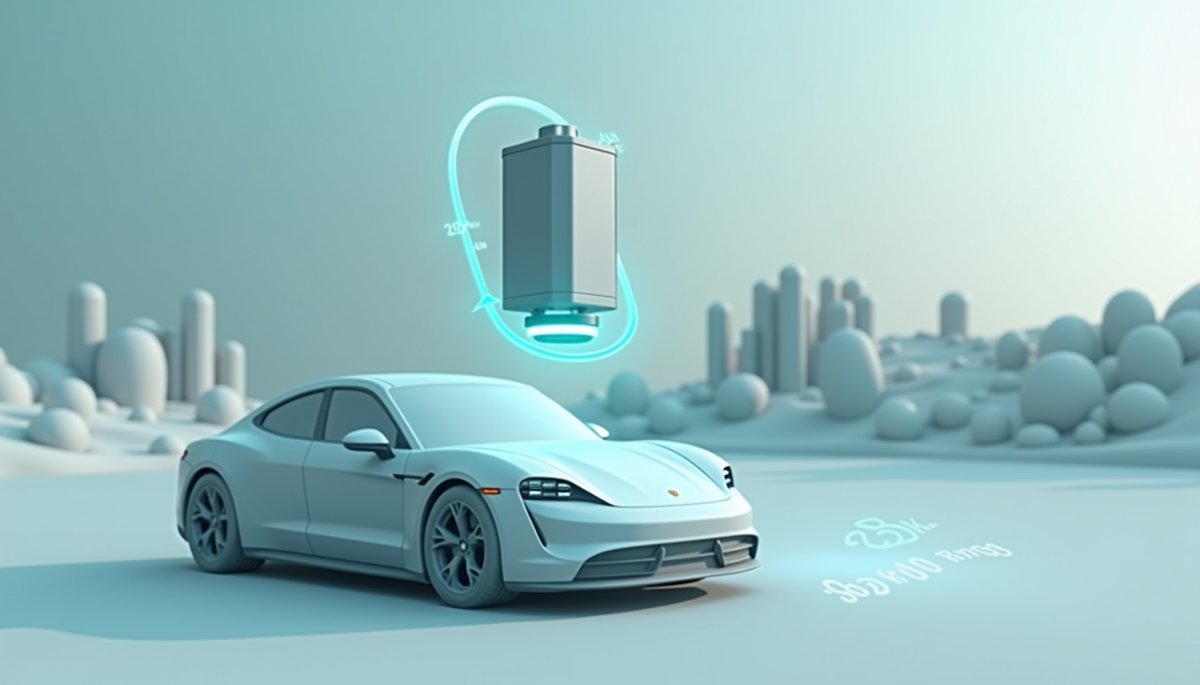
Porsche has detailed its 2027 Taycan, and while the headline-grabber is a controversial fake gearbox, the more consequential changes sit under the skin: a bigger standard battery, faster charging and — in North America — a switch to the Tesla-originated NACS charging port. For a premium EV that competes directly with the Model S, it is a significant mid-cycle update.
A bigger battery becomes standard
The most practical change is that the 105 kWh "Performance Battery Plus" is now standard across the entire 2027 Taycan range rather than a paid upgrade. On Europe's WLTP cycle that lifts range to as much as 700 km in the most efficient variants, according to European outlets covering the launch. Paired with the Taycan's 800-volt architecture, the pack accepts up to 320 kW at a compatible DC fast charger, keeping Porsche near the front of the field on charging speed.
NACS arrives — but only in North America
The detail most relevant to the wider Tesla story is the connector. In North America, the 2027 Taycan's passenger-side DC fast-charging port is now natively NACS — the standard Tesla opened up to the rest of the industry — with a CCS adapter supplied and the AC port left as J1772. Porsche notes one exception: the Taycan Turbo GT with the Weissach Package keeps the previous port. The change gives Taycan drivers in the US and Canada native access to Tesla's Supercharger network, another marker of how thoroughly NACS has displaced CCS in that market.
For European buyers the connector story is different. The continent standardised on CCS2, and Tesla has already opened much of its European Supercharger network to other brands — Volvo drivers gained access this year — so the Taycan keeps its existing port on this side of the Atlantic. The NACS switch is a North-American change, not a European one.
The fake gears everyone is talking about
The most divisive addition is "E-Shift," a system that simulates an eight-speed manual gearbox, complete with paddle shifters on the GT Sport steering wheel and an artificial shove between "gears." It is purely synthetic — there is no second set of gears in a Taycan — and Porsche charges extra for it as an option. Reaction has split between drivers who want more engagement from an EV and those who see it as adding cost to mimic something electric cars deliberately left behind.
Why it matters for European owners
The Taycan sits in the same premium bracket as Tesla's Model S, so its 2027 update is a useful gauge of where the high-end EV market is heading. Making a 105 kWh battery and 320 kW charging the baseline raises the bar against which Tesla's ageing flagship is measured in Europe, even as the NACS-versus-CCS2 split keeps the charging-port question a largely American one for now. The simulated gearbox, meanwhile, is a reminder that as EV performance converges, brands are increasingly competing on feel and theatre rather than raw numbers.