
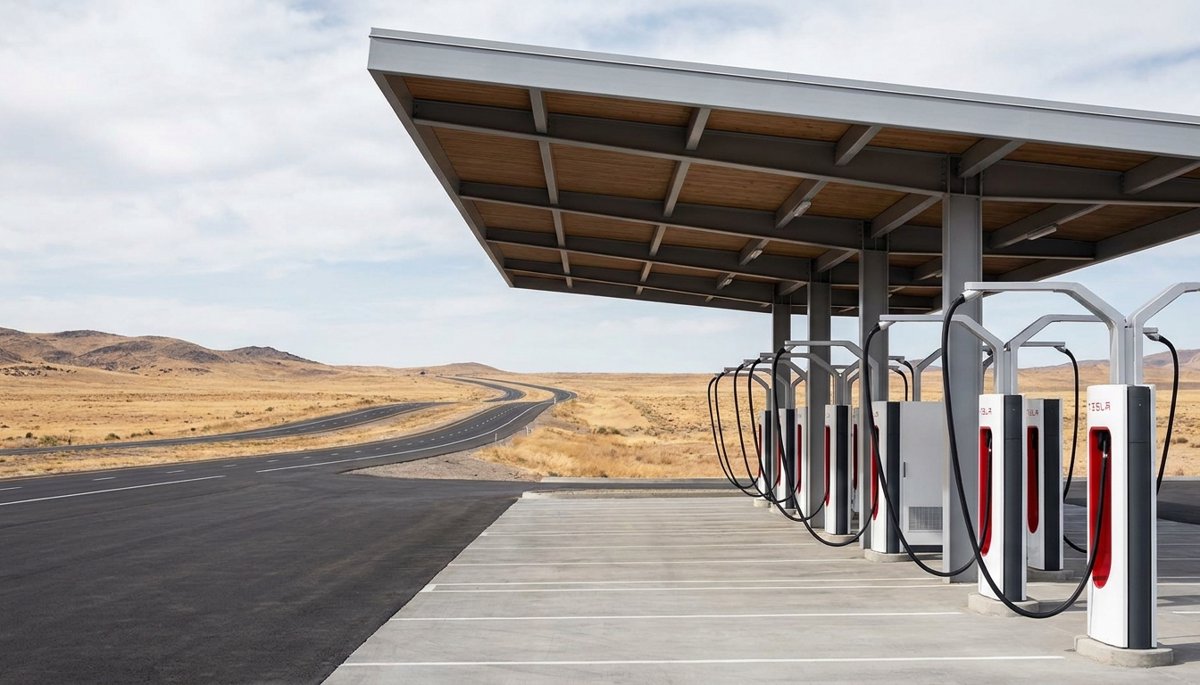
Volvo has announced an expanded partnership with Tesla that pulls the Supercharger network directly into the carmaker's own digital ecosystem. Starting in the fourth quarter of 2026, Volvo EV drivers in Europe will be able to locate Superchargers, check stall availability, start a charge, and pay for it without leaving the Volvo Cars app. The integration arrives over the air, so no new hardware or visit to a service centre is required.
The move was reported on 26 May 2026 by Not a Tesla App and confirmed by European outlets including electrive and Electrek. It builds on Volvo's earlier position as the first European manufacturer to sign an agreement with Tesla to adopt the North American Charging Standard (NACS), which already gives its North American drivers app-based access to roughly 120,000 charging points across the United States and Canada.
What is actually changing
Volvo EVs can already physically charge at European Superchargers, which Tesla has been opening to non-Tesla cars through its own app since the pilot programmes of recent years. The friction was the workflow: drivers had to maintain and authenticate a second app to start and pay for a session. The new integration removes that step, folding discovery, navigation, live availability, session control, and billing into the native Volvo Cars app.
Coverage and eligible models
The rollout covers more than 20,000 Supercharger stalls across 29 European countries, with the densest coverage concentrated in Germany, France, Norway, the United Kingdom, Sweden, Italy, and Spain. The over-the-air update applies to Volvo's current fully electric line-up.
| Detail | Figure |
|---|---|
| Start | Q4 2026 |
| Supercharger stalls | 20,000+ |
| Countries | 29 |
| Eligible models | EX30, EX40, EC40, EX60, EX90, ES90 |
What it means for European owners
For Volvo drivers, the change collapses two apps into one and makes the largest fast-charging network on the continent a first-class option inside the car they already own. For existing Tesla owners, more brands sharing the network is a double-edged development: it strengthens the commercial case for Tesla to keep expanding V4 sites, but it also raises the prospect of busier stalls at peak travel times. Tesla has been steadily widening third-party access in Europe as it turns the Supercharger network into a standalone revenue stream rather than a Tesla-only perk.
The bigger picture
Opening the network to a premium European rival underlines how central charging infrastructure has become to Tesla's business beyond car sales. Each new brand that plugs in deepens utilisation of the network and normalises the idea of the Supercharger as neutral public infrastructure — a notable shift for hardware that was once one of Tesla's strongest lock-in advantages.