
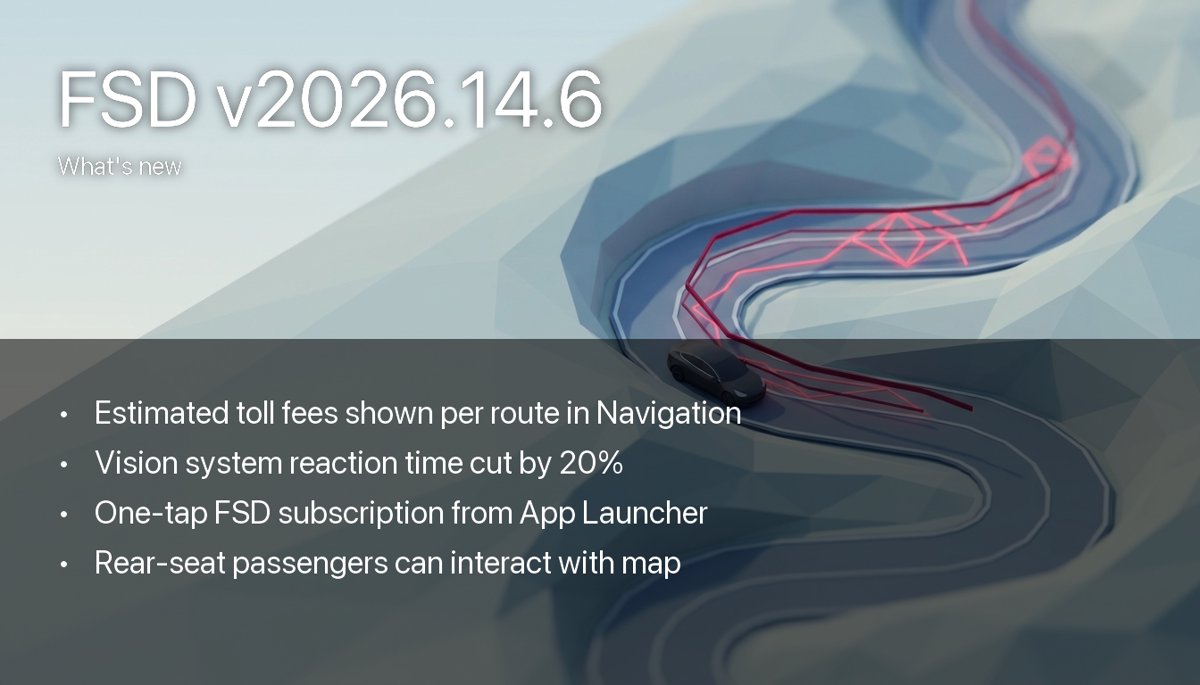
Tesla began pushing update 2026.14.6.7 — carrying Full Self-Driving (Supervised) v14.3.3 — to the fleet on 3 June. As is normal for a fresh release, the initial rollout is small, reaching well under 2% of vehicles in its first days, and the build will widen over the following weeks.
What's new in FSD v14.3.3
The headline changes are under the hood. Tesla says it upgraded the reinforcement-learning stage of the driving model, citing "improvements in a wide variety of driving scenarios," and rewrote part of its AI compiler to cut the vision system's reaction time by a claimed 20%. The other notable change is driver monitoring: the release notes promise "better eye gaze tracking, eye wear handling, and higher accuracy in variable lighting conditions" — a meaningful tweak for owners who wear glasses or drive at dawn and dusk, and a clear nod to the regulatory scrutiny FSD faces in Europe. The release applies to AI4 (HW4) vehicles; older HW3 cars are slated for a separate "V14 Lite" build later in the year.
Quality-of-life additions
Beyond the driving stack, the update bundles several features owners will notice day to day:
- One-tap Self-Driving subscription. A new Self-Driving section in the App Launcher lets drivers subscribe, learn the controls, and view their stats without leaving the car.
- Estimated toll fees. Navigation now shows expected toll costs per route — including EV discounts where they apply — when Online Routing is enabled.
- Rear-display map interaction. Rear-seat passengers on dual-screen cars can view and interact with the map while the car navigates.
- Premium Immersive Sound audio processing on Model 3 and Model Y, alongside the wider "Hey Grok" voice activation introduced in the Spring update.
What it means for European owners
Two things stand out for the European fleet. First, the toll-fee estimates are genuinely more useful here than in North America, given how many trips cross tolled French, Italian, or Austrian motorways. Second, the driver-monitoring upgrades land exactly as Tesla pushes FSD Supervised through one national regulator after another — sharper attention tracking is the kind of change that helps homologation as much as it helps drivers. The features build directly on the FSD v14.3 release that launched earlier in the spring.
As always, the rollout is staged and region-dependent: not every feature reaches every market or trim at the same time, and FSD Supervised itself remains usable only where it has been locally approved.