
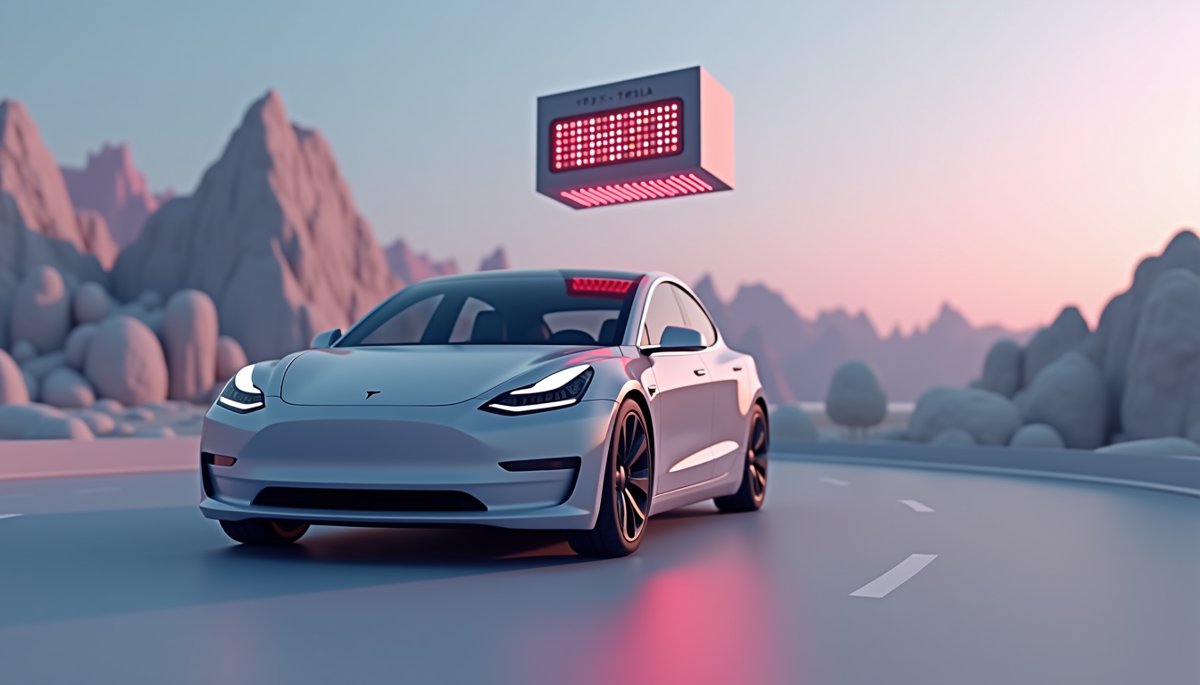
Tesla has filed a patent describing a markedly cheaper way to build adaptive matrix headlights, swapping out much of the electronics that make today's units expensive for a thin, light-reactive film. The filing was surfaced this week by Not a Tesla App, and while a patent is a long way from a shipping part, the approach hints at how Tesla wants to bring fine-grained beam control to more of its cars without the price penalty that comes with it today.
How the Design Works
Conventional matrix headlights steer their beam by switching dozens of individually addressable LEDs on and off, each managed by ambient-light sensors and dedicated control electronics. That complexity is why a single damaged matrix module can cost well over $3,000 to replace. Tesla's patent takes a different route: it places an ultra-thin photochromic film in front of a much smaller cluster of LEDs. The film's dye reacts to light from the car's own LEDs at a specific wavelength, shifting the lens from dark to transparent in the areas that need to be lit.
Because the masking is done chemically rather than with banks of switched diodes, the patent suggests the resolution can still be high. Tesla describes dividing each of seven LEDs per headlight into four or more pixels and using eight film squares per LED, which works out to roughly 112 controllable segments across a pair of headlights — enough to match the adaptive behaviour of the rest of the fleet.
Why It Could Matter for Repair Costs
The most immediate benefit is economic. Moving the "sub-pixels" onto a replaceable chemical film means a scuffed or cracked unit might be refreshed by swapping the film rather than the entire electronic module. For owners, that is the difference between a minor part and a four-figure repair bill — a meaningful change given how exposed headlight assemblies are to road debris and low-speed knocks.
The patent was framed in part around the Cybertruck, whose narrow front fascia leaves little room for a traditional matrix array. But the underlying idea is not model-specific, and a lower-cost production method would be just as relevant to the Model 3, Model Y, Model S and Model X.
The European Angle
Adaptive matrix beams have long been legal and widely used in Europe, where Tesla already enables the feature on cars sold in the region — unlike the United States, which only recently cleared the regulatory path. For European owners, the headline is not whether the technology arrives but what it costs to own and repair. A design that keeps the same beam-shaping behaviour while cutting both manufacturing and replacement costs would land squarely on the side of affordability.
As always with patents, the caveat is large: filing one does not commit Tesla to producing it, and many never reach a production car. For now, the document is best read as a signal of intent — a sign Tesla is looking for ways to make a premium lighting feature cheap enough to spread across its line-up.