
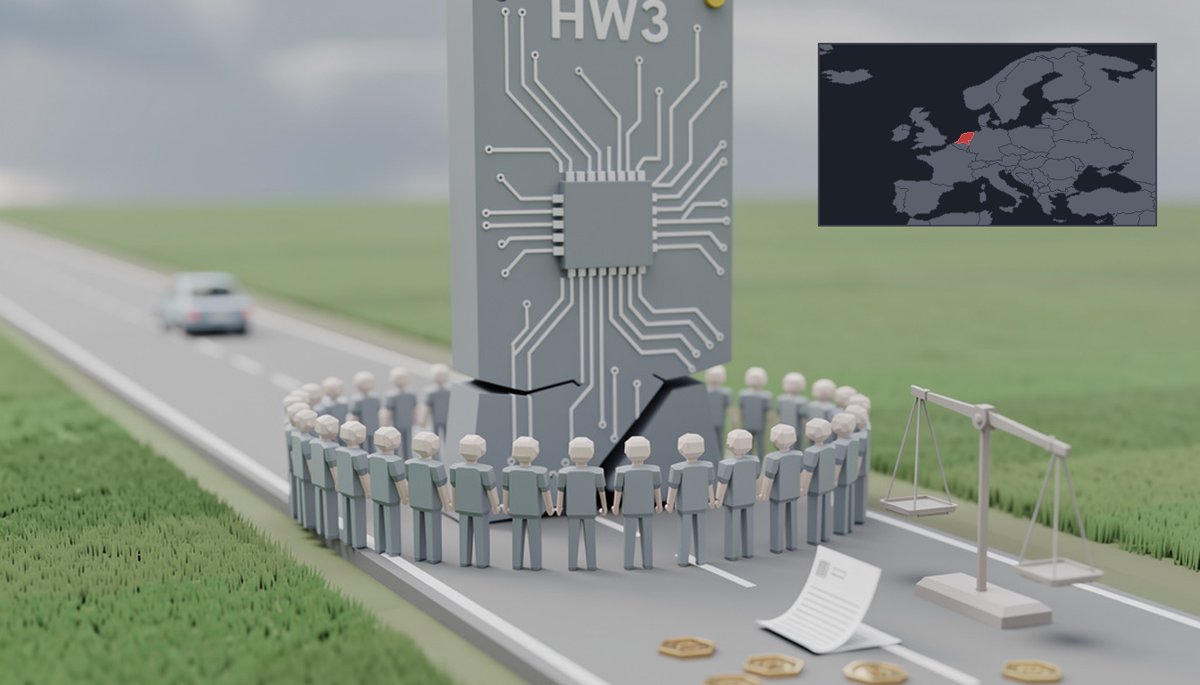
A collective legal claim in the Netherlands against Tesla over its broken Hardware 3 (HW3) self-driving promises has grown to nearly 7,000 verified participants and, as of 18 June 2026, gained the backing of Kennedy Van der Laan, one of the country's most respected law firms. The escalation turns what began as a grassroots owner campaign into a formal legal action.
What owners are claiming
The claim, organised by Dutch Tesla owner Mischa Sigtermans, rests on the argument that Tesla sold HW3 cars as being "suitable for full self-driving" and never delivered. Participants are seeking two things:
- A refund of the Full Self-Driving package they paid for separately — up to €6,400 in the Netherlands.
- Compensation for lost vehicle value, on the basis that part of every pre-HW4 Tesla's price reflected the self-driving promise.
A litigation funder is financing the action, so participants pay nothing up front; the funder instead takes a percentage of any proceeds. That structure has helped the claim scale quickly — it drew roughly 3,000 owners in its first week back in April 2026 and has more than doubled since.
The evidence: HW3 was never submitted
The campaign points to documents from the Dutch vehicle authority RDW. According to those filings, Tesla applied for FSD approval exclusively for HW4 hardware on 5 November 2024 and never submitted HW3 cars for assessment. The RDW confirmed on 13 May 2026 that "HW3 was never submitted for assessment" — a detail owners argue shows Tesla itself does not consider the older hardware capable of the feature it was sold for.
Tesla's own admission
The legal pressure follows Tesla's increasingly candid statements about HW3's limits. During its Q1 2026 earnings call, Elon Musk acknowledged that Hardware 3 cars cannot achieve Unsupervised FSD, citing memory-bandwidth constraints — a reversal of years of assurances and the company's advice to early owners to "be patient." TeslAnt covered that admission and the proposed remedies in our report on Tesla ruling out Unsupervised FSD for HW3.
Why it matters for Europe
The Netherlands is one of the first European markets where Tesla FSD (Supervised) has gone live, which sharpens the contrast for HW3 owners who can see the feature working on newer cars but not their own. A win — or even a credible settlement — could set a template for similar collective claims elsewhere in the EU, where group litigation over consumer promises is increasingly common. For now the action is a claim, not a verdict, and Tesla has not publicly responded to the law firm's involvement.