
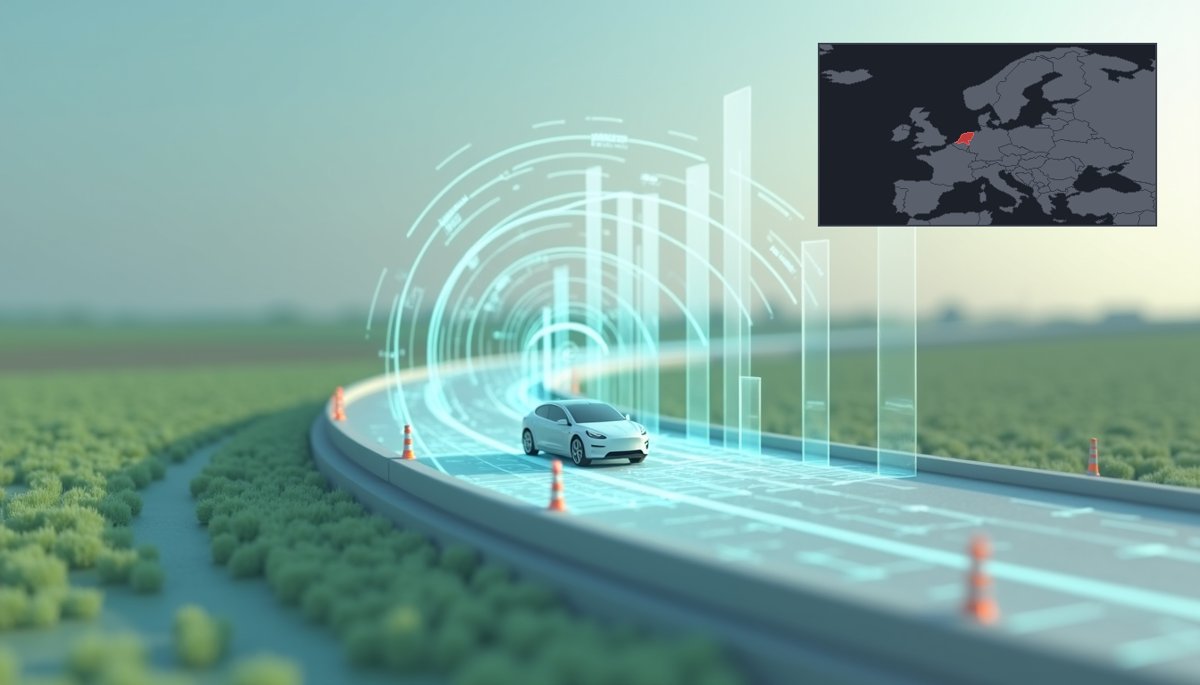
Tesla has published its first European safety report for Full Self-Driving (Supervised), and the headline number is striking: cars running FSD on Dutch roads recorded 3.5 times fewer collisions than manually driven Teslas over the same period. The report covers 10 April to 5 June 2026 — the roughly two-month window since the Dutch vehicle authority RDW granted Tesla the first national FSD approval in Europe.
It is the first time Tesla has released localized, road-type-specific safety data for a European market, and it matters beyond the Netherlands: the figures are the opening entry in what Tesla has committed to as ongoing annual performance reporting, and they arrive just as Denmark becomes the fourth European country to approve the system.
What the numbers show
The gap is widest on motorways. Across 16.6 million kilometres of highway driving with FSD engaged, Tesla reports zero collisions — against 33 collisions over 158.7 million manually driven highway kilometres. On non-highway roads the system still came out ahead, but by a narrower margin.
| Road type | FSD distance | FSD collisions | Manual baseline | Improvement |
|---|---|---|---|---|
| Highway | 16.6M km | 0 | 33 over 158.7M km | 3.4x safer |
| Non-highway | 7.0M km | 3 | 109 over 152.9M km | 1.6x safer |
| Combined | 23.6M km | 3 | 142 over 311.6M km | 3.5x safer |
Tesla also reported sharp drops in the harsh-driving events its telemetry tracks: 14.9 times fewer automatic emergency braking activations, 8.8 times less harsh acceleration, 7.3 times less harsh braking, and 8 times fewer hard swerves when FSD was driving.
The caveats worth keeping
Two things temper the topline figure. First, every number here comes from Tesla's own fleet telemetry — there has been no independent verification of the dataset, and the RDW required the reporting as a condition of type approval rather than auditing it directly. Second, the 3.5x headline is carried largely by motorway performance, where serious crashes are rarer to begin with. On the non-highway roads where most serious injuries in the Netherlands actually occur, FSD's advantage shrank to 1.6x.
None of that erases the result — a clean record across 16.6 million highway kilometres is a meaningful signal — but FSD remains a supervised driver-assistance system. Dutch approval under UN Regulation 171 still requires an attentive driver ready to take over, and the data reflects human-plus-software performance, not autonomous driving.
Why it matters for European owners
For owners in markets where approval is rolling out — the Netherlands, Lithuania, Estonia and now Denmark — this is the first concrete evidence of how the system behaves on local roads rather than American ones. The RDW's annual-reporting requirement also means European regulators will get a recurring, comparable dataset, something Tesla has never been compelled to publish in the United States. As FSD Supervised expands across the continent, that compliance record may end up mattering as much as the safety numbers themselves.
Update: 2026-06-15
Since publication, Tesla's Dutch safety figures have drawn pushback. Dutch outlet Autoblog reported that critics accuse Tesla of overstating FSD's benefits — particularly a company claim that universal FSD could prevent 32,000 deaths and 1.9 million injuries, which rests on comparing airbag-deployment crashes in modern Teslas against broad US NHTSA data covering all vehicle types and every crash severity. The RDW has also distanced itself from Tesla's framing, stating it never relies solely on company-supplied data and that it approved FSD Supervised on its own tests — not on the telemetry Tesla published.
Update: 2026-07-29
On 28 July 2026, Tesla expanded its European FSD safety reporting from the Netherlands alone to five approved countries — adding Lithuania, Estonia, Denmark and Belgium — and the combined figure rose to 5.2 times fewer collisions than manual driving, TeslaNorth reported. Over an extended 10 April to 26 July window, Tesla now claims zero highway collisions across 41.9 million kilometres — up from 16.6 million in the Dutch-only report — an 8.5x highway advantage and 2.8x on other roads. The headline improved as the dataset grew, but the caveats hardened: the numbers remain self-reported and unaudited, and the European Transport Safety Council has written to EU transport ministers warning that supervised-driving systems are reaching public roads faster than independent oversight can keep up, citing a fatal FSD-related crash in the United States.