
Tesla has released an official First Responder Interaction Plan for the Cybercab, the purpose-built robotaxi that entered production in April 2026. The document is aimed at fire departments, paramedics and police, and it gives the clearest picture yet of how the two-seater behaves on public roads with no one in control — because, as the guide repeatedly states, there is no driver and no way for a human to take over.
That framing matters. Unlike every other car Tesla sells, the Cybercab ships with no steering wheel and no pedals. The First Responder guide treats the vehicle as fully driverless throughout, reinforcing that Tesla intends to deploy it without manual controls rather than retrofitting them later.
How the Cybercab reacts to emergency vehicles
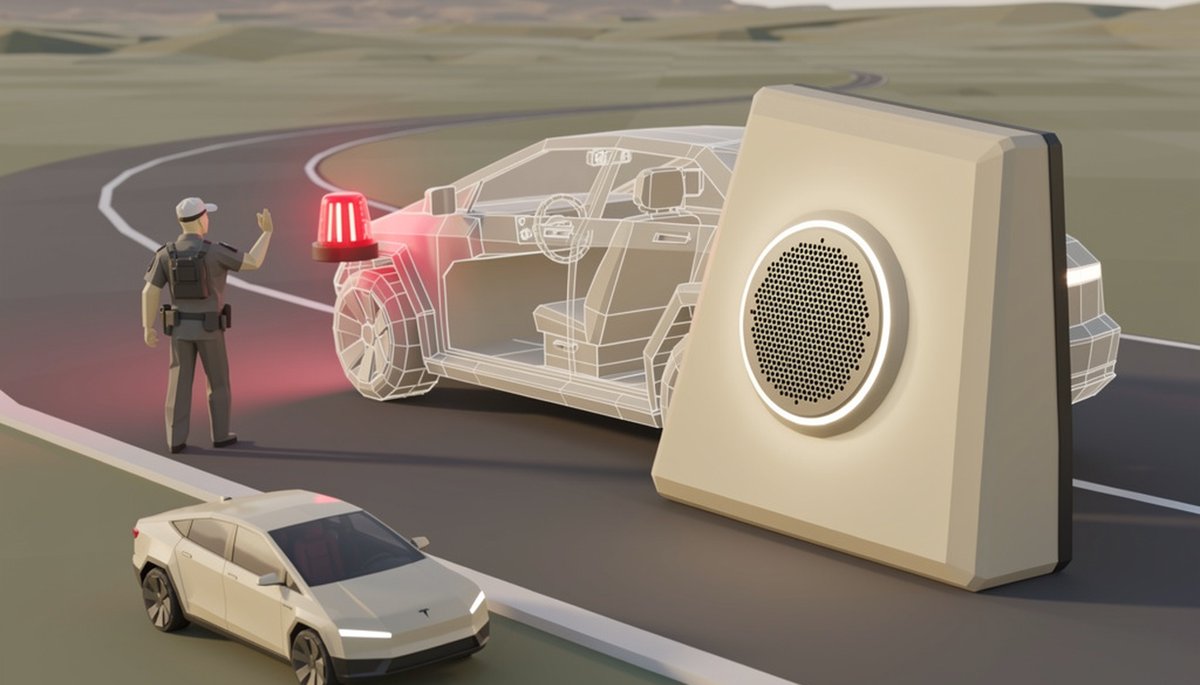
According to the guide, the Cybercab's Autonomous Mode uses its camera suite together with external microphone arrays to detect emergency vehicles and sirens. When an emergency vehicle approaches from behind, the robotaxi is designed to automatically pull over and yield, then resume once the path is clear.
The car can also respond to people, not just other vehicles. Tesla says the system can recognise hand gestures from first responders — for example, an officer waving traffic through — and can follow temporary pathways marked out by traffic cones. Those are exactly the unstructured, human-directed situations that have long been the hardest cases for autonomous driving.
Talking to a car with no driver
One of the more striking details is how responders communicate with an empty vehicle. The Cybercab carries external microphones on its B-pillars and speakers mounted on the underside of the chassis. Through them, a first responder standing next to the car can speak directly with Tesla's remote Robotaxi Support team without opening a door or breaking a window. Remote staff can then unlock the car, hold it in place, or guide responders through shutting it down.
Already testing on public roads
The guide arrives as Tesla runs engineering tests of its first production Cybercabs on public roads in Austin, Texas. The cars are being tested exactly as designed — no wheel, no pedals — with a safety monitor on board during this phase but no driver controls of any kind. The Texas Department of Transportation has acknowledged the vehicle's control-less layout, which builds on Tesla's earlier move to self-certify the Cybercab as a Level 4 system in Texas.
Why it matters for Europe
The Cybercab is not on sale, and Tesla has positioned it first for its own US robotaxi service rather than private buyers. European deployment would also have to clear the EU's UN-ECE type-approval rules, which still assume a human driver and manual controls — a far higher bar than Texas self-certification. Even so, the First Responder plan is a useful preview of the safety logic European regulators and emergency services will eventually scrutinise if and when wheel-less robotaxis reach the continent. For now, it is the most concrete look yet at how Tesla expects a genuinely driverless car to share the road with the people whose job is to respond when something goes wrong.
Update: 2026-07-02
On 1 July 2026, further detail from Tesla's First Responder Interaction Plan clarified how the wheel-less Cybercab can be shut down and recovered. The vehicle carries two independent First Responder Loops; cutting and removing a section of either loop cuts power to the whole car, though full de-powering can take up to two minutes. If a Cybercab is disabled or stuck, responders can move it manually using its onboard controls, and the plan documents standard towing procedures. The document also spells out the robotaxi's operating envelope: it drives day or night and in light to moderate rain, fog and snow, but declines new rides when severe weather is forecast and pulls over to a safe stop if caught out. Unlike Tesla's passenger cars, the Cybercab has no frunk.