
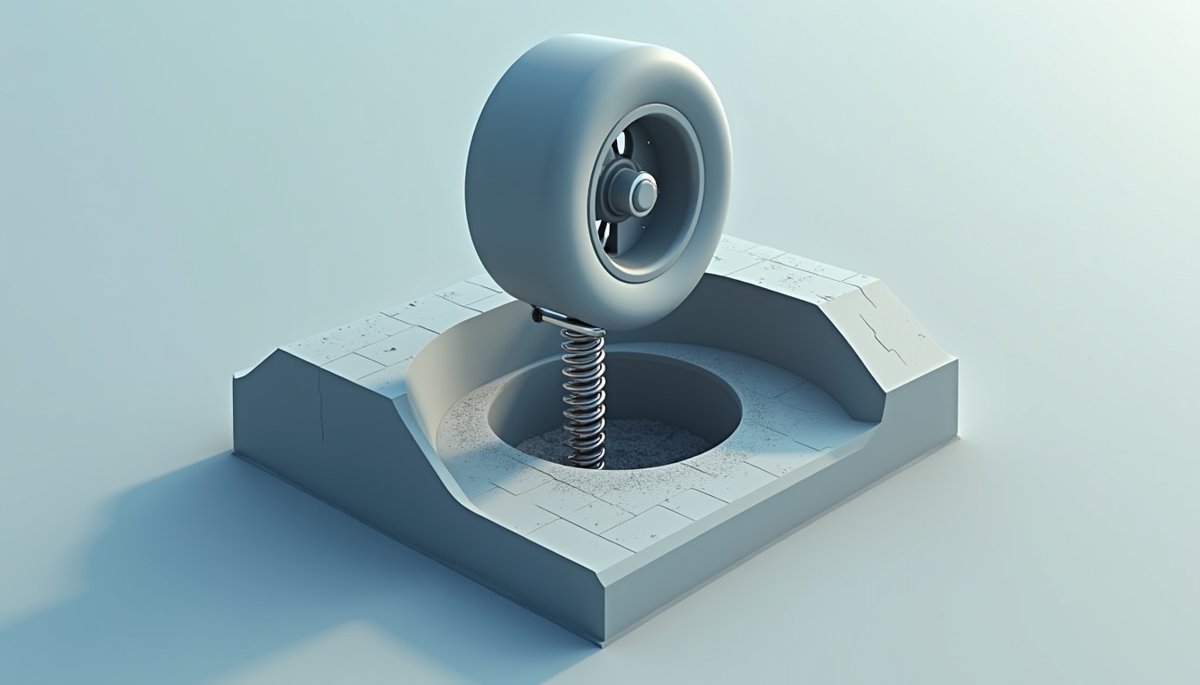
Tesla has been granted a patent for an active suspension system designed to tackle a complaint as old as the car itself: the jarring thud of hitting a pothole. The patent, US12654505B2, titled "Suspension Actuator System for a Vehicle," describes hardware that can sense a road defect and lift the affected wheel out of the way before the impact reaches the cabin. It was reported on 17 June 2026 and credits inventors Brian Lee Doorlag, Avraham Kagan and Justin Sill.
How the system works
At the heart of the design is an actuator built into the top strut mount. An electric motor drives a belt that turns a threaded screw, lengthening or shortening the strut shaft in real time by moving its upper mounting point up or down. That gives the car active control over each wheel's vertical position. Sensors — accelerometers and wheel-position monitors — detect a pothole, ridge or rut as it approaches, and the system retracts the wheel into its housing to soften how hard it strikes the edge.
A hybrid, not a brute-force actuator
What makes the patent notable is that Tesla does not try to do everything with the motor. The design splits the labour: a parallel air spring carries the vehicle's weight and handles slow body movements, passive springs and adaptive dampers absorb high-frequency vibration, and the powered actuator is reserved for the larger, lower-frequency events — the potholes and sharp dips. Because the air spring offsets the static load, the motor draws less power than a fully active system would. Tesla's filing argues that lighter motor loads mean less energy spent on the suspension, which on an electric car translates into a marginal range benefit.
Tying it to fleet data
The patent reads more interestingly alongside Tesla's earlier work on mapping road roughness from fleet data. In principle, a car would not have to wait until its own sensors spot a pothole; it could be warned in advance because thousands of other Teslas have already driven the same stretch and logged the bump. That would let the suspension pre-position the wheel rather than react at the last moment — the difference between bracing and flinching. It is not the only comfort idea in Tesla's recent filings, either; the company also patented electromagnetic suspension built into the seats.
From patent to product is not guaranteed
As ever, a granted patent is a statement of intent, not a product plan. Tesla files far more patents than it ships, and there is no commitment here to a specific model, price or date. The company already runs adaptive air suspension on the Model S and Model X and engineered a sophisticated set-up for the Cybertruck, so the direction is plausible — but owners should read this as a look into Tesla's research rather than a feature already on its way to their driveway.
Why it matters for European owners
Ride quality and pothole damage are universal grievances, and European roads — from patched-up city streets to frost-cracked rural lanes — would give active suspension plenty to do. A system that shields wheels and tyres from sharp-edged holes could cut a common and costly form of damage, while a smoother ride and a small efficiency gain would be welcome on both comfort and range. Whether, and when, any of it reaches a production Tesla remains the open question.