
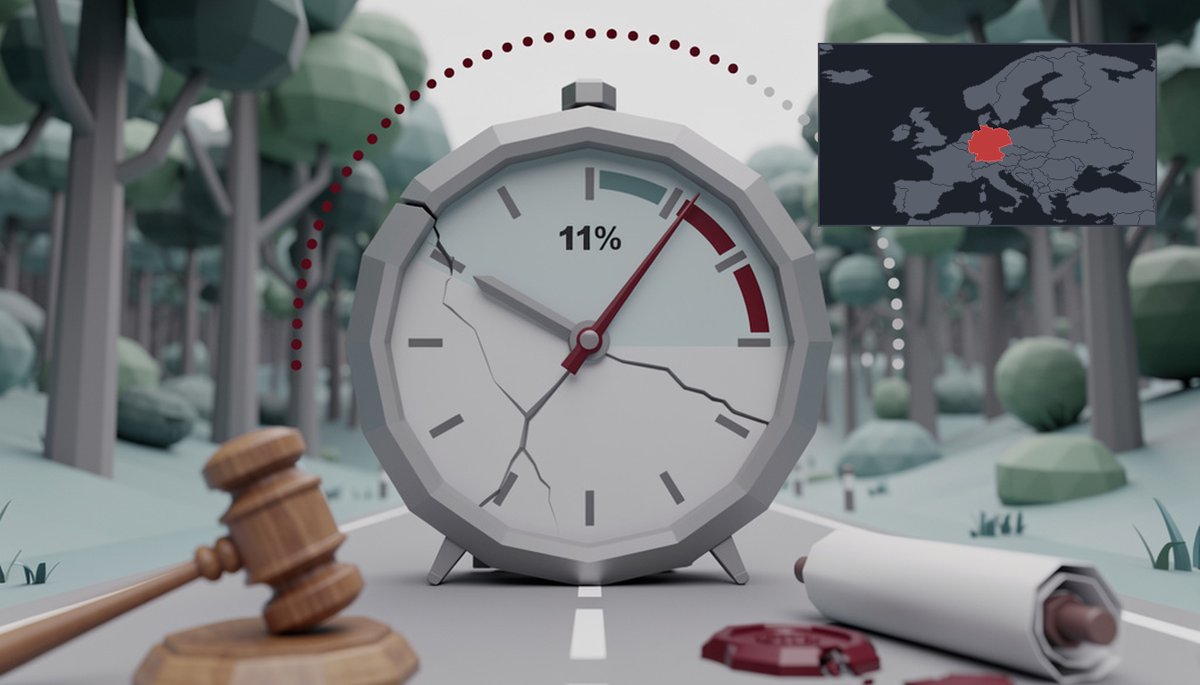
A German court has handed EV buyers a notable piece of leverage: if an electric car's real range falls materially short of the figure on the spec sheet, that can be grounds to walk away from the purchase entirely.
The ruling
The Regional Court of Wuppertal (Landgericht Wuppertal, case 10 O 282/23) found that an electric car whose actual range deviates significantly from the manufacturer's official WLTP figure has a material defect (Sachmangel) — and that this entitles the buyer to rescind the sales contract. In effect, the court treated the advertised WLTP range not as a soft marketing estimate but as a legally binding part of what the buyer paid for.
The case behind it
The dispute centred on an electric car bought for €39,000, advertised with a WLTP range of 332 to 341 km. A court-appointed expert put the vehicle on a test bench and measured only 282 km — roughly 18% below the manufacturer's stated figure. That gap was enough for the court to side with the buyer.
The ten-percent line is not arbitrary. As the German automobile association ADAC notes, the court leaned on established Federal Court of Justice (BGH) case law covering fuel overconsumption in combustion cars, where a deviation of more than 10% from the stated figure has long been treated as a substantial defect. The Wuppertal court simply applied the same threshold to electric range.
Why this matters for European Tesla owners
Tesla advertises WLTP range figures across Europe just like every other manufacturer, and real-world range routinely lands below the lab number — especially in winter, at motorway speeds, or with a heat pump working hard. This ruling does not mean any winter range dip is a defect. The relevant comparison is against the standardised WLTP test, not against a cold-morning commute, and the threshold is a sustained shortfall above 10% — an 18% gap measured under controlled conditions, as in this case.
A few practical takeaways for buyers in Germany and, by extension, markets that watch German consumer-law precedent:
- The spec sheet is a promise. A manufacturer's WLTP figure can be held to as a guarantee, not dismissed as an estimate.
- Document early. If you suspect a serious shortfall, gather evidence — consistent measurements, ideally independent testing — rather than relying on a single bad trip.
- The bar is high. This was an 18% lab-verified gap, not the everyday 10–20% real-world variance most EVs show against WLTP in mixed driving.
The decision is a regional-court ruling rather than a Federal Court of Justice judgment, so it is not yet binding nationwide. But by anchoring itself to existing BGH consumption case law, it gives EV buyers a clear, well-reasoned precedent — and puts manufacturers on notice that range claims carry legal weight.