
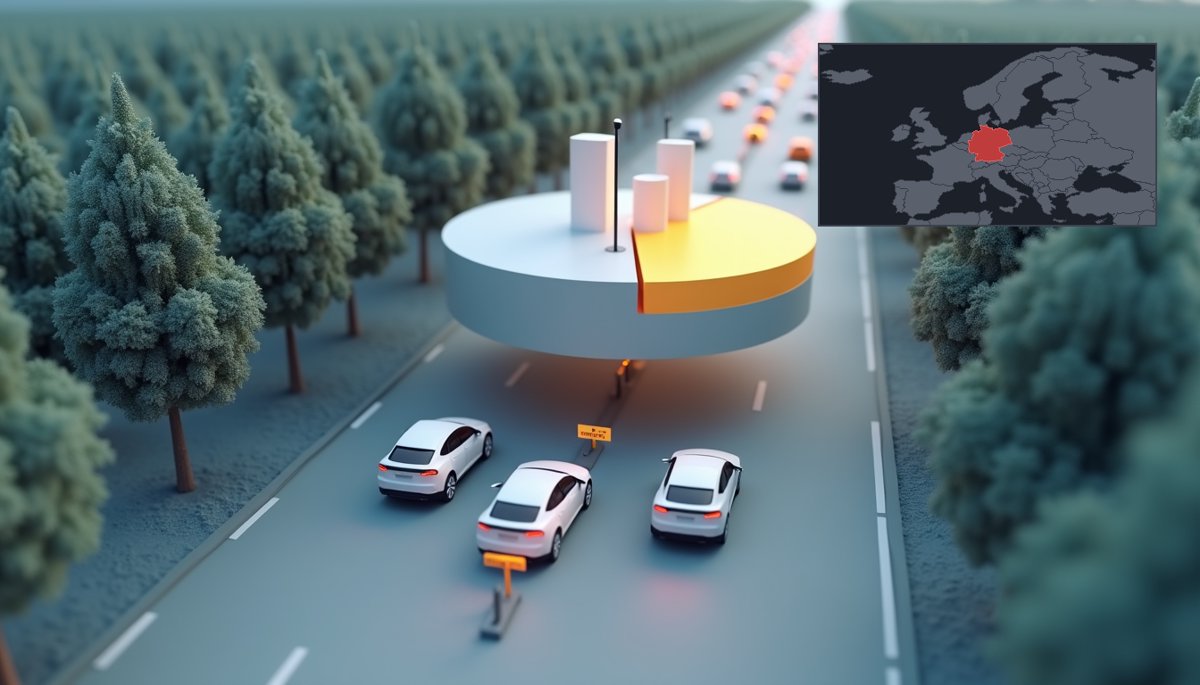
Battery-electric cars held their ground across Europe's core markets in May 2026, new registration data shows, with BEVs accounting for roughly a quarter of sales in both Germany and Austria even as the wider new-car market barely moved. The pattern is consistent across the figures released by national authorities this month: electric demand is growing while combustion sales stagnate.
Germany: Flat Market, Rising BEVs
Germany's Federal Motor Transport Authority (KBA) recorded 239,448 new passenger car registrations in May, essentially flat against the same month last year. Within that total, battery-electric registrations jumped 39.3% year-on-year to 59,969 units — about a 25% market share. The Škoda Elroq led the monthly BEV ranking, while the Tesla Model 3 climbed 13 places up the table. Among plug-in hybrids, which rose around 1%, the BYD Atto 2 took the top spot.
The growth coincides with Germany reopening its EV incentive portal in May, and it marks the country's fourth consecutive month of year-on-year new-car market growth. Tesla in particular has rebounded sharply: German registrations of the brand more than quadrupled in May, up about 315%, leaving it roughly 200% ahead for the year so far.
Austria Near Its Record
Austria told a similar story. The country registered 6,598 new electric cars in May, up 21.6% on the year, lifting the BEV share to 25.8% — just shy of the record set the previous month. As in Germany, electric demand is climbing against a backdrop of subdued overall registrations.
| Market | BEV registrations (May 2026) | BEV share | YoY change |
|---|---|---|---|
| Germany | 59,969 | ~25% | +39.3% |
| Austria | 6,598 | 25.8% | +21.6% |
A Mixed Picture Across Europe
The rest of the continent is more uneven. France posted another month of new-car registration gains, with battery-electric models doing much of the heavy lifting as the market recovers from a weak start to the year — though analysts caution that leaning so heavily on one powertrain carries its own risks. Spain, by contrast, saw a rare year-on-year downturn in May, its first since December 2025, as uncertainty over the shape of its EV incentives weighed on buyers.
What It Means for Tesla
For Tesla, the data reinforces the rebound already visible in its own European numbers. A 25%-plus BEV share in Germany and Austria means electric cars are now firmly mainstream in the markets where Tesla sells best, and the Model 3's climb up the German ranking suggests the brand is recapturing share as the broader segment grows. The bigger question is durability: with several countries still formalising or reopening incentive schemes, how much of May's strength reflects genuine demand versus buyers timing purchases around subsidies will only become clear in the months ahead.