
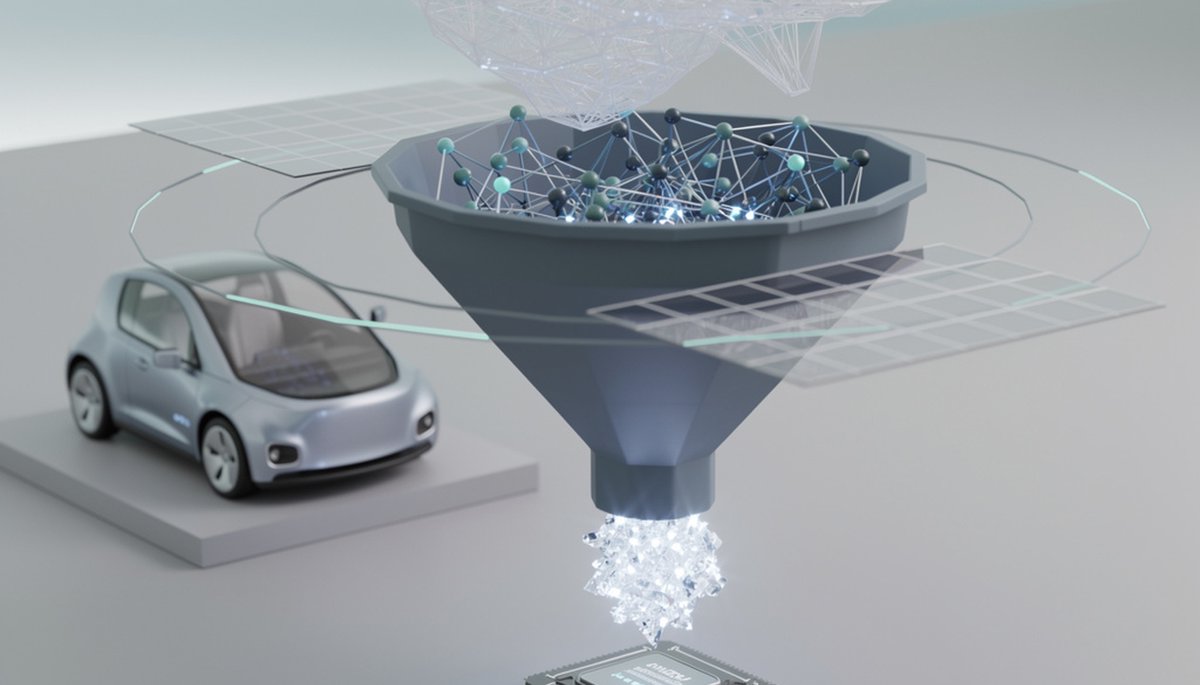
An exclusive report from Not a Tesla App says the Full Self-Driving software running on current Hardware 4 (HW4/AI4) vehicles is a scaled-down — or "distilled" — version of the heavier AI models Tesla develops first for its purpose-built Cybercab robotaxi. Tesla has not publicly confirmed the arrangement, so the specifics here are reporting rather than official disclosure.
How distillation would work
In machine learning, "distillation" is a well-established technique: a large, capable "teacher" model is used to train a smaller, faster "student" model that approximates the teacher's behaviour within a tighter compute budget. According to the report, Tesla develops FSD for the Cybercab's more powerful next-generation computer first, then distils it down to run on the slightly less powerful HW4 systems in today's production cars. The Cybercab's extra headroom gives Tesla a larger sandbox in which to build heavier, more complex networks that can later be streamlined for the rest of the fleet.
The HW3 parallel
If accurate, the approach mirrors what Tesla has already done further down the stack. FSD v14 Lite for older Hardware 3 (HW3/AI3) cars is itself a distilled version of the main v14 branch, trimmed to fit HW3's tighter compute and memory. The report frames the HW4 build as the middle rung of the same ladder: the Cybercab model at the top, an HW4 model distilled from it, and v14 Lite distilled again for HW3.
Why it matters for owners
For HW4 owners, the framing is encouraging. Being able to run a version of the very software Tesla is developing for driverless, commercial operation suggests HW4 is well positioned to progress toward higher levels of autonomy, rather than being left behind by the Cybercab program. It also implies HW4 cars benefit indirectly from every advance made on the flagship hardware, since the fleet model is derived from it.
The flip side is baked into the word "distilled." A student model is, by design, a compromise — lighter and faster than its teacher, but not identical in capability. If the fleet builds are distilled from the Cybercab, some ceiling on what HW4 (and especially HW3) can ultimately do relative to the purpose-built robotaxi hardware is implied.
The unconfirmed caveat
None of this is officially documented by Tesla. The report is credible and consistent with Tesla's known engineering approach — the company has openly discussed training larger models and shipping optimised versions to the fleet — but there is no published distillation roadmap, and the exact performance gap between the Cybercab, HW4, and HW3 models has not been disclosed. European HW4 owners, who are only now receiving FSD (Supervised), should read this as informed insight into Tesla's software strategy rather than a specification they can hold the company to.