
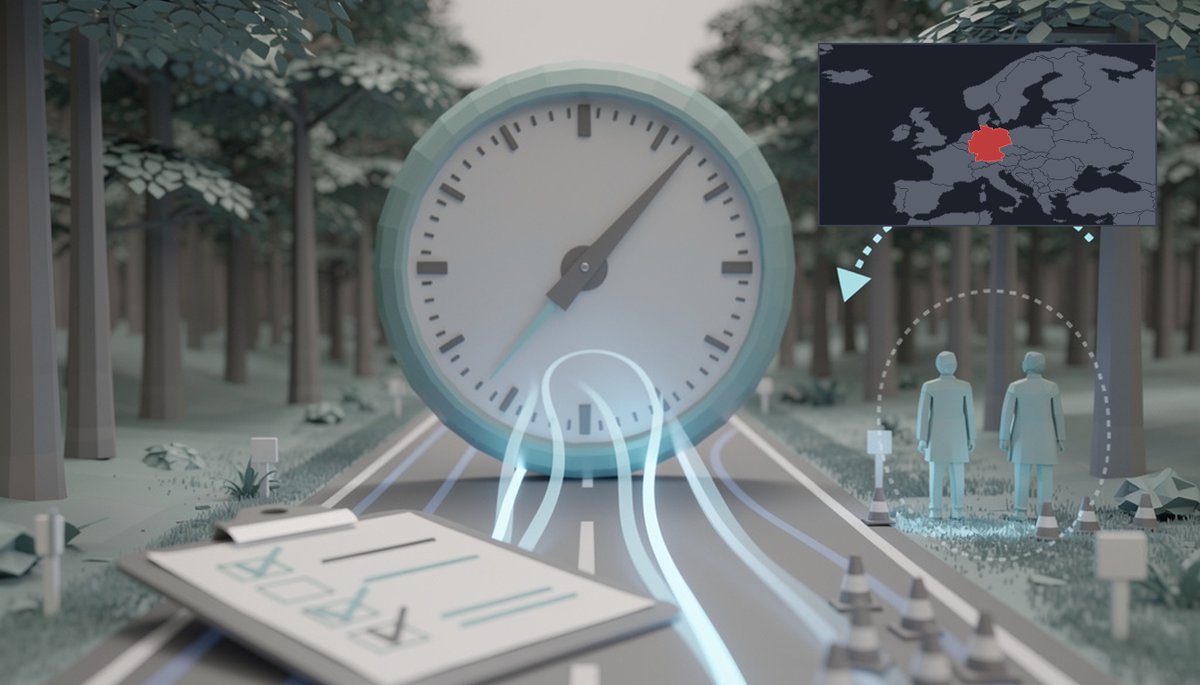
Germany Joins the FSD Approval Queue
Germany's Federal Motor Transport Authority (Kraftfahrt-Bundesamt, or KBA) is now reviewing Tesla's Full Self-Driving (Supervised) system, working alongside Tesla and the Dutch vehicle authority RDW. German outlet Teslamag reported this week that the KBA is preparing to test the system, and by 13 July 2026 the approval was said to be nearing its final stages. Tesla has not confirmed a firm date, however, and the timeline remains unofficial — so this should be read as an encouraging signal rather than a done deal.
How Germany Fits the European Picture
The German review does not start from scratch. On 10 April 2026, the RDW issued the first provisional EU type approval for FSD (Supervised), the result of roughly 18 months of testing and more than 1.6 million kilometres driven on European roads. Under the EU's mutual-recognition rules, other member states can adopt that provisional approval rather than re-run the entire process — which is what the KBA's review is deciding for Germany.
That framework has already produced a steady run of national decisions. The Netherlands went first, followed by Denmark and, in June, Belgium became the fifth European country to approve FSD. Finland and Italy are at earlier stages, while Czechia has said it will wait for the EU rather than recognise the Dutch approval outright. Germany, France and Italy were expected to be among the earliest large markets to act, potentially within four to eight weeks of the Dutch decision.
The Autobahn Problem
Germany carries a complication the earlier approvals did not: the unrestricted Autobahn. On derestricted sections, FSD could face vehicles closing from behind at 200 km/h or more, a scenario that stresses lane-keeping and rear-traffic awareness far beyond a typical 130 km/h motorway. The KBA is expected to insist on specific high-speed testing to confirm the system handles those closure speeds without phantom braking or hesitation before it signs off.
That caution matters because Germany is Europe's largest car market, and its regulatory verdict tends to carry weight with neighbouring authorities. A clean KBA approval would be a strong signal for the rest of the bloc; a demand for extra high-speed validation could equally slow the wider rollout.
What's Confirmed and What Isn't
It is worth being precise about the status. The RDW's provisional approval and the KBA's ongoing review are established facts. What remains unconfirmed is any official German go-live date: reports of an imminent approval trace back to trackers and community channels, not to a formal KBA or Tesla announcement. German owners hoping to switch FSD on should treat the "nearing approval" talk as promising but provisional until the authority publishes its decision. Given the Autobahn testing question, a few more weeks of validation would not be a surprise.
Update: 2026-07-22
On 21 July 2026, German Transport Ministry State Secretary Christian Hirte gave the first official word on the timeline, and it is more measured than community trackers had suggested. As Teslamag reported, Hirte said the KBA will receive a Tesla this month for its own hands-on evaluation of FSD (Supervised) — the first confirmation of the testing the authority had been preparing. More importantly, he stressed that Germany will not sign off on its own: a national type-approval decision will follow only after the EU's Technical Committee on Motor Vehicles votes on bloc-wide approval, a vote now expected no earlier than October 2026. That points to a realistic German go-live in the autumn at the earliest, tempering July's talk of imminent approval.