
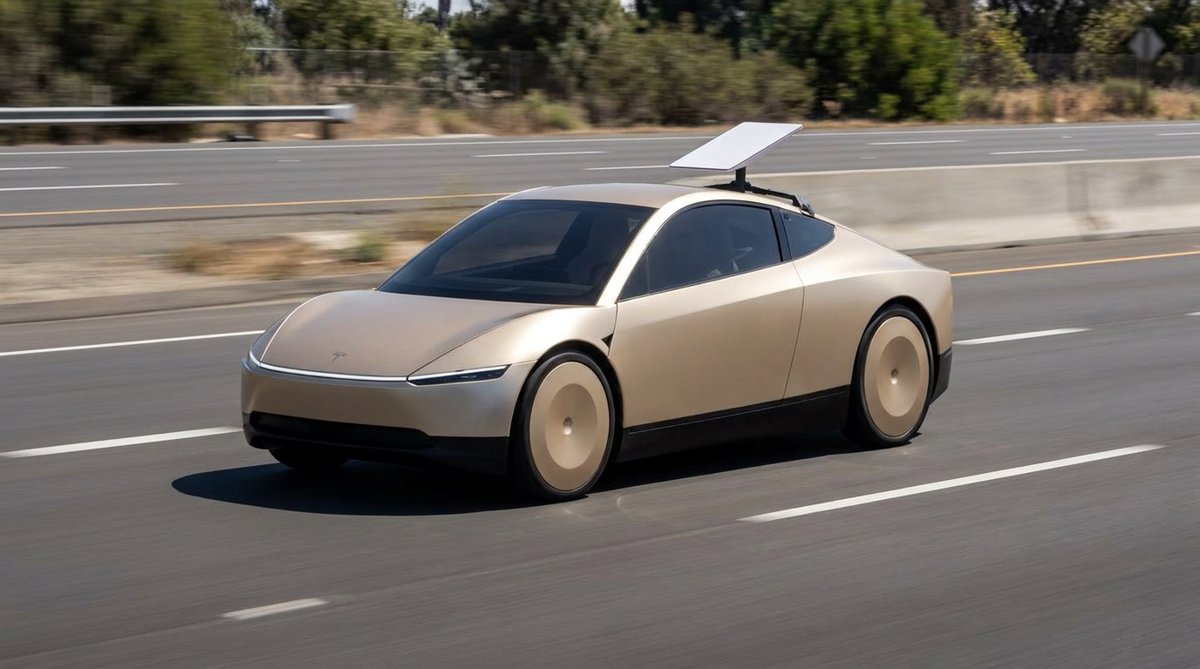
Tesla's purpose-built Cybercab robotaxi has been spotted on public roads with a Starlink Mini satellite terminal mounted on its rear liftgate. The pairing is the clearest signal yet that Tesla is engineering the Cybercab to fall back on SpaceX's low-earth-orbit (LEO) satellite network when terrestrial cellular coverage is missing or congested.
What was seen
The prototype was photographed during open-road validation testing in Texas. The Starlink Mini — SpaceX's portable, briefcase-sized terminal — was visibly bolted to the rear of the vehicle rather than concealed under bodywork. That suggests the integration is at the test-fixture stage rather than a production design, but the very fact that engineers chose to validate the radio path on a real Cybercab is a meaningful design decision.
The Cybercab is unusual: it has no steering wheel, no pedals, and no manual control surface of any kind. Reliability of the cellular link isn't a convenience question for a vehicle like that — it's a safety question. If the connection drops at the wrong moment, there is no fallback to a human in the driver's seat.
Why Starlink makes sense
Three use cases line up with what's been seen:
- Teleoperator hand-off. When the autonomy stack encounters a scene it can't resolve, a remote human supervisor needs to see the camera feeds and issue guidance. Tesla's own NHTSA filings confirmed earlier this month that two Austin Robotaxi crashes happened during teleoperator-driven manoeuvres, so this hand-off path is already live in production. A LEO link with low latency and broad coverage is a much stronger substrate for this than 5G — which can drop to nothing on rural roads or in dead zones around large buildings.
- Fleet data uplink. Every Cybercab uploads multi-camera video and event data back to Tesla's servers for offline training. Starlink throughput substantially beats LTE/5G in many testing locations, especially during off-peak hours.
- Coverage in cellular dead zones. A robotaxi cannot stop and ask a passenger for directions or a tether. Starlink fills the geographic gaps that operators like Waymo currently sidestep by limiting their service areas to dense urban grids.
What this doesn't tell us
The Starlink Mini is a test fixture, not a launch spec. A production Cybercab will not ship with a visible suitcase-sized dish on the boot lid. The longer-term question is whether Tesla integrates a flat-panel Starlink antenna into the vehicle body — work SpaceX has previously hinted at — or whether satellite is reserved as a fallback layer on top of cellular.
There is also no public confirmation from Tesla or SpaceX that the integration is permanent, that it will ship to consumers, or that the sub-$30,000 consumer Cybercab targeted for 2027 will include satellite connectivity at all. The Wikipedia entry for the Cybercab and Tesla's own product page remain silent on the topic.
EU implications
For European observers, the Cybercab itself is not on the near-term road map — Tesla has not begun Type Approval for a vehicle without manual controls in any EU member state. But the Starlink-as-fallback pattern is portable, and Tesla could realistically deploy it on Model Y and Model 3 vehicles running FSD Supervised once that system clears the EU regulatory hurdle. Patchy rural cellular in countries like Norway, Sweden, and northern Scotland is exactly the kind of coverage gap that LEO satellite is built to close.