
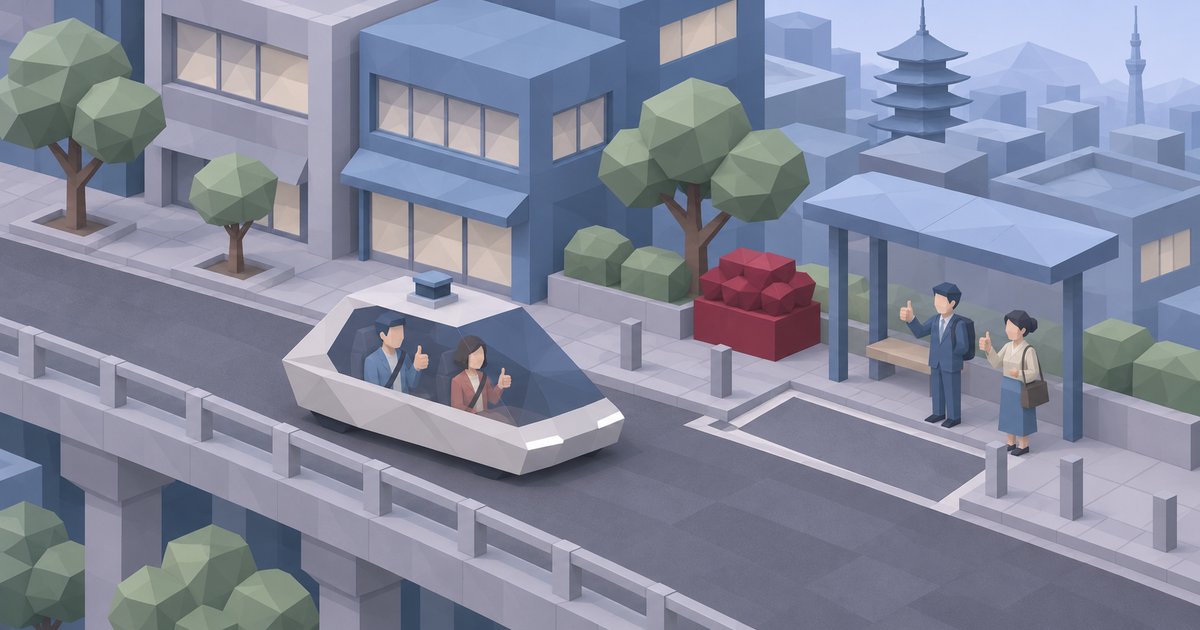
Japan will stop requiring a steering wheel and pedals on driverless cars. The Ministry of Land, Infrastructure, Transport and Tourism (MLIT) said on 4 November 2026 that it will amend the country's vehicle safety standards from December so that Level 4 and Level 5 vehicles without a steering wheel or brake pedal are certified uniformly, Nikkei reports. Until now, vehicles like that have been certified case by case.
MLIT presented the change to industry groups and other stakeholders at its Vehicle Safety Measures Review Committee the same day. The meeting was closed to the public, and the ministry says its materials go online after the meeting. None had been posted by 10:15 UTC.
What changes in December
| Until now | Vehicles produced from December | |
|---|---|---|
| Driverless cars without a steering wheel or brake pedal | Certified case by case | Certified uniformly under the safety standards |
| Steering wheel | Required | Not required for Level 4 and Level 5 |
| Lane-departure warning, rear-view mirrors | Required | Not required for Level 4 and Level 5 |
Level 4 means fully automated driving under defined conditions, such as a set area; Level 5 means fully automated driving everywhere. The rule falls under Japan's Road Transport Vehicle Act.
The change follows the UN. According to Nikkei, the standard for vehicles without such controls was agreed in June at the UN's World Forum for Harmonization of Vehicle Regulations (WP29) and is expected to become an international standard in December, so Japan will apply it to vehicles produced from that month. In June, TeslAnt reported that the same forum had adopted the first global regulation for automated driving systems.
The government's target is 10,000 Level 4 buses and taxis by the 2030 fiscal year. Nikkei expects the change to give carmakers more design freedom and help mass production. Waymo plans to start robotaxi service in Japan in 2027 with bZ4X robotaxis built by Toyota.
Why it matters for Tesla
The Cybercab, Tesla's two-seat robotaxi, has no steering wheel and no pedals. It was shown in Tokyo, Osaka and Nagoya in September on an Asia-Pacific display tour, parked and roped off. Tesla has announced no plans to sell or operate it in Japan.
The committee also discussed setting up a working group on an "excellence certification" for "Level 2++" cars, which drive with almost no input from the driver, according to Nikkei. It gave no criteria or timetable. Tesla's FSD (Supervised) is a Level 2 system of that kind. Tesla Japan's president said in October that the company still aims to launch it in Japan in 2026, but that the decision is not Tesla's alone.
Where Europe stands
Japan's change covers Japan only. WP29 is also the UN forum whose regulations underpin European type approval, but Nikkei's report says nothing about other countries. In Europe, the Cybercab begins a 12-stop display tour in Zürich on 5 November. Tesla's supervised system is approved country by country; Latvia became the tenth EU country on 26 October.
Update: 2026-11-05
MLIT has since posted the committee's materials, and they give the details Nikkei lacked. A working group of four experts, with industry and government observers, will draft a certification for "L2++" cars by March 2027 (MLIT document 5). MLIT defines these as cars whose AI-based assistance needs almost no driver input on motorways and ordinary roads, with the driver still watching. Carmakers apply; MLIT lists certified models on its website and can withdraw a certification. The criteria cover driving performance, safeguards against over-trust and misuse, and how the maker maintains and improves the function. Public consultation follows in March 2027 and promulgation in June, and applications open when the scheme takes effect in October 2027. In December 2026 Japan will also adopt the latest revision of UN Regulation 171. It allows hands-off driving on multi-lane roads with a central divider and no intersections or crossings, and lane changes without the driver's approval on ordinary roads if gaze monitoring is fitted (MLIT document 3-4).