
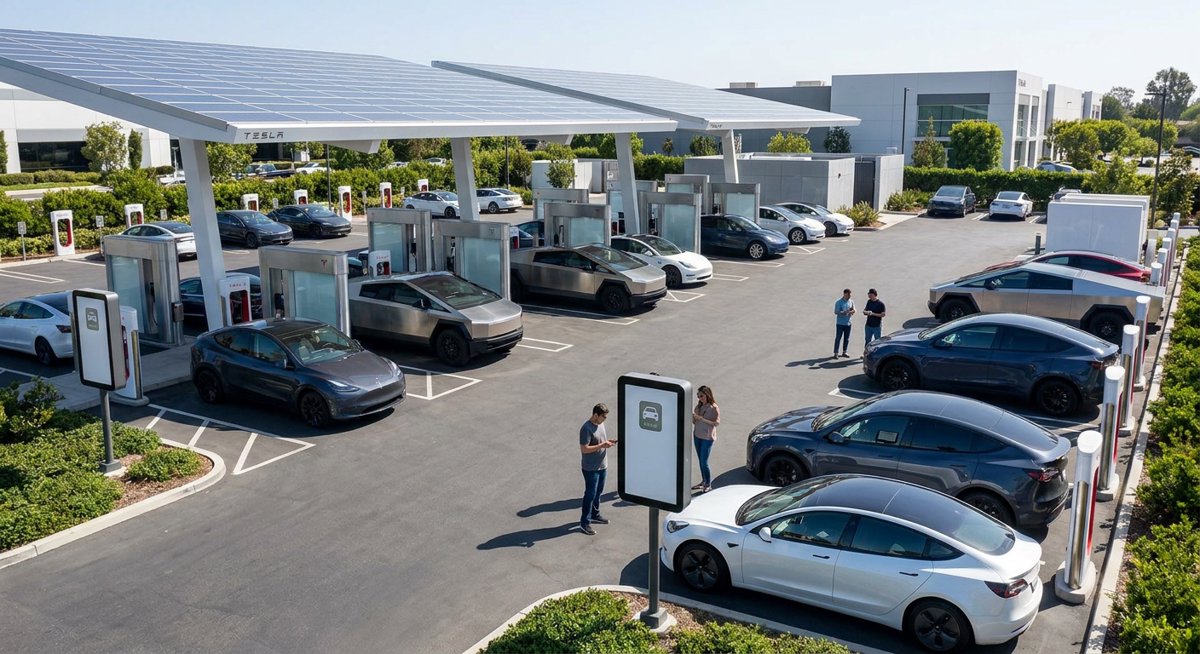
Tesla is making its first public move to fix the queuing problem at busy Supercharger sites. A software-based Virtual Queue feature, in internal testing since summer 2025, is going into a public beta in the last week of May 2026 — confirmed by the official Tesla Charging account on X. Tesla App Updates and community member Meriam Al Sultan documented an early real-world run at the Saratoga Avenue Supercharger in San Jose, California, with photos and a short video shared on 18 May 2026.
How the Virtual Queue works
The Virtual Queue is purely software — no physical barriers, no ground markings, no separate marshal. When every stall at a Supercharger site is occupied, the car shows a status-bar prompt inviting the driver to join a digital waitlist. Once joined, the centre screen displays the driver's position in line and an estimated wait time. iOS users see the same position and ETA live on their lock screen via a Live Activity widget, so they can stay in the cabin with climate on, or walk to a nearby café, without missing their turn.
When a stall opens up, the next driver in line gets a 3-minute countdown timer to claim the spot, with an option to extend by 30 seconds if they need a moment to drive over. If the timer expires without the car reaching a stall, the system moves on to the next person in line.
The line-cutting problem
The first real-world test surfaced the feature's biggest weakness right away. Al Sultan reported eight separate cases of drivers who simply rolled up and plugged in without joining the queue at all — most likely because they had no idea the Virtual Queue existed. The current beta has no enforcement mechanism: stalls are not reserved by VIN allow-list, and the car or charger can't refuse a session for a driver who isn't next in line. When a line-cutter takes a stall, the system silently bounces the waiting driver back to the top of the queue, with no notification or penalty for the offending vehicle.
That's a meaningful limitation for the rollout to work at scale. Without a hard interlock — Supercharger refusing to start a session for a non-queued VIN, or the stall holding a 30-second grace window for the queued car — the Virtual Queue depends entirely on driver awareness and good faith.
Where it's being tested
Tesla picked five high-traffic sites in the United States for the initial trial, including locations in California and New York. The Saratoga Avenue site in San Jose is one of the documented ones. The selection clearly targets sites where peak-hour overcrowding is a daily fact rather than an edge case.
Why it matters for the broader network
Tesla now processes more than 50 million charging sessions per quarter across roughly 80,000 Supercharger stalls worldwide. As NACS adoption brings more non-Tesla vehicles onto the network — including in Europe, where Tesla has opened a growing share of sites to other brands — peak-hour congestion at popular sites is becoming structural rather than occasional. The company has also been deploying AI-powered forecasting to predict congestion patterns, but a queuing mechanism is the missing piece for handling the contention that forecasting can't avoid.
The European Supercharger network is not in the initial test set, but Tesla has historically rolled charging-app features globally after a US beta. Owners in dense corridors — the German autobahn, the French Riviera summer routes, the Dutch motorways — are the next obvious audience if the enforcement and onboarding issues from the US beta get resolved.
What to watch next
The immediate test for the public beta is whether Tesla can add a stall-side or session-start interlock that turns the queue into a real ordering mechanism, rather than an opt-in courtesy. The company has not commented on whether enforcement will arrive as part of the same Supercharger firmware push or in a later update.