
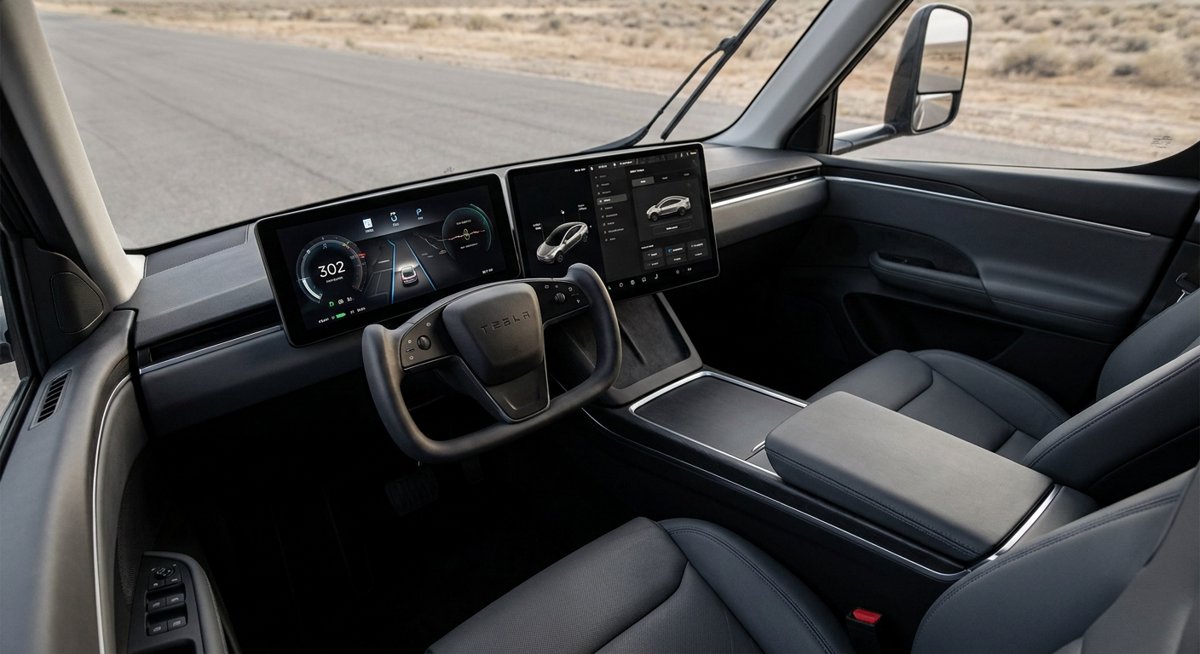
Tesla has been adamant for over a decade that one big touchscreen is all a Tesla driver needs. The production Tesla Semi quietly breaks that rule. Cabin footage shared by Tesla enthusiast David Moss on X on 5 May 2026, after riding in the truck, shows a two-display layout designed specifically for commercial fleet driving — and it looks more like a heavy-duty truck cockpit than a Model Y interior.
What each screen does
The cabin uses two large displays flanking the driver's central seat. The left display is a dedicated instrument cluster — trip metrics, vital vehicle system indicators, mechanical status, and a high-fidelity parking visualisation that David Moss described as matching the fidelity of the Unreal Engine-based renders in current passenger Teslas, but tuned for industrial fleet navigation.
The right display handles the rest of the cabin: navigation, climate controls, the settings menu, and media apps including Apple Music and Spotify. It is, in essence, the centre screen of a Model 3 or Model Y, but moved to the side of the cockpit so the driver sees the road over the steering wheel, not over an entertainment surface.
How it differs from a passenger Tesla
The Semi's two-screen layout is the first time Tesla has shipped a separate, dedicated instrument cluster since the original Model S facelift removed it. Several smaller design choices follow from that split:
- The dock layout is vertical, not horizontal. The Semi runs mirrored vertical docks down the outside edge of each display — easier for a driver in a fixed upright commercial seating position to reach without leaning forward.
- There are quick-access controls for overhead deck lights, digital seat height adjustment, and the digital side-mirror camera feeds.
- The truck has a dedicated physical button for heated mirrors, giving the driver independent control. In passenger Teslas, heated mirrors are grouped under the rear-defroster control and can't be triggered without the defrost cycle.
These aren't small detail differences. They're the kind of fleet-driver-driven decisions you'd expect from a class 8 truck, and they signal that Tesla's interior design language can flex when the use case demands it.
Production status
Tesla kicked off high-volume Semi production at its Sparks, Nevada facility on 18 May 2026, targeting 50,000 electric class 8 trucks per year at full ramp. The Sparks line is co-located with the existing Gigafactory Nevada complex and is the first time Semi has moved past pilot-line manufacturing — earlier units, including the trucks running with PepsiCo since 2022, came off a low-volume line at the same site.
Why this matters for European fleet operators
The dual-screen layout matters for European homologation. EU heavy-vehicle type approval under UN-ECE Regulation 79 (steering) and Regulation 121 (controls) prefers dedicated instrument clusters with primary vehicle data visible without the driver shifting gaze laterally. A single touchscreen approach has been a recurring point of friction for Tesla's passenger cars in EU certification reviews; a Semi cockpit with a left-side instrument cluster is a much more conventional shape for European certifiers to evaluate. With Tesla still working through Type Approval for Semi in the EU — no Semi has yet been homologated for European road use — this kind of conventional layout reduces the regulatory delta and should shorten the path to certification once Tesla files.
What this signals
The Semi's cockpit shows Tesla willing to break its own UI orthodoxy where the use case is sufficiently different from the passenger lineup. Whether that flexibility carries over to other commercial products — the long-rumoured Robovan, or fleet variants of Model Y for the Robotaxi service — is now a more open question than it was six months ago.