
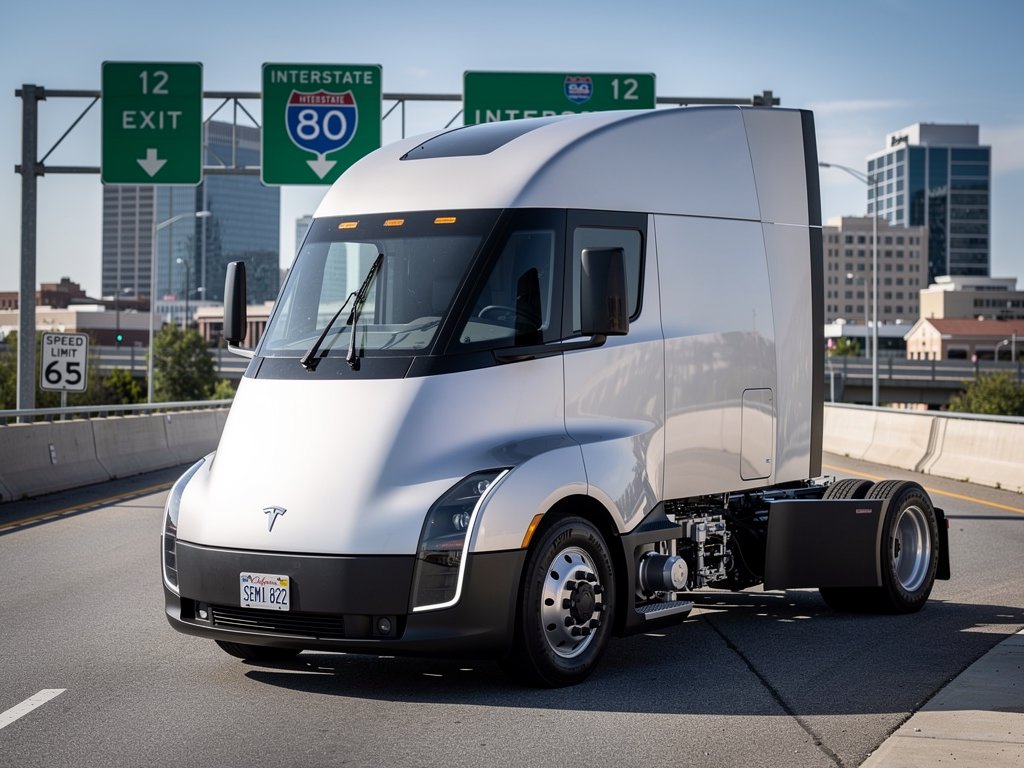
A California Air Resources Board (CARB) executive order signed on 15 April 2026 has officially confirmed the Tesla Semi's two battery configurations, ending more than three years of speculation about how much energy each variant actually carries. The Long Range trim ships with an 822 kWh usable pack; the Standard Range trim carries 548 kWh (Electrek, Teslarati, Not a Tesla App).
What the Filing Reveals
CARB Executive Order A-374-0095 is the formal certification document that has to exist before the truck can be sold for use on California roads, and it lists battery specifications in terms the regulator can audit. Both Semi variants share Tesla's NMCA (nickel-manganese-cobalt-aluminium) lithium-ion chemistry and the 4680 cell format that the company also uses in the Cybertruck and the latest Model Y builds. The Standard Range pack is effectively the Long Range pack with one of three parallel battery modules removed — a clean 33% reduction that maps almost exactly onto the 822-to-548 kWh ratio (Inside EVs).
| Trim | Usable Battery | Chemistry | Cell Format | Tesla Range Target |
|---|---|---|---|---|
| Long Range | 822 kWh | NMCA | 4680 | 500 mi (~805 km) |
| Standard Range | 548 kWh | NMCA | 4680 | 325 mi (~523 km) |
Applied to Tesla's own published efficiency figure of roughly 1.7 kWh per mile at full 82,000 lb gross combination weight, those packs land at about 480 miles real-world for the Long Range and about 320 miles for the Standard — both within touching distance of the headline numbers Tesla has been quoting since the 2017 unveil (Drive Tesla Canada).
Why Two Trims, and Why Now
The two-trim split is the only way Tesla can give long-haul fleets a 500-mile workhorse without forcing regional and port operators to pay for energy they will never use on shorter routes. A 548 kWh pack is still roughly five times the size of a Model 3 Long Range battery, but it cuts kerb weight by an estimated 1.8 tonnes versus the Long Range — useful payload back for a tractor unit that already gives up weight to its battery.
The disclosure also lines up with the start of volume production. The first Semi off the high-volume Gigafactory Nevada line rolled out on 30 April 2026, ending a multi-year pilot phase, and CARB needed a finalised production-spec filing in place for that to legally happen.
What This Means for Europe
Tesla has not yet committed to a European Semi launch, and the 82,000 lb / 37-tonne gross combination weight the CARB filing refers to does not align with EU tractor-unit norms, which top out closer to 40 tonnes and use different regulatory categories. But the underlying numbers are the most useful data point European fleet planners have had to date: an 822 kWh truck operating at ~1.7 kWh per mile becomes a credible competitor to Renault Trucks E-Tech T, Volvo FH Electric, and the upcoming Mercedes-Benz eActros 600 the moment Tesla decides to type-approve it for European roads. With Daimler, MAN, and Volvo all now shipping 500+ kWh long-haul electric tractors, the Semi's spec sheet no longer looks exotic — it looks like the segment baseline.