
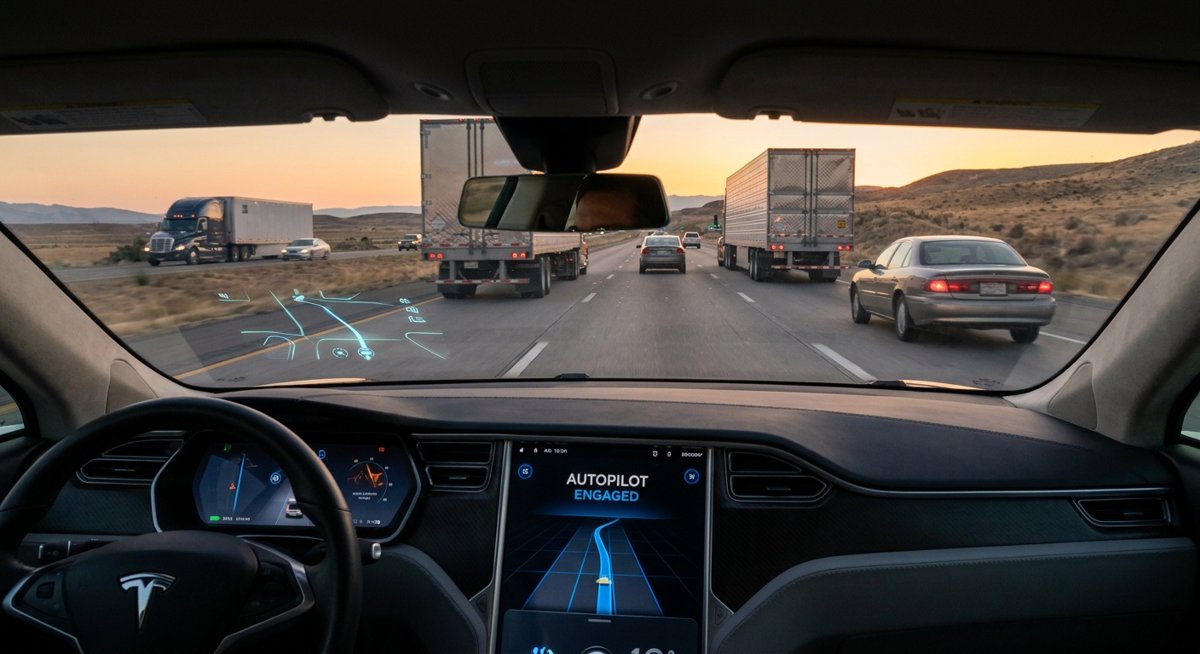
Elon Musk used a Monday 18 May 2026 appearance to put new dates on Tesla's Robotaxi rollout. He said fully self-driving Tesla vehicles operating without a human safety monitor in the cabin will become "more widespread" across the United States later this year, and that, pending regulatory approval, the service should cover "roughly a quarter to half of the US population" by the end of 2026.
It's an aggressive target, and not a brand-new one — Musk made a similar projection in July 2025, telling shareholders Robotaxi could "probably" reach half the US population by year-end 2025. That target slipped. The May 2026 restatement keeps the same shape of the goal but slides it forward by twelve months.
Where the service stands today
Tesla currently runs fully unsupervised Robotaxi service — no driver, no in-cabin safety monitor — in three Texas cities: Austin, Dallas, and Houston. The Dallas and Houston launches went live in mid-April 2026 and were the first US cities outside Austin to get the no-monitor variant.
The Austin operation expanded into night rides on 4 May 2026, and the unsupervised fleet has grown to 29 Model Ys serving the city. A larger staging operation of 60 Robotaxi-equipped Model Ys was spotted in Phoenix in early April 2026, ahead of a launch there.
The seven-city H1 target
Tesla's published H1 2026 plan names seven additional cities for Robotaxi launches in the first half of the year: Dallas, Houston, Phoenix, Miami, Orlando, Tampa, and Las Vegas. Dallas and Houston are already live; Phoenix is staged. The remaining four — Miami, Orlando, Tampa, Las Vegas — are the open commitments for the May–June window.
Musk's Monday remarks reframed the goal in terms of population coverage rather than city count. Reaching "a quarter to half of the US population" by year-end implies launches well beyond the seven-city Sun Belt list, presumably into the larger metros where local regulators have so far been less welcoming.
Software changes underway
A decompile of the Robotaxi app version 26.4.5, published by Tesla App Updates on 16 May 2026, suggests the operational backend is being upgraded alongside the city rollout. The new build adds remote-operator voice calls (passengers can talk directly to Tesla teleoperators through the cabin microphone), proactive remote assistance that monitors ride conditions and offers help without being asked, multi-stop ride dispatch, rider-controlled cabin settings from the smartphone app, and a high-security "kill switch" that lets Tesla completely disable a vehicle's driving capability remotely. The build also adds a manual override path for fleet operators on the steering-wheel-less Cybercab, limited to speeds under 2 mph for safety.
These are operations-and-safety features rather than autonomy improvements — they fit the picture of a company scaling driverless service rapidly and putting the human-oversight layer where the safety monitor used to sit.
How realistic is the target?
The gap between today's footprint (three live cities, ~29 unsupervised vehicles in Austin) and "a quarter to half of the US population" is wide. The US has roughly 340 million people; covering even 25% means a network across most of the top 10 metros. Texas has been workable because the state has effectively permissive autonomous-vehicle rules; California, New York, Illinois, and Washington all carry tougher local regimes that have slowed competitors like Waymo and Zoox.
Musk's prior similar projection in July 2025 missed by enough that it's worth flagging this one as an Elon timeline claim rather than a confirmed schedule. The confirmed facts as of mid-May 2026 are: three cities with fully unsupervised service, a 29-vehicle Austin fleet, seven cities targeted for H1 launches, and a software backend (app v26.4.5) being upgraded to support scale.
European angle
Musk made no commitments on a European Robotaxi launch in the Monday remarks. FSD Supervised is still being prepared for UNECE Type Approval, and unsupervised service in the EU would require a separate regulatory path that Tesla has not yet publicly opened. European owners watching this rollout should treat the US population-coverage target as a US-only commitment for now.