
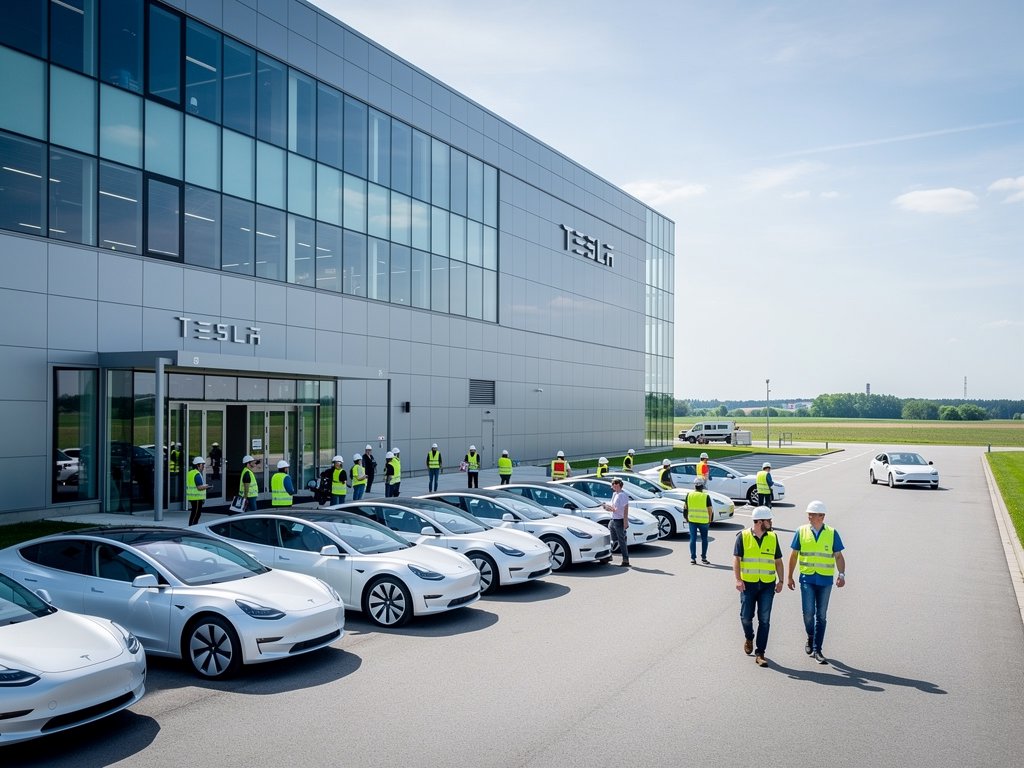
Tesla's European factory is shifting from cost discipline to capacity expansion. Giga Berlin's senior director of manufacturing confirmed on 23 April 2026 that the Grünheide plant will begin recruiting approximately 1,000 new employees in May and convert 500 existing temporary workers to permanent contracts. The goal is to raise Model Y production by around 20% starting in the third quarter of 2026.
This is the largest single hiring round at Giga Berlin since the plant opened in March 2022 and a sharp reversal from the workforce reductions of late 2024 and early 2025.
The Numbers
| Metric | Current | Target |
|---|---|---|
| Giga Berlin workforce | ~11,500 | ~12,500 (+9%) |
| New hires | — | 1,000 (from May 2026) |
| Temporary → permanent conversions | — | 500 |
| Weekly Model Y output | Baseline | +20% from Q3 2026 |
| Target completion | — | End of June 2026 |
Beyond the immediate 1,000 hires, Tesla has also opened a search for several hundred additional workers for battery cell production, which is scheduled to start in the first half of 2027.
What Triggered the Reversal
The catalyst is European demand. Model Y registrations across the continent jumped to 33,723 units in March 2026 — a 117% year-over-year increase that put the car back at the top of Europe's bestseller list for the first time in months. Germany alone saw Model Y registrations quadruple year-over-year to 9,252 units.
For the first quarter overall, Tesla registered 78,336 vehicles in Europe, up 44.9% year-over-year, capturing around 10.8% of the EV market. That momentum reverses the steep decline Tesla experienced across major European markets in 2025, when registrations in Germany fell more than half at their lowest point.
Giga Berlin is also the only Tesla factory in Europe, making it the sole source of locally-built Model Y for the continent. Any production increase translates directly into shorter delivery waits and reduced dependence on imports from Shanghai.
How Fast Can 20% Actually Ramp?
The announced target of "20% more weekly production from the third quarter" is a meaningful jump but not an implausible one. Giga Berlin's nameplate capacity is 5,000 cars per week, while recent output has been well below that — reported at around 3,000 to 3,500 cars per week in early 2026. A 20% increase on a roughly 3,000-per-week base pushes output toward 3,600–3,800 per week, still comfortably inside the theoretical ceiling.
The practical constraints are logistics and supplier ramp rather than factory floor. The new hires are concentrated in general assembly and paint — the two areas that typically bottleneck when Tesla accelerates output. Training cycles at Giga Berlin have historically run 6 to 10 weeks, which aligns with a hiring start in May and a productive cadence by July.
European Context
The Giga Berlin expansion lands alongside two other signals from Tesla's Q1 2026 earnings call on 22 April: doubled referral rewards in Europe, and confirmation that Model Y remains the priority for incremental demand-side investment. Whether the 20% ramp is sustainable through the second half of 2026 depends heavily on whether March's demand momentum holds — something the April and May registration numbers will answer in the coming weeks.
Update: 2026-06-22
In mid-June 2026, with the ramp due to begin, Giga Berlin plant manager André Thierig reaffirmed that Grünheide will lift Model Y output by roughly 20% from July. The factory is now running at around 5,000 cars a week, well above the ~3,000-3,500 baseline reported in spring, and built more than 61,000 Model Y in the first quarter of 2026, a plant record. German outlet Teslamag puts the July target at about 6,200 cars a week, which would push sustained weekly output past 6,000 for the first time as recovering European demand absorbs the additional volume.
Update: 2026-06-25
On 25 June 2026, Tesla confirmed a second round of expansion at Grünheide: roughly 1,000 more hires and a further 20% output step, targeting 7,500 vehicles per week from October — up from the ~5,000 a week the plant now runs and the ~6,200 July first-phase target. Tesla again cited recovering European Model Y demand after a weak 2025. Across both phases and battery work, the full plan is expected to add around 3,500 jobs in total. The move makes Grünheide's ramp a two-step climb rather than the single 20% increase announced in April. Sources: Electrek, Teslarati, Not a Tesla App.