
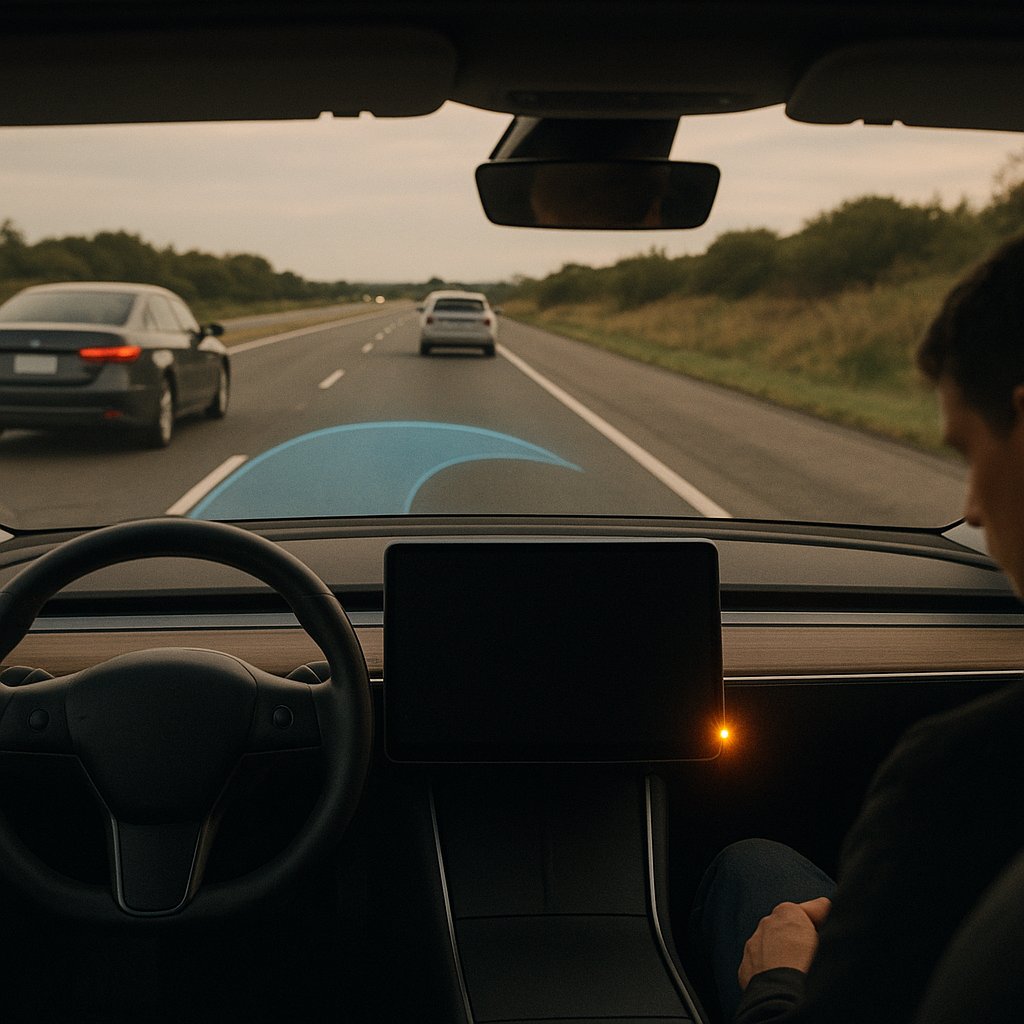
Tesla's Full Self-Driving (Supervised) v14.3 changes one of the most criticised pieces of behaviour in the previous releases: what the car does when the driver stops paying attention. Rather than slowing to a stop in the live lane after a string of unanswered nag warnings, the car now actively scans the road ahead for a safe pull-over spot and parks itself there.
What changed in v14.3
In earlier FSD versions, the cabin camera and steering-wheel torque sensor would trigger escalating attention alerts. If the driver still didn't respond, the car would simply slow down and stop in whatever lane it was in. That kept the car from continuing unsupervised, but it created a different hazard — a stationary Tesla in a moving lane of traffic, with no hazard lights and no shoulder.
With v14.3, the response sequence is much closer to what a human driver would do in a medical emergency. Once attention alerts go unanswered, the car looks for a safe pull-over location — typically the right shoulder, a parking lane, or the next exit ramp — and only stops once it has parked safely off the active travel lane.
Strike system relaxed
The second meaningful change is to the FSD "strike" lockout. Historically, a single inattention strike ended FSD for the remainder of the drive. To reset, the driver had to stop the car, put it in park, exit the vehicle, and start a fresh trip.
With v14.3, the system still issues a strike and updates the visible strike count once the car has parked. But the driver can now simply put the car back in drive and re-enable FSD immediately — no full vehicle restart required. Owners on community boards have noted that the original lockout was particularly punitive on long highway drives, where one accidental hands-off-too-long event could mean an hour or more of manual driving with no recourse.
Why the change matters for European owners
FSD Supervised remains gated in most EU markets pending regulatory approval, but the v14.x branch is the one Tesla is actively iterating to meet UNECE driver-monitoring expectations. The pull-over behaviour brings the system into closer alignment with what European Type Approval is likely to expect of an L2+ assist that depends on driver supervision: a graceful, non-hazardous fallback when the driver fails to take over, rather than an in-lane standstill.
The distinction matters because UNECE Regulation 157 and the upcoming L2+ assist framework both require that any driver-monitoring fallback ends in a "minimum-risk manoeuvre" — broadly, the car bringing itself to a safe state outside active traffic. A controlled pull-over satisfies that; a stop in a live lane does not.
Rollout status
FSD v14.3 is shipping in firmware 2026.14.x for HW4 (AI4) vehicles, with a v14-Lite variant in preparation for HW3 cars. NotATeslaApp notes that the pull-over change may have actually landed during the late v14.2 rollout and only become widely visible in v14.3 — community video evidence is the clearest demonstration so far.