
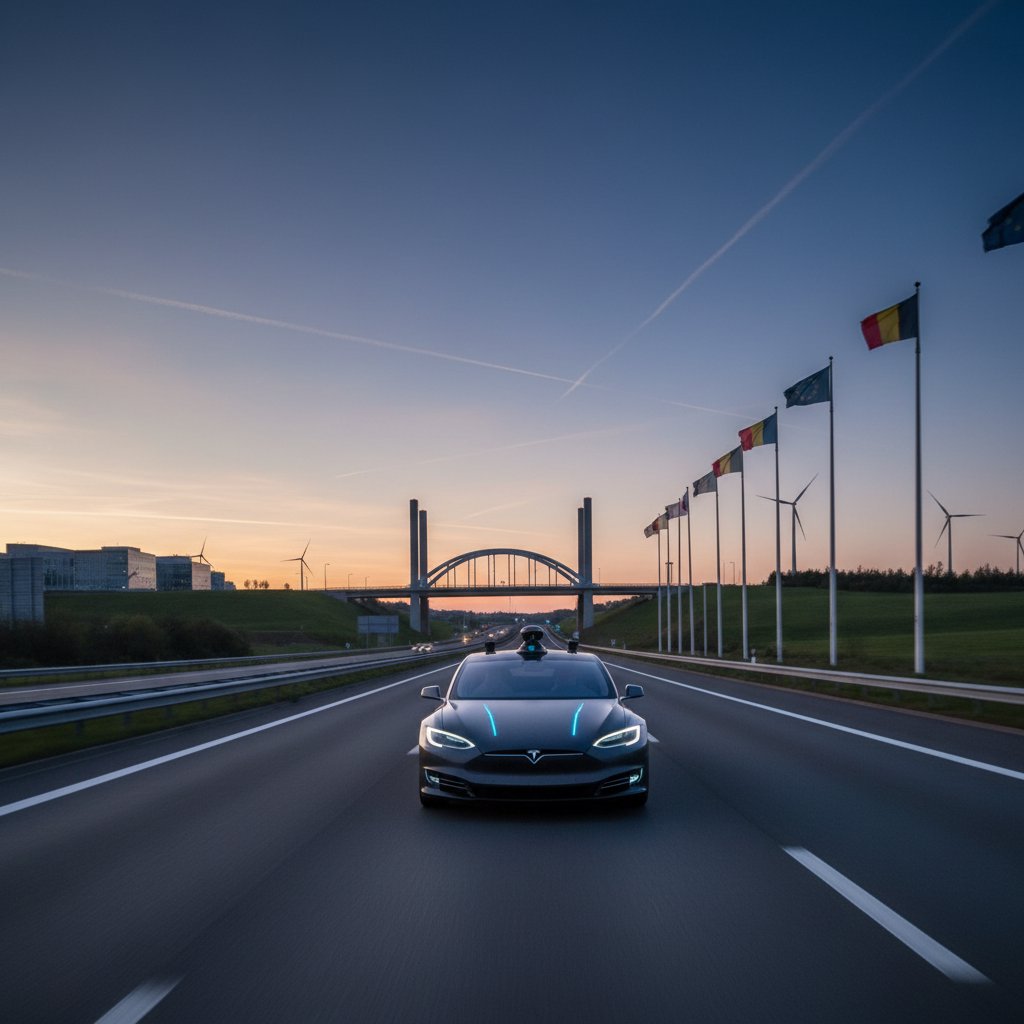
Belgium has become the second European Union country to authorise Tesla Full Self-Driving (Supervised) for testing on public roads. Flemish Minister for Mobility Annick De Ridder confirmed the approval after her administration completed an accelerated screening of Tesla's file in early May 2026.
How the Approval Came Together
De Ridder ordered the fast-tracked review at the start of May, instructing her administration to deliver an opinion on "rapid homologation" within a week. The accelerated screening looked at the Dutch RDW dossier that Tesla submitted in February 2026, plus traffic-safety data from Tesla's testing in the Netherlands since the Dutch type approval landed on 10 April.
The Flemish administration recommended that Tesla complete a limited round of additional in-country testing before homologation is granted. The reasoning is straightforward: Belgian road geometry, signage and lane discipline differ enough from the Dutch network that the screeners wanted live data on Flemish highways and urban roads before signing off on a final approval.
Tesla is now cleared to test on "at least one vehicle in Flanders" as part of that additional data-gathering phase. The federal Belgian authority will weigh the Flemish report alongside its own review before any production rollout can begin in the country.
What Tesla Brought to the File
Tesla used its weeks of approved testing in the Netherlands to compile a fresh evidence package for the Flemish review. The Dutch programme has now logged tens of thousands of supervised kilometres on motorways, urban roads and rural routes, with disengagement data that the company can show to other EU regulators. That body of data was the lever that allowed De Ridder to compress what would normally be a multi-month homologation file into a one-week screening.
It also helps that Tesla has been quietly running closed-course autonomous miles inside its own Berlin plant. The company has logged roughly 150,000 km of FSD operation on the Giga Berlin grounds, using the system to move new Model Ys from end-of-line to the outbound logistics yard. Those kilometres aren't on public roads, so they don't carry direct regulatory weight, but they let Tesla validate every software build against a European fleet before it goes out for road testing.
How Belgium Fits into the European Sequence
Belgium is the third domino in the Tesla FSD Europe story. The Netherlands cleared the system for series use on 10 April 2026. Sweden, Norway and Italy have authorised supervised testing under their own national rules. Germany and France remain in early dialogue with Tesla but have not yet opened a formal homologation file.
The broader EU question is being handled in parallel through the Technical Committee on Motor Vehicles (TCMV), which votes on cross-border type approval. A favourable TCMV vote in late June would let Tesla extend the Dutch approval to every EU member state. If that vote happens before Belgium finalises its national homologation, the EU-wide track would supersede it. If it slips, Belgium's national approval becomes the cleanest second path to a live production rollout.
| Country | Status (May 2026) | Source |
|---|---|---|
| Netherlands | Series approval (10 April) | RDW |
| Belgium (Flanders) | Supervised testing approved | Flemish Ministry of Mobility |
| Sweden | Supervised testing in Nacka | Transport Agency |
| Norway | Supervised testing | Norwegian authorities |
| Italy | Parliamentary push for fast-track | Ministry of Transport (pending) |
| Germany, France | Dialogue only | n/a |
What Belgian Owners Should Watch
A Flemish testing approval is not the same as the ability to buy or subscribe to FSD in Belgium. The current step lets Tesla run its own validation vehicles; consumer enablement waits for either federal homologation or a TCMV-wide green light. Owners who already paid for FSD outright still cannot enable the supervised feature set on Belgian roads until that further approval lands.
The practical timeline for activation is now a function of two parallel tracks. If the TCMV vote in late June is favourable, Belgian owners would be among the first beneficiaries of an EU-wide rollout. If the vote is delayed or split, Tesla and the Flemish administration's national track becomes the faster route, with activation possible later in summer 2026.