
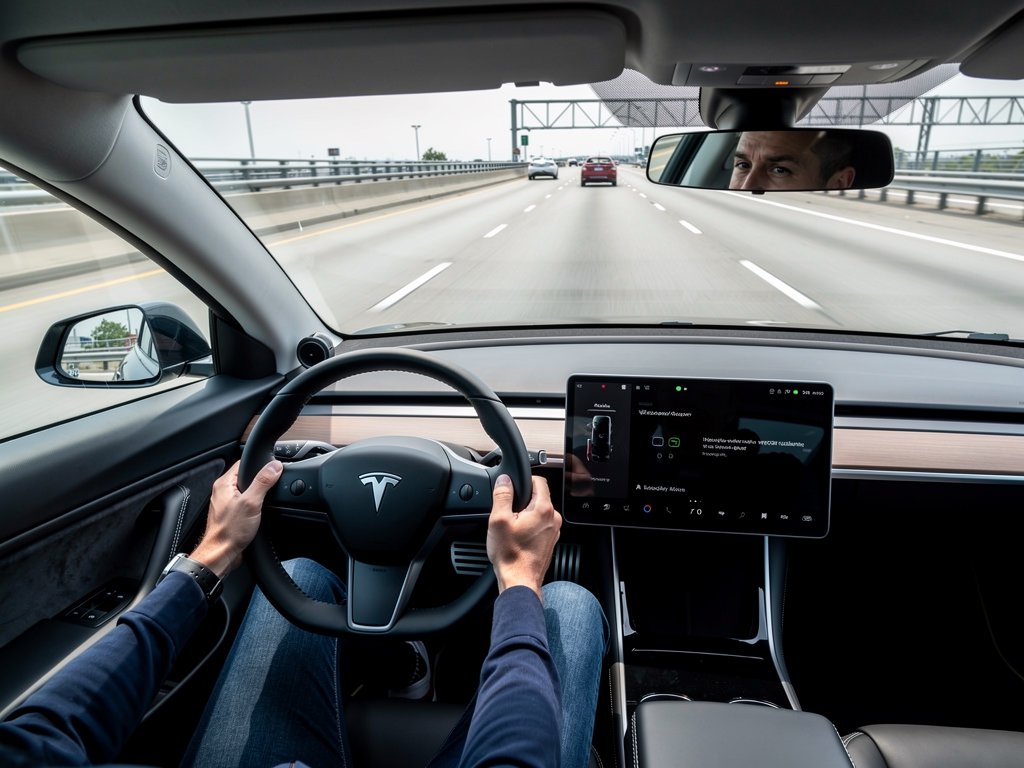
Tesla's Full Self-Driving fleet crossed ten billion cumulative miles on 3 May 2026, according to the company's public safety dashboard. The exact reported figure is 10,010,684,206 miles, of which 3,761,203,620 were driven on city streets — historically the harder, more contested half of the autonomy problem. The crossing matters because Musk himself made it matter: in January 2026 he publicly stated that Tesla needed roughly ten billion real-world miles to reach safe Unsupervised FSD.
The Number Behind the Number
The milestone is more about velocity than total. Tesla's safety page shows the fleet adding roughly 28.8 million miles per day in early May, up from about 14 million miles per day at the start of 2026. The acceleration is the direct result of FSD v14 expanding eligibility to more vehicles, the FSD Supervised launch in Europe and China earlier this year, and a higher take-rate in markets where the feature is now bundled with new orders. At current cadence, the fleet adds another billion miles roughly every five weeks.
Why Musk Picked Ten Billion
The ten-billion figure is not regulatory; it is Musk's own data-volume estimate for what the FSD model would need to reach the safety profile required for unsupervised operation. He had previously named six billion as the threshold during 2023 and 2024 commentary, and moved to ten billion in early 2026 after Tesla failed to deliver promised Unsupervised FSD by the end of 2025. The number is therefore a moving target, not a fixed engineering bar — but hitting the number Tesla itself nominated removes one of Musk's stated reasons for waiting.
What It Doesn't Mean
Ten billion miles does not mean a regulatory clearance, an OTA flip, or a Robotaxi expansion. Tesla still ships FSD as Supervised in every market that has approved it. In the EU, FSD Supervised is currently authorised in the Netherlands, with a Swedish municipal trial in Strängnäs and active parliamentary pressure for approval in Italy. None of those approvals would automatically convert to Unsupervised on the back of a fleet-data figure; each national homologator sets its own threshold and procedure.
Independent analysts also note that crash and intervention rates inside the ten billion miles are not broken out by Tesla, so the data volume is an upper bound on what the model could theoretically have learned, not a lower bound on what the model has demonstrably mastered. "Hitting a round number doesn't mean Tesla is about to flip a switch on Level 4 autonomy," Electrek wrote on the milestone day.
What Comes Next
Musk's current public timeline puts consumer Unsupervised FSD at Q4 2026 at the earliest. In parallel, Tesla is seeding small validation fleets in Florida, Nevada, and Arizona to map local driving conditions ahead of any commercial Robotaxi expansion, and has held back wider Robotaxi rollout until FSD v15 ships. Hardware 3 cars are excluded from the unsupervised path entirely and will move onto a parallel FSD v14 Lite branch by late June 2026.
What It Means for European Owners
For European owners with HW4 cars, the immediate effect of the ten-billion-mile milestone is none — supervision remains, the EU regulatory path remains, and the next visible change will be FSD v15, not a status flip on the cars already on the road. The data milestone lives upstream of any European homologation: even if Tesla's safety case is now more defensible to RDW in the Netherlands, to KBA in Germany, or to UTAC in France, those agencies set their own thresholds and require their own evidence, and the route from "Supervised" to "Unsupervised" inside the EU still runs through national type-approval rather than a software switch from Texas. The practical EU questions for the rest of 2026 are whether Italy follows the Dutch route to Supervised approval, whether Sweden expands the Strängnäs municipal trial, and whether Tesla expands the FSD Supervised launch into Germany before FSD v15 ships.